Facts
The petitioner, a land broker, was implicated in FIR No. 77/2024 registered at Police Station Khadgaon under Section 420 IPC concerning an alleged attempt to sell restricted rehabilitation land at Village Murargota through manipulation of online revenue records.
Source reference: para. 3The landowners had executed documents in favour of the petitioner for sale, but registration did not take place because the land was subject to restrictions under Section 165(7)(b) of the Chhattisgarh Land Revenue Code, 1959.
Source reference: para. 3During investigation, three cheques issued from the account of alleged purchaser Devendra Gupta were found deposited in the petitioner’s bank account.
Source reference: paras. 3–5The petitioner claimed that the cheques represented repayment of a loan or credit facility extended to co-accused Sanjay Mishra and denied any connection with the land transaction.
Source reference: paras. 3–5The investigation culminated in a charge-sheet dated 30 April 2026 for offences under Sections 420, 468, 470, 471, 120-B, 201 and 34 IPC, followed by the Magistrate’s cognizance order dated 23 July 2026 in Criminal Case No. 141/2026.
Source reference: para. 3The petitioner invoked Section 528 of the Bharatiya Nagarik Suraksha Sanhita, 2023, seeking quashing of the FIR, charge-sheet, cognizance order and consequential proceedings.
Source reference: para. 2Issues
Whether the material collected during investigation, including witness statements, bank-account statements and transaction documents, prima facie disclosed the petitioner’s involvement in the alleged offences so as to justify continuation of the criminal proceedings?
Source reference: paras. 6–9, 14–16Whether the High Court should exercise its inherent jurisdiction under Section 528 BNSS to quash the FIR, charge-sheet, cognizance order and consequential proceedings at the threshold?
Source reference: paras. 9–13Whether the petitioner’s explanation that the disputed cheques were deposited towards repayment of an independent loan liability constituted a disputed question of fact requiring determination at trial rather than in quashing proceedings?
Source reference: paras. 14–16Law Applied
The Court applied Section 528 of the Bharatiya Nagarik Suraksha Sanhita, 2023, corresponding to the inherent jurisdiction formerly exercised under Section 482 CrPC, under which criminal proceedings may be quashed only sparingly and in exceptional cases where the allegations, taken at face value, do not disclose any offence or where continuation of the proceedings would constitute an abuse of process.
Source reference: paras. 10–12Relying on Rupan Deol Bajaj v. K.P.S. Gill, Rajesh Bajaj v. State of NCT of Delhi, and Medchl Chemicals & Pharma (P) Ltd. v. Biological E. Ltd., the Court reiterated that proceedings should not be quashed where a prima facie case disclosing the ingredients of the alleged offence exists, although patently absurd or inherently improbable allegations may be quashed.
Source reference: para. 11Under Neeharika Infrastructure Pvt. Ltd. v. State of Maharashtra, the High Court must not assess the reliability or genuineness of allegations, appreciate evidence, or conduct a mini-trial while exercising inherent jurisdiction.
Source reference: para. 12The Court also relied on Pradeep Kumar Kesharwani v. State of Uttar Pradesh, which reaffirmed that disputed questions of fact and the evidentiary worth of investigation material cannot ordinarily be adjudicated in proceedings under the inherent jurisdiction.
Source reference: para. 13Reasoning
The Court held that the charge-sheet was not based solely on the petitioner’s receipt of funds. The statement of Devendra Gupta, bank statements showing the disputed transactions, revenue records, documents concerning the proposed land transaction and other investigative material collectively disclosed circumstances requiring examination at trial.
Source reference: paras. 14–16The petitioner’s assertion that the cheques were repayment of a loan to co-accused Sanjay Mishra was treated as a disputed factual defence that could not be conclusively accepted at the quashing stage.
Source reference: para. 14Similarly, the petitioner’s absence from the initial complaint and the differing version allegedly given by Devendra Gupta before the Collector’s Committee did not justify discarding the subsequent investigative material, since the credibility and evidentiary value of those statements had to be tested during trial.
Source reference: para. 15The Court therefore found that the material could not be characterised as wholly insufficient or irrelevant and that the case did not fall within the exceptional category warranting exercise of Section 528 BNSS.
Source reference: paras. 14–17Holding
The High Court answered the issues against the petitioner and declined to exercise its inherent jurisdiction under Section 528 BNSS.
The prayer to quash FIR No. 77/2024, the charge-sheet dated 30 April 2026, the cognizance order dated 23 July 2026 and the consequential proceedings in Criminal Case No. 141/2026 was rejected.
Source reference: para. 17The petition was dismissed, with the Court clarifying that its observations were confined to the quashing petition and would not prejudice either party at trial.
Source reference: paras. 18–19Acts & Sections Cited
8 provisions across 3 statutes referred to in this judgment. Each provision opens on LawLens.
Bharatiya Nagarik Suraksha Sanhita, 20231
Indian Penal Code, 18606
Code of Criminal Procedure, 19731
Original Court PDF
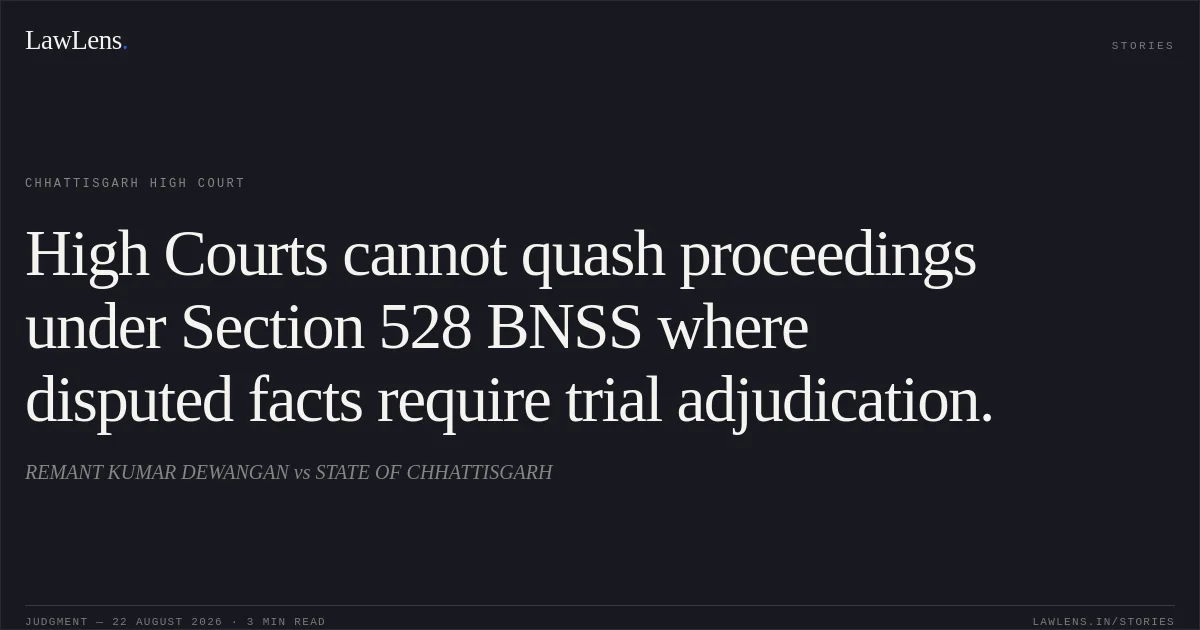
REMANT KUMAR DEWANGANvsSTATE OF CHHATTISGARH
Click to open original judgment
Original judgment, available to read, download and summarize on LawLens.in