Facts
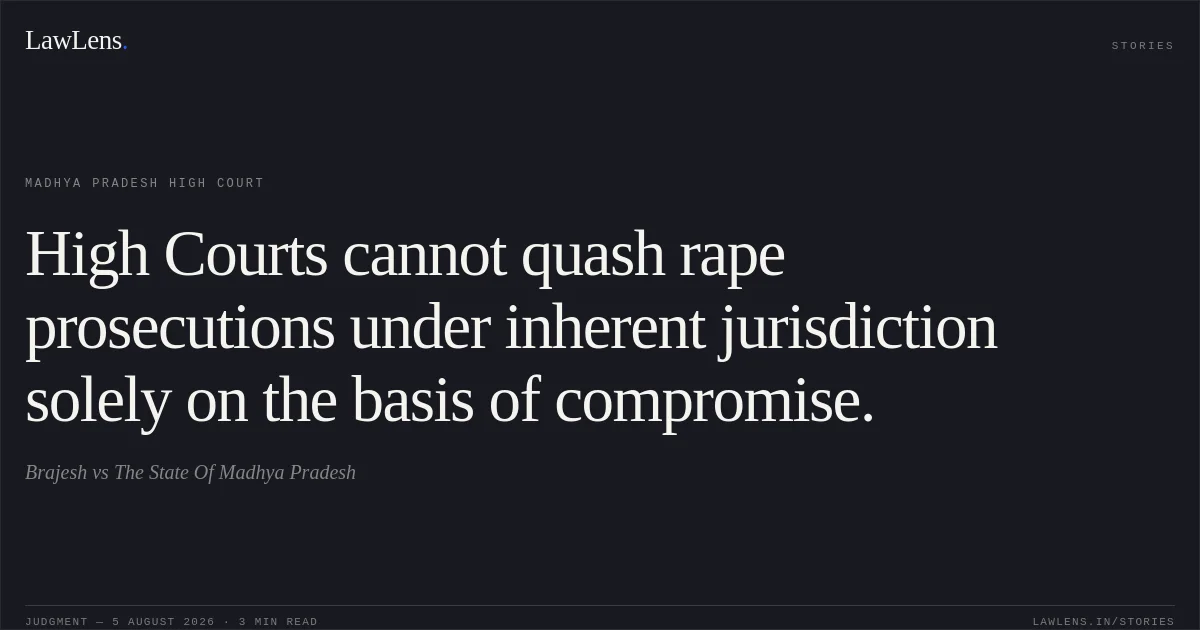
The petitioner sought quashing of FIR Crime No. 189/2025 registered at Police Station Basai, District Datia, under Sections 127(2), 351(3) and 70(1) of the Bharatiya Nyaya Sanhita, 2023, and all consequential proceedings under Section 528 of the Bharatiya Nagarik Suraksha Sanhita, 2023, on the basis of a compromise with the complainant.
Source reference: para. 1The complainant alleged that she was induced to travel to Basai on the promise of securing employment, taken to co-accused Jaspendra Thakur’s house, wrongfully confined, and subjected to forcible sexual assault by Jaspendra Thakur and the petitioner. She further alleged that she was threatened with harm to her child if she disclosed the incident.
Source reference: para. 2The parties subsequently filed a compromise application supported by affidavits. The Principal Registrar verified the parties, signatures, and voluntariness of the compromise and reported that it had been entered into without threat, inducement, or coercion.
Source reference: para. 3–4The petitioner and complainant supported quashing, while the State opposed it on the ground that the alleged offences were serious and affected society at large.
Source reference: para. 5–8Issues
Whether the High Court could exercise its inherent jurisdiction under Section 528 of the BNSS to quash the FIR and consequential criminal proceedings on the basis of a compromise between the accused and the complainant where the allegations concerned wrongful confinement and forcible sexual assault/gang rape?
Source reference: para. 9Whether the alleged offences could be treated as a private dispute capable of settlement, notwithstanding the parties’ voluntary compromise?
Source reference: para. 10–15Law Applied
The Court applied Section 528 of the Bharatiya Nagarik Suraksha Sanhita, 2023, which preserves the High Court’s inherent power to prevent abuse of the process of court and secure the ends of justice, while requiring that such power be exercised sparingly and with caution.
Source reference: para. 10It relied on Gian Singh v. State of Punjab, (2012) 10 SCC 303, holding that heinous and serious offences such as rape, murder and dacoity, which have a serious impact on society, cannot ordinarily be quashed merely on the basis of compromise.
Source reference: para. 12The same principle was reiterated in Narinder Singh v. State of Punjab, (2014) 6 SCC 466, and State of Madhya Pradesh v. Laxmi Narayan, (2019) 5 SCC 688, which recognize that offences involving mental depravity, rape, or serious societal repercussions are not private disputes amenable to quashing on settlement.
Source reference: para. 13–14The Court also considered the alleged offences under Sections 127(2), 351(3) and 70(1) of the BNS.
Source reference: para. 1Reasoning
Although the compromise was verified as voluntary, the Court held that voluntariness alone did not justify quashing.
Source reference: para. 11The FIR alleged that the complainant had been deceitfully induced by a promise of employment, unlawfully confined, and subjected to forcible sexual assault by two accused persons.
Source reference: para. 11These allegations implicated the complainant’s bodily integrity and dignity and were therefore grave offences against society rather than matters of purely personal dispute.
Source reference: para. 11–16Applying the principles in Gian Singh, Narinder Singh and Laxmi Narayan, the Court held that societal interest in prosecuting such offences outweighed the parties’ private settlement.
Source reference: para. 11–16Consequently, the compromise could not furnish a lawful basis for exercising inherent jurisdiction under Section 528 of the BNSS.
Source reference: para. 11–16Holding
The Court answered the issues against the petitioner and declined to quash the FIR or consequential criminal proceedings despite the compromise.
The petition was dismissed as devoid of merit.
Source reference: para. 17The trial court was directed to proceed in accordance with law, uninfluenced by the observations made in the quashing proceedings, and any pending interlocutory applications were disposed of.
Source reference: para. 18–19Acts & Sections Cited
4 provisions across 2 statutes referred to in this judgment. Each provision opens on LawLens.
Bharatiya Nagarik Suraksha Sanhita, 20231
Bharatiya Nyaya Sanhita, 20233
Original Court PDF
BrajeshvsThe State Of Madhya Pradesh
Click to open original judgment
Original judgment, available to read, download and summarize on LawLens.in