Facts
The petitioner, an Ex-Head Constable (GD) of the Border Security Force, was posted as a Nursing Assistant/Physiotherapist at the STC BSF Hospital, Churachandpur, Manipur.
Source reference: p.3A recruit constable complained that, while admitted at the hospital for an eye condition, the petitioner had engaged in disgraceful conduct of an unnatural kind.
Source reference: para. 2(c)The petitioner was charged under Section 24(a) of the Border Security Force Act, 1968, for allegedly committing the act at about 0030 hours on 11 February 2025.
Source reference: p.3; para. 2(c)After a Record of Evidence and trial before the Summary Security Force Court (“SSFC”), he was convicted and dismissed from service on 10 March 2025.
Source reference: p.7, para. 9His statutory petition under Rule 167(2) of the Border Security Rules, 1969, read with Section 117 of the BSF Act, was rejected by the Director General, BSF, on 17 April 2026.
Source reference: p.3, para. 2(d)Before the High Court, the petitioner challenged the conviction, dismissal and rejection order on the grounds of variance between the charge and evidence, contradictions in the complainant’s testimony, inadequate assistance and cross-examination, non-production of material witnesses and documents, non-speaking adjudication by the statutory authority, and disproportionate punishment.
Source reference: pp.3–7, paras. 3–6The respondents maintained that the statutory procedure had been followed and that the petitioner had been given an opportunity to cross-examine the witnesses.
Source reference: p.7, para. 7Issues
1. Whether the SSFC proceedings and conviction under Section 24(a) of the BSF Act were vitiated by material variance between the charge and the evidence, contradictions in the complainant’s testimony, or insufficiency of corroboration.
Source reference: pp.3–6, paras. 3–5; pp.7–11, paras. 9–10; pp.14–15, paras. 15–172. Whether the petitioner was denied a fair and meaningful opportunity of defence, including effective assistance and cross-examination under the applicable BSF Rules and Article 21 of the Constitution.
Source reference: pp.6–7, paras. 5–7; pp.13–16, paras. 14, 18–193. Whether the Director General’s statutory rejection order was legally defective for failure to consider the petitioner’s grounds and for allegedly using prejudicial language.
Source reference: p.6, para. 44. Whether dismissal from service was disproportionate to the misconduct proved against the petitioner.
Source reference: p.6, para. 6; pp.16–17, paras. 20–21Law Applied
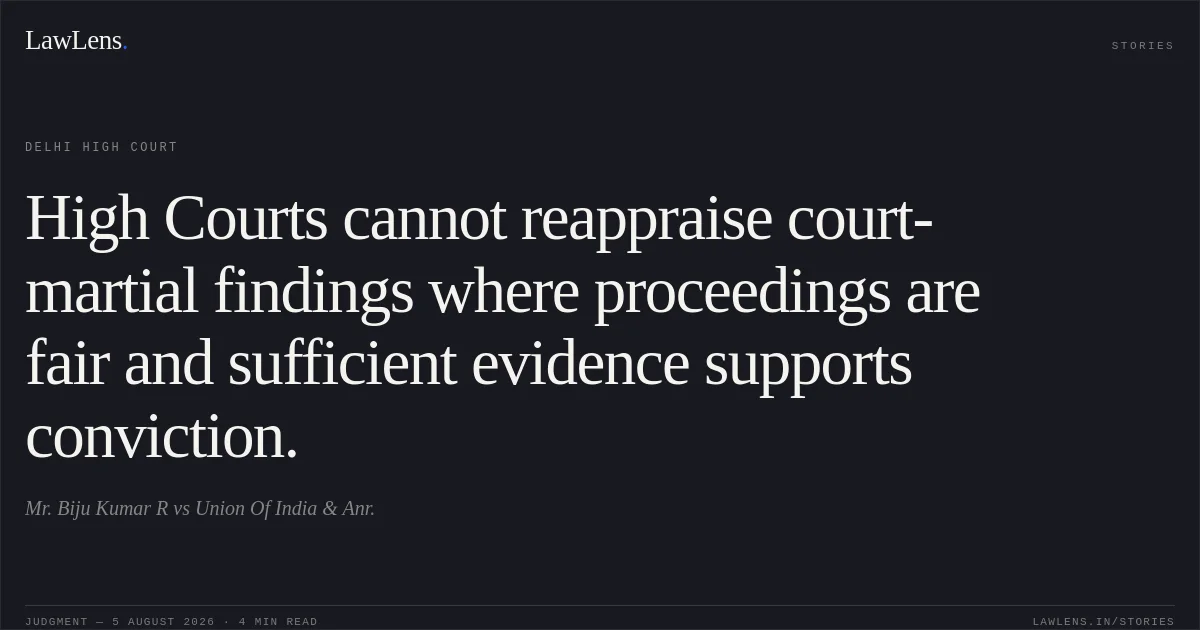
The Court applied Article 226 of the Constitution, under which judicial review of court-martial or analogous disciplinary proceedings is available but is not an appellate reappreciation of evidence.
Source reference: pp.11–13, para. 11Section 24(a) of the BSF Act, 1968 criminalises “disgraceful conduct of an unnatural kind”; Section 50 permits dismissal as a punishment, including in conjunction with imprisonment; and Section 117, read with Rule 167(2) of the Border Security Rules, provides the statutory mechanism for challenging the proceedings before the Director General.
Source reference: pp.3, 7, 16–17, paras. 2(d), 9, 20The Court relied principally on Union of India v. Major A. Hussain, (1998) 1 SCC 537, which holds that where a court-martial has jurisdiction, has been properly constituted, follows the prescribed procedure and there is sufficient evidence to sustain the conviction, the High Court should not interfere merely by undertaking a detailed appellate examination of the record; interference is warranted for procedural illegality, violation of mandatory safeguards or demonstrated prejudice.
Source reference: pp.11–13, para. 11The Court also applied the principle that the credible testimony of the complainant in an offence of this nature can by itself sustain a finding of guilt and does not invariably require independent eyewitness corroboration.
Source reference: pp.14–15, para. 16Reasoning
The Court found that the petitioner had been given an opportunity to call defence witnesses and make a statement, but declined to call witnesses and submitted a written defence.
Source reference: p.14, para. 14The record showed that he had cross-examined four prosecution witnesses, including the complainant, and had not raised any contemporaneous objection regarding ineffective assistance or denial of a meaningful defence; the plea was therefore treated as an afterthought.
Source reference: pp.14–16, paras. 14, 18–19The Court held that the complainant’s account was materially consistent regarding the core incident and that the alleged discrepancies concerning the number and timing of earlier incidents were not material.
Source reference: p.15, para. 17It also noted that the contradictions were not put to the complainant during cross-examination.
Source reference: p.15, para. 17The complainant’s prompt disclosure to colleagues and superior officers was treated as corroborative conduct, while the absence of an eyewitness was held immaterial because the incident occurred in private and the complainant’s testimony was sufficient.
Source reference: pp.14–15, para. 16The Court further considered the petitioner’s previous conviction under Section 24(a) in 2003 for similar conduct as relevant to the disciplinary context and rejected the challenge to the severity of punishment.
Source reference: p.15, para. 17; pp.16–17, paras. 20–21Applying the limited scope of Article 226 review recognised in Major A. Hussain, the Court found no jurisdictional, procedural or evidentiary infirmity warranting intervention.
Source reference: pp.11–13, para. 11Holding
The High Court answered the issues against the petitioner.
It held that the SSFC proceedings were conducted in accordance with the prescribed procedure, that the evidence was sufficient to sustain the conviction under Section 24(a) of the BSF Act, and that the petitioner had not established denial of a fair opportunity or material prejudice.
Source reference: pp.13–16, paras. 12–19The Court also held that dismissal was proportionate considering the gravity of the misconduct, the requirements of discipline in the BSF, and the petitioner’s previous similar conviction.
Source reference: pp.16–17, paras. 20–21The writ petition challenging the SSFC dismissal order dated 10 March 2025 and the Director General’s rejection order dated 17 April 2026 was dismissed, and the pending application was disposed of.
Source reference: p.17, paras. 22–24Original Court PDF
Mr. Biju Kumar RvsUnion Of India & Anr.
Click to open original judgment
Original judgment, available to read, download and summarize on LawLens.in