Facts
The petitioner, a police Inspector and Station House Officer, was initially appointed as a Sub-Inspector in 1983 and promoted as Inspector in 2009.
Source reference: no citationA departmental charge-sheet dated 13 February 2014 alleged three instances of misconduct concerning failure to act on directions relating to a religious-site dispute and failure to promptly report a serious law-and-order incident at Jhondpura.
Source reference: p.2After the petitioner submitted his defence, a departmental enquiry was conducted in which he participated and was afforded an opportunity of hearing.
Source reference: no citationThe Enquiry Officer found Charges 1 and 2 proved and Charge 3 partly proved.
Source reference: no citationAfter supplying the enquiry report and considering the petitioner’s explanation, the Inspector General, Chambal Zone, imposed the penalty of withholding one increment with cumulative effect by order dated 31 December 2016.
Source reference: pp.19–21The petitioner’s departmental appeal was rejected by order dated 1 August 2017.
Source reference: pp.21–24He challenged the punishment order, appellate order and charge-sheet under Article 226, alleging, inter alia, non-consideration of his defence, non-speaking appellate adjudication and lack of competence of the Inspector General.
Source reference: p.2Issues
1. Whether the Inspector General was competent under Police Regulation 223 to impose the penalty upon a police Inspector under Police Regulations 214 and 215.
Source reference: para.122. Whether the disciplinary and appellate orders were vitiated for being non-speaking, unreasoned or passed without considering the petitioner’s defence and appeal grounds.
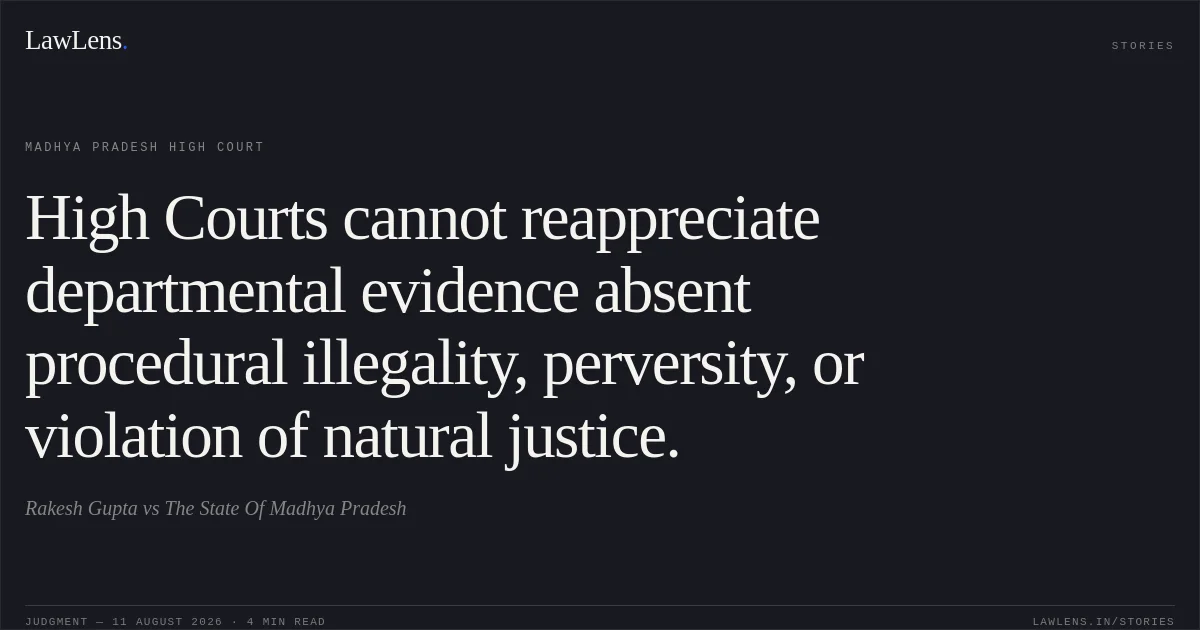
Source reference: paras.12, 143. Whether the High Court, in exercise of judicial review under Article 226, could reappreciate the evidence or interfere with the departmental findings in the absence of violation of natural justice, statutory procedure, perversity or a finding based on no evidence.
Source reference: paras.8–9, 13–16Law Applied
The Court applied the settled principle that judicial review of disciplinary proceedings is confined to the decision-making process and does not confer appellate jurisdiction to reappreciate evidence or substitute the Court’s findings for those of the disciplinary authority, as stated in State of Karnataka v. N. Gangraj, (2020) 3 SCC 423, State of A.P. v. S. Sree Rama Rao, AIR 1963 SC 1723, and B.C. Chaturvedi v. Union of India, (1995) 6 SCC 749.
Source reference: pp.3–7Interference is permissible where the enquiry violates natural justice or statutory procedure, is arbitrary or mala fide, is based on extraneous considerations, or the finding is perverse or based on no evidence; adequacy or reliability of evidence ordinarily cannot be examined in writ jurisdiction.
Source reference: pp.7–13The Court also relied on State Bank of Bikaner & Jaipur v. Nemi Chand Nalwaya, (2011) 4 SCC 584, and Union of India v. P. Gunasekaran, (2015) 2 SCC 610, which prohibit reappreciation of evidence and interference merely because another view is possible.
Source reference: pp.8–12Under Police Regulation 223, the Inspector General is competent to impose punishments prescribed under Regulations 214 and 215 upon police personnel up to the rank of Inspector.
Source reference: para.12Although the petitioner relied on Kranti Associates (P) Ltd. v. Masood Ahmed Khan, (2010) 9 SCC 496, the Court held that the impugned orders were adequately reasoned.
Source reference: pp.2, 24–26Reasoning
The Court examined the punishment and appellate orders and found that both authorities had considered the petitioner’s reply, defence, medical explanation, version regarding the timing of the incident, alleged instructions to subordinate officers and other grounds raised in appeal.
Source reference: paras.10–12The departmental record disclosed evidence from police officials and the preliminary enquiry supporting the findings that the petitioner failed to take appropriate preventive steps and did not promptly inform senior officers and the control room about the incident.
Source reference: pp.19–24Since the petitioner participated in the enquiry and was given an opportunity to present his defence, no breach of natural justice or statutory procedure was established.
Source reference: para.14The Court further held that Police Regulation 223 expressly empowered the Inspector General to impose the punishment on an Inspector, rejecting the petitioner’s challenge to the authority’s competence.
Source reference: para.12As the findings were supported by evidence and were neither perverse nor based on no evidence, the Court declined to reassess the merits of the departmental case or the adequacy of the evidence under Article 226.
Source reference: paras.13–16Holding
The Court held that the Inspector General was the competent disciplinary authority under Police Regulation 223, that the enquiry complied with natural justice, and that the punishment and appellate orders were reasoned and based on the departmental record.
No ground for judicial review was established, and the Court refused to reappreciate the evidence or substitute its own view for that of the departmental authorities.
Source reference: paras.15–16The writ petition was accordingly dismissed, and the challenged charge-sheet, punishment order dated 31 December 2016 and appellate order dated 1 August 2017 were not interfered with.
Source reference: para.17Original Court PDF
Rakesh GuptavsThe State Of Madhya Pradesh
Click to open original judgment
Original judgment, available to read, download and summarize on LawLens.in