01Facts
The appellant joined the Tamil Nadu Electricity Board as an Assistant Engineer on 20 October 1976 and was subsequently promoted as Executive Engineer. Disciplinary proceedings were initiated under Regulation 8(b) of the Tamil Nadu Electricity Board Employees’ Discipline and Appeal Regulations, and he was not permitted to retire upon attaining superannuation on 30 April 2006.
p. 2 · ¶ 2A charge memo dated 12 May 2008 alleged that he had acquired movable and immovable properties in his name and in the names of his family members, disproportionate to his known sources of income; that his son had accepted gifts of house sites and houses without prior sanction; and that the acquisition of properties had not been reported to the prescribed authority, in violation of Regulations 9(1), 13(1) and 13(2) of the Employees’ Conduct Regulations.
pp. 2–4 · ¶ 2–3After an oral enquiry, the Enquiry Officer found all charges proved. The disciplinary authority thereafter ordered the appellant’s removal from service on 19 February 2011.
p. 4 · ¶ 4His departmental appeal was rejected, and he challenged that decision in an earlier writ petition. On 4 February 2013, the High Court set aside the removal order and remitted the matter to the appellate authority for fresh consideration and a speaking order.
p. 4 · ¶ 6The appellate authority again rejected the appeal on 20 May 2013, leading to the writ petition. The Single Judge dismissed the writ petition, and the appellant preferred the present intra-court appeal.
p. 5 · ¶ 702Issues
i.1. Whether the disciplinary proceedings and enquiry were conducted in accordance with Regulation 8(b), and whether the appellant was afforded a reasonable opportunity and complied with the principles of natural justice?
pp. 6–8, 11 · ¶ 9, 14–16ii.2. Whether the findings that the appellant’s properties were disproportionate to his known sources of income and that the conduct regulations had been violated were supported by legally sufficient evidence?
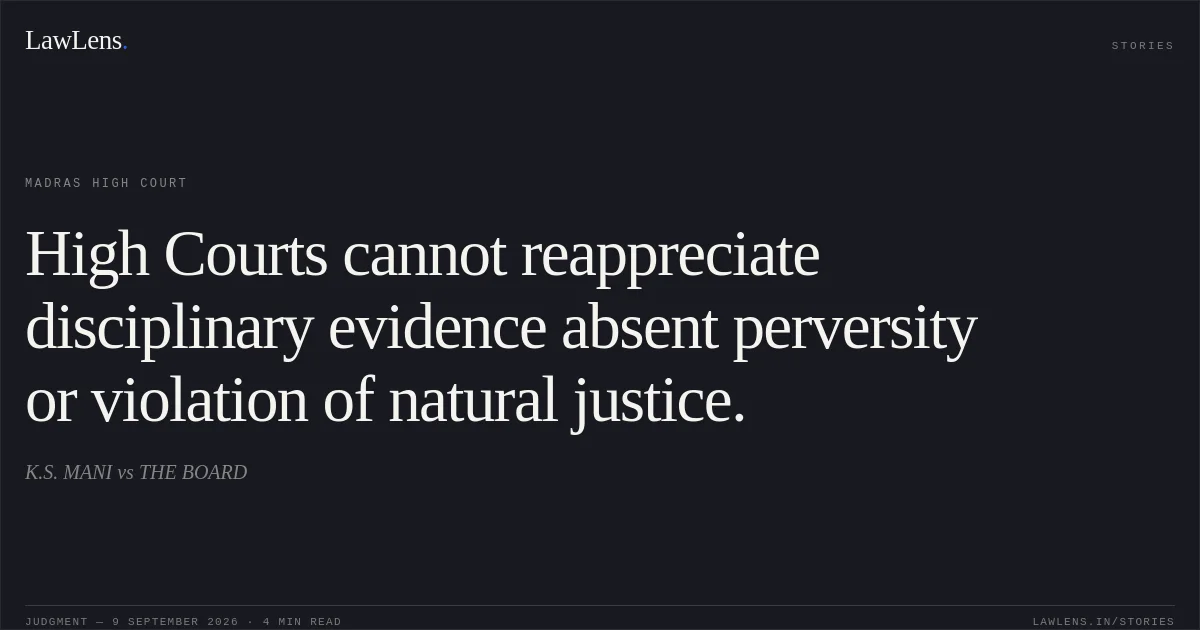
pp. 8–11 · ¶ 10–12iii.3. Whether the High Court, in exercise of judicial review, could reappreciate the evidence or substitute its own view for that of the Enquiry Officer, disciplinary authority and appellate authority?
pp. 11–15 · ¶ 16–19iv.4. Whether the punishment of removal from service was disproportionate to the proved misconduct and warranted judicial interference?
pp. 13–15 · ¶ 17–2003Law Applied
The Court applied Regulation 8(b) of the Tamil Nadu Electricity Board Employees’ Discipline and Appeal Regulations, which prescribes the procedure for imposing major penalties, including issuance of charges, opportunity to submit a defence, oral enquiry, examination and cross-examination of witnesses, submission of an enquiry report, and consideration of the employee’s further representation.
pp. 6–8 · ¶ 9The Court also applied Regulations 9(1), 13(1) and 13(2) of the Employees’ Conduct Regulations concerning prior sanction for acceptance of gifts and the reporting of movable and immovable property.
pp. 2–4 · ¶ 2–3In a departmental enquiry, misconduct is established on the standard of preponderance of probabilities rather than proof beyond reasonable doubt.
p. 11 · ¶ 13Relying on State of Karnataka v. Umesh, (2022) 6 SCC 563, and Chatrapal v. State of Uttar Pradesh, 2024 SCC OnLine SC 146, including the principles in P. Gunasekaran, the Court held that judicial review is limited to examining procedural fairness, compliance with natural justice and statutory rules, existence of some evidence, perversity, extraneous considerations, and whether the punishment shocks the conscience; the Court cannot reappreciate evidence as an appellate authority.
pp. 12–15 · ¶ 17–19Provisions in the judgment · 1
Indian Evidence Act, 1872 Section 106
04Reasoning
The Court found that the appellant participated in the oral enquiry, was given an opportunity to submit his explanation and defence, and was furnished with the enquiry report before the disciplinary authority passed the final order.
p. 4, 8, 11 · ¶ 4, 9, 15His challenge to the fairness of the enquiry was therefore unsupported.
p. 4, 8, 11 · ¶ 4, 9, 15The Enquiry Officer considered the prosecution material and the appellant’s defence but found that the alleged independent sources of income of the appellant’s wife and son were not substantiated by documentary evidence.
pp. 8–11 · ¶ 12Mere oral assertions and testimony regarding rental income, family transactions and loans were held insufficient, particularly when documentary proof could reasonably have been produced.
pp. 8–11 · ¶ 12Since the charges were supported by material evidence and the appellant failed to disprove the alleged disproportion between the properties and known income, the findings could not be characterised as perverse or as findings based on no evidence.
pp. 8–11 · ¶ 10–12Applying the restricted scope of judicial review, the Division Bench declined to reassess the evidence or interfere merely because another view might have been possible.
pp. 11–15 · ¶ 16–20It also found no basis to conclude that the punishment of removal was so disproportionate as to shock the conscience of the Court.
pp. 11–15 · ¶ 16–2005Holding
The Division Bench answered the issues against the appellant.
pp. 11–15 · ¶ 13–20It held that the disciplinary enquiry complied with Regulation 8(b) and the principles of natural justice, that the findings of misconduct were supported by evidence on the applicable standard of preponderance of probabilities, and that the High Court could not reappreciate the evidence in judicial review.
pp. 11–15 · ¶ 13–20The Court found no infirmity in the Single Judge’s order upholding the disciplinary and appellate decisions.
p. 15 · ¶ 21The writ appeal was accordingly dismissed, with no order as to costs.
p. 15 · ¶ 21Original Court PDF
K.S. MANIvsTHE BOARD
Click to open original judgment
Original judgment, available to read, download and summarize on LawLens.in