Facts
The petitioner, a Sub-Inspector posted at Police Station Hazira, was alleged to have apprehended three persons gambling near Resham Mill/Almari Karkhana on 21 October 2017, brought them to the police station, and released them without initiating legal proceedings, making a Rojnamcha entry, or informing the Station House Officer.
Source reference: p. 2; pp. 15–17A complaint also alleged that money had been taken for their release, although the Enquiry Officer found no evidence substantiating the alleged monetary transaction.
Source reference: p. 2; pp. 15–17The petitioner was suspended on 31 October 2017, and the suspension was revoked on 7 November 2017.
Source reference: p. 2; paras. 2, 12–14Following a preliminary enquiry, a charge-sheet was issued on 9 February 2018. A departmental enquiry was conducted, in which the petitioner participated, produced his defence, and examined witnesses.
Source reference: p. 2; paras. 2, 12–14The Enquiry Officer found the charge proved, and the Disciplinary Authority removed the petitioner from service by order dated 11 October 2019.
Source reference: p. 2; paras. 2, 12–14His statutory appeal was dismissed on 2 March 2020, and his mercy petition was rejected on 13 August 2020.
Source reference: p. 2; paras. 2, 12–14The petitioner challenged the punishment, appellate, and mercy orders under Article 226 of the Constitution.
Source reference: no citationIssues
Whether the findings of misconduct recorded by the Enquiry Officer and accepted by the Disciplinary and Appellate Authorities were based on no evidence or were otherwise perverse, arbitrary, or legally unsustainable.
Source reference: p. 15; para. 11Whether the departmental enquiry violated the principles of natural justice or any statutory procedure, including by relying on particular witnesses and allegedly failing to examine another relevant witness.
Source reference: pp. 3–5, 17–19; paras. 3–5, 13–16Whether the punishment of removal from service was disproportionate to the proved misconduct and warranted interference under Article 226.
Source reference: pp. 3, 19–20; paras. 3, 13, 17Law Applied
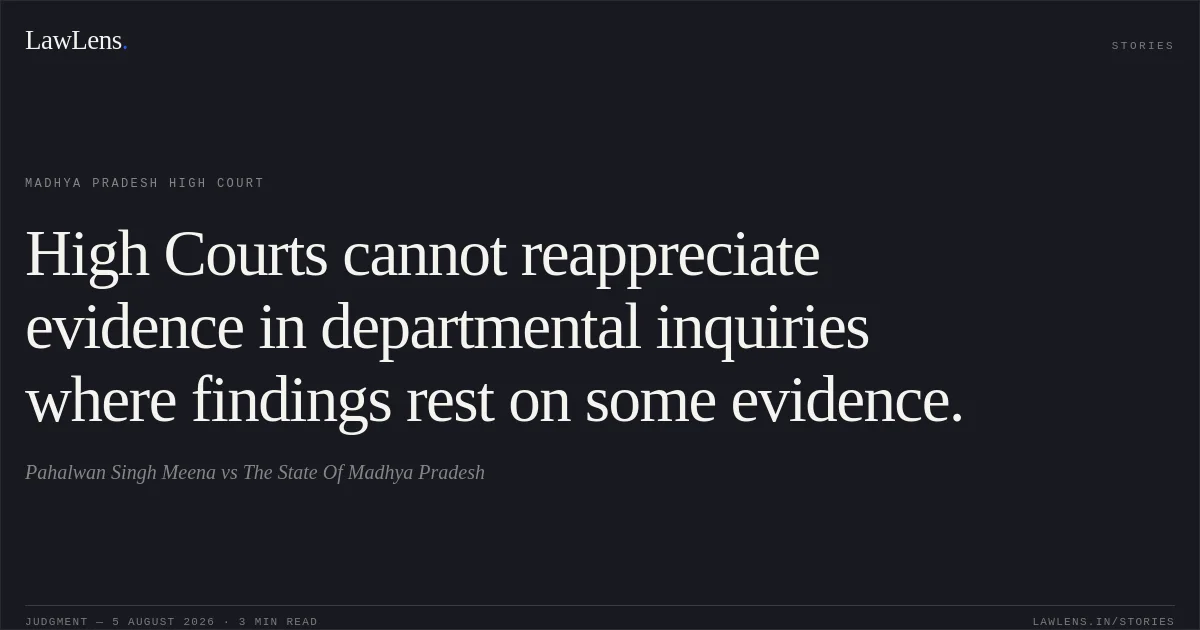
The Court applied the settled limits of judicial review under Article 226: a constitutional court does not act as an appellate authority or reappreciate evidence in departmental proceedings.
Source reference: pp. 5–8; para. 8Relying principally on State of Karnataka v. N. Gangraj, State of A.P. v. S. Sree Rama Rao, and B.C. Chaturvedi v. Union of India, the Court held that interference is permissible only where the enquiry is conducted by an incompetent authority, violates natural justice or statutory rules, is based on no evidence, or produces a conclusion that no reasonable person could reach.
Source reference: pp. 5–8; para. 8High Court of Bombay v. Shashikant S. Patil, State Bank of Bikaner & Jaipur v. Nemi Chand Nalwaya, Union of India v. P. Gunasekaran, and State Bank of India v. Ramesh Dinkar Punde were applied to reiterate that adequacy, reliability, and sufficiency of evidence cannot ordinarily be examined in writ jurisdiction.
Source reference: pp. 7–14; paras. 8–10Departmental proceedings require proof on the preponderance of probabilities, not proof beyond reasonable doubt, and the Evidence Act’s strict rules do not apply.
Source reference: pp. 11–14; para. 9The proportionality of punishment is generally not reviewable unless the penalty is mala fide or so disproportionate that it shocks the Court’s conscience.
Source reference: pp. 8–10, 19–20; paras. 8, 13, 17Reasoning
The Court found that the statements of Constables Patiram, Jitendra Semil, and Dharmendra Singh Gurjar consistently supported the material allegation that several persons were found gambling, that three were apprehended, and that they were released without legal proceedings, Rojnamcha entries, or intimation to the Station House Officer.
Source reference: pp. 15–18; paras. 12–13The Enquiry Officer also considered the petitioner’s defence, the presenting officer’s submissions, and CCTV footage, and concluded that the principal misconduct was proved; the absence of evidence regarding payment of money did not negate the proved misconduct of unauthorisedly releasing the persons.
Source reference: pp. 16–17; para. 12The Court held that the petitioner’s objections concerning evidentiary discrepancies, the identity or duty status of witnesses, and the non-examination of another witness invited impermissible reappreciation of evidence rather than demonstrating a case of “no evidence” or procedural prejudice.
Source reference: pp. 17–19; paras. 13–16Since the petitioner had participated in the enquiry and had been afforded an opportunity to defend himself, no violation of natural justice or statutory procedure was established.
Source reference: p. 17; para. 14The removal penalty was also not shown to be mala fide or shockingly disproportionate, particularly in light of the disciplinary obligations attached to police service.
Source reference: pp. 19–20; para. 17Holding
The High Court answered all issues against the petitioner.
It held that the departmental findings were supported by evidence, the enquiry complied with natural justice and applicable procedure, and the punishment did not warrant judicial interference.
Source reference: p. 20; para. 18The writ petition was dismissed as meritless, and the impugned punishment, appellate, and mercy orders were left undisturbed.
Source reference: p. 20; para. 18Original Court PDF
Pahalwan Singh MeenavsThe State Of Madhya Pradesh
Click to open original judgment
Original judgment, available to read, download and summarize on LawLens.in