Facts
The Petitioner manufactured stainless-steel cladding and railing during January–December 2005.
Source reference: no citationBelieving that the activity did not amount to “manufacture,” it did not pay Central Excise duty for the period 15 January 2005 to 31 December 2005.
Source reference: no citationIt claimed to have reversed CENVAT credit of ₹31,93,569: on a pro-rata basis for January–September 2005 and at 10% of the sale price under Rule 6(3) of the CENVAT Credit Rules, 2004, for October–December 2005.
Source reference: para. 5After admitting its duty liability, the Petitioner approached the Settlement Commission and sought adjustment of the reversed CENVAT credit against its duty liability.
Source reference: paras. 2, 6In an earlier proceeding, this Court directed the Settlement Commission to re-examine the claim and permitted it to call for further information, if required.
Source reference: para. 6On remand, the Settlement Commission sought documents including RG-23A Part II registers, input invoices and other statutory records.
Source reference: para. 7The Petitioner relied upon ER-1 returns, RG-23A records, sales working sheets and a correlation statement, while the Respondents contended that the documents were incomplete and insufficient to verify the reversal.
Source reference: paras. 7–9By Final Order No. F-3640/CE/2020-SC(PB) dated 29 April 2020, the Settlement Commission rejected the claim for adjustment of ₹31,93,569.
Source reference: para. 10The Petitioner challenged that order under Article 226 of the Constitution.
Source reference: no citationIssues
Whether the Settlement Commission exceeded the scope of the remand directions dated 11 May 2010 by requiring further statutory records and invoices to verify the Petitioner’s claim of CENVAT credit reversal?
Source reference: paras. 15, 20–21Whether the Settlement Commission’s conclusion that the documents produced were insufficient to establish reversal of CENVAT credit warranted interference by the High Court under Article 226?
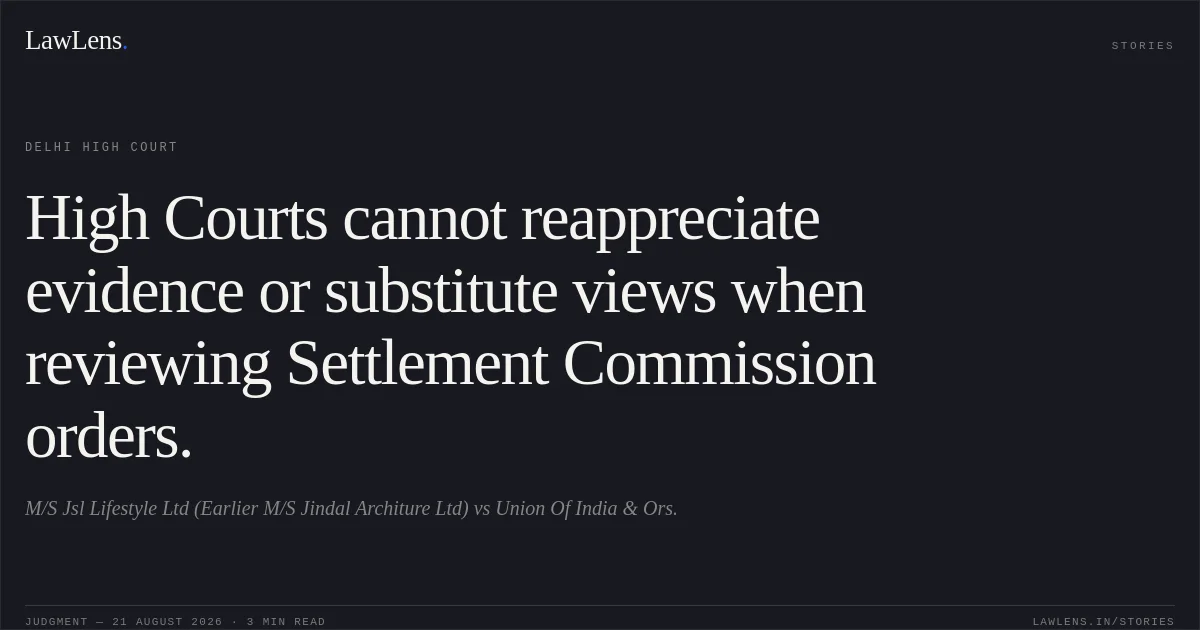
Source reference: paras. 17–19, 22–27Whether the High Court could re-appreciate the sufficiency and evidentiary value of the material placed before the Settlement Commission in the absence of fraud, bias, mala fides or statutory illegality?
Source reference: paras. 16–17, 23–26Law Applied
The Court applied the narrow scope of judicial review under Article 226 over orders passed by the Settlement Commission in exercise of its statutory and discretionary jurisdiction.
Source reference: para. 16Relying on Jyotendrasinhji v. S.I. Tripathi, 1993 Supp (3) SCC 389, and Kotak Mahindra Bank Ltd. v. Commissioner of Income Tax, Bangalore & Ors., the Court held that interference is ordinarily permissible only where the order contravenes the governing statute, causes prejudice, or is affected by fraud, bias or mala fides; the High Court cannot act as an appellate court by reassessing the sufficiency of evidence.
Source reference: para. 16The Court also applied the relevant provisions of the Central Excise Act, 1944 and Rule 6(3) of the CENVAT Credit Rules, 2004 concerning the Petitioner’s claim of CENVAT credit reversal.
Source reference: paras. 2, 5The Settlement Commission was entitled, pursuant to the remand directions, to call for further information necessary to verify the claim.
Source reference: paras. 6, 20–21Reasoning
The Court held that the dispute concerned the adequacy, sufficiency and evidentiary value of the ER-1 returns, correlation statement, RG-23A records, invoices and other documents produced by the Petitioner.
Source reference: paras. 18–19The Settlement Commission had considered the material and recorded a reasoned finding that the Petitioner had not furnished sufficient documentary evidence to substantiate the claimed reversal.
Source reference: paras. 18–19Determining whether the documents adequately established the reversal was within the Settlement Commission’s fact-finding remit, and requiring RG-23A Part II registers and input invoices did not exceed the remand directions, which expressly permitted further information to be sought.
Source reference: paras. 20–21The Petitioner’s contention that the Department had not earlier disputed availment or reversal of credit did not eliminate the requirement to substantiate the specific adjustment claim before the Settlement Commission.
Source reference: para. 22Since there was no allegation or finding of fraud, bias, mala fides, statutory contravention or jurisdictional error, the challenge effectively sought appellate re-appreciation of evidence, which was impermissible under Article 226.
Source reference: paras. 23–27Holding
The High Court held that the Settlement Commission acted within its jurisdiction and that its reasoned rejection of the claim did not disclose any ground warranting judicial interference.
The writ petition was accordingly dismissed, the Impugned Final Order dated 29 April 2020 was upheld, and the Petitioner’s request for adjustment of ₹31,93,569 against its duty liability was declined.
Source reference: paras. 27–29The pending application was also closed.
Source reference: para. 30Acts & Sections Cited
1 provisions across 1 statute referred to in this judgment. Each provision opens on LawLens.
Central Excise Act, 19441
Original Court PDF
M/S Jsl Lifestyle Ltd (Earlier M/S Jindal Architure Ltd)vsUnion Of India & Ors.
Click to open original judgment
Original judgment, available to read, download and summarize on LawLens.in