Facts
S.N. Sharma claimed membership of the respondent co-operative housing society and asserted entitlement to allotment of a plot. After alleging illegal deprivation of allotment, he instituted a dispute under Section 61 of the Delhi Co-operative Societies Act, 1972, which was referred to arbitration.
Source reference: p.2An earlier ex parte award was set aside by the Supreme Court, with directions to continue the proceedings from the stage at which the Society had been proceeded ex parte. On remand, the Registrar, acting as Arbitrator, held that Sharma was a member of the Society and directed allotment of a plot to his legal heir upon payment of the land cost. The Society’s appeal under Section 76 of the Act was dismissed by the Delhi Co-operative Tribunal.
Source reference: p.2; p.3; paras. 3, 10In a writ petition under Articles 226 and 227 of the Constitution, the Delhi High Court set aside both orders, holding that the authorities had ignored material documents showing Sharma’s resignation in 1951, transfer of his share, and rejection of his subsequent membership application in 1952; it also noted the existence of four prior claimants for allotment.
Source reference: pp.4–5, 11–12; paras. 4, 11Issues
Whether the High Court was justified in exercising certiorari jurisdiction under Articles 226 and 227 of the Constitution to interfere with the concurrent orders of the Arbitrator and the Co-operative Tribunal?
Source reference: pp.8–9; para. 8Whether the original claimant had been validly admitted as a member of the Society after his resignation in 1951 and was consequently entitled to allotment of a plot?
Source reference: pp.8–11; paras. 8–10Whether the claim for allotment could be sustained in light of the existence of four members with prior claims to allotment?
Source reference: pp.11–12, 16; paras. 11, 16Law Applied
The Court applied Sections 61 and 76 of the Delhi Co-operative Societies Act, 1972 concerning adjudication of disputes and appeals against arbitral orders, together with the supervisory and certiorari jurisdiction under Articles 226 and 227 of the Constitution.
Source reference: no citationRelying on Hari Vishnu Kamath v. Syed Ahmad Ishaque, as discussed in General Manager, Rengali Hydro Electric Project v. Sri Giridhari Sahu, the Court held that certiorari is supervisory, not appellate, and ordinarily does not permit reappreciation of evidence; however, interference is permissible for jurisdictional errors, breach of natural justice, errors of law apparent on the face of the record, or findings based on no evidence or overwhelming contrary evidence.
Source reference: pp.12–14; para. 12In Central Council for Research in Ayurvedic Sciences v. Bikartan Das, the Court reiterated that findings based on no evidence, surmises, conjectures, or perversity may be corrected through certiorari, although certiorari cannot be used merely to substitute a different factual conclusion.
Source reference: p.14; para. 12The Court also referred to Shalini Shyam Shetty v. Rajendra Shankar Patil regarding the distinct fields of Articles 226 and 227.
Source reference: pp.5–6, 14–15; paras. 5, 13Reasoning
The Arbitrator and Tribunal proceeded on the assumption that Sharma continued to be a member because his name appeared in a membership list, without adequately examining the contrary documentary record.
Source reference: pp.9–11; paras. 9–10The High Court correctly identified the resignation recorded in the Managing Committee minutes dated 5 May 1951, transfer of Sharma’s share on 18 August 1951, rejection of his fresh membership application on 5 November 1952, and later rejection of his request to deposit plot money on 4 November 1979.
Source reference: pp.14–16; para. 14By disregarding these documents and relying on a presumption unsupported by the record, the authorities rendered a perverse finding amounting to an error of law amenable to certiorari.
Source reference: pp.13–16; paras. 13–15The Court further found that equitable considerations supported the High Court’s conclusion because four members had prior claims to plots.
Source reference: p.16; para. 16Since Sharma was never admitted as a member, the question of plot availability did not require determination.
Source reference: p.16; para. 17Holding
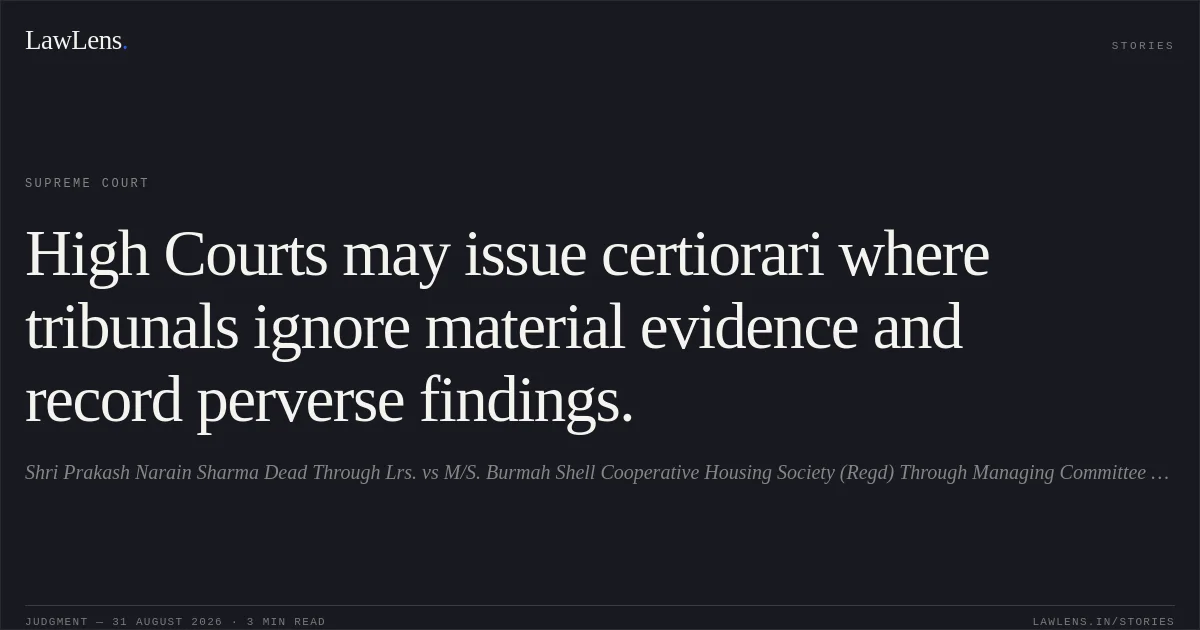
The Supreme Court held that the High Court had properly exercised its certiorari jurisdiction because the Arbitrator and Tribunal had ignored material documentary evidence and recorded a finding unsupported by the record.
Sharma had not been validly admitted as a member after his 1951 resignation and was therefore not entitled to allotment of a plot.
Source reference: p.17; para. 18The civil appeals were dismissed, the High Court’s judgment was affirmed, and the parties were left to bear their own costs; pending interlocutory applications were disposed of.
Source reference: p.17; para. 18Acts & Sections Cited
3 provisions across 1 statute referred to in this judgment. Linked provisions open on LawLens.
Delhi Co-operative Societies Act, 19723
Original Court PDF
Shri Prakash Narain Sharma Dead Through Lrs.vsM/S. Burmah Shell Cooperative Housing Society (Regd) Through Managing Committee Member Sh. P. Jindal
Click to open original judgment
Original judgment, available to read, download and summarize on LawLens.in