Facts
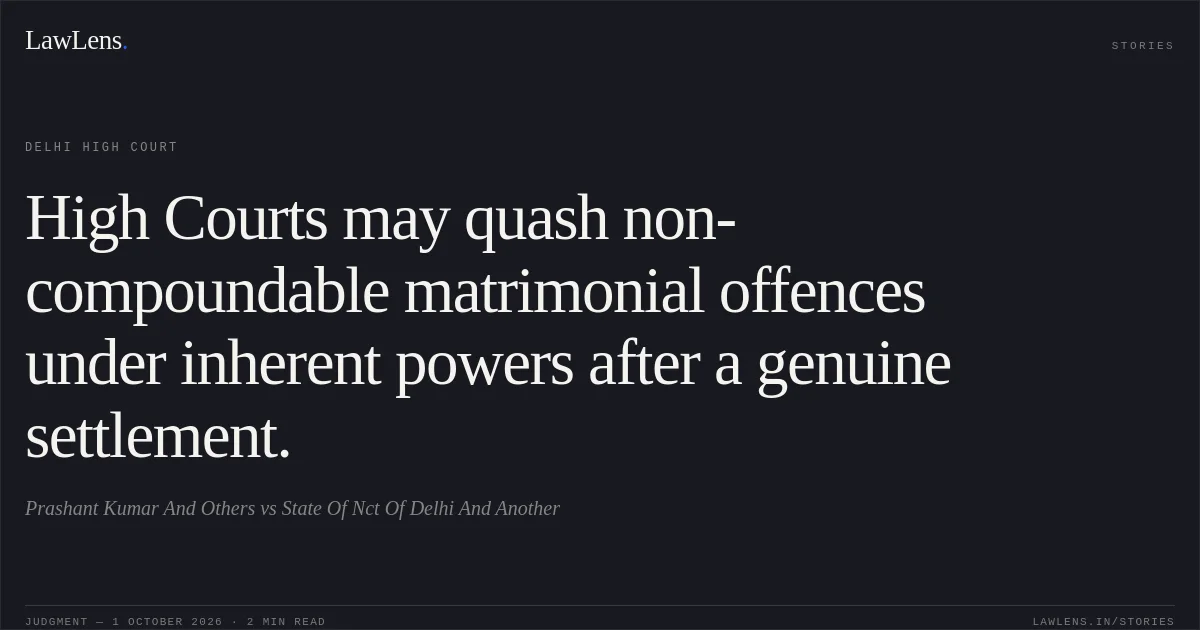
The petitioners sought quashing under Section 528 of the Bharatiya Nagarik Suraksha Sanhita, 2023, of an FIR registered under Sections 498A, 406 and 34 IPC, and the proceedings arising from it, including a chargesheet that also invoked Section 4 of the Dowry Prohibition Act, 1961.
Source reference: p. 1, para. 1The FIR arose from matrimonial disputes between petitioner no. 1 and respondent no. 2; they had lived separately since 1 January 2023.
Source reference: p. 1, para. 2The parties entered into a mediated settlement under which petitioner no. 1 agreed to pay respondent no. 2 ₹11,10,000 in full and final settlement. Their marriage was subsequently dissolved by mutual-consent divorce.
Source reference: p. 2, paras. 3–5Respondent no. 2 confirmed receipt of ₹7,00,000 and accepted a demand draft for the balance ₹4,10,000 at the hearing. She stated that the settlement was voluntary and that she had no objection to quashing.
Source reference: p. 2, paras. 7–8Issues
1. Whether the High Court could quash non-compoundable offences under Sections 498A and 406 IPC and Section 4 of the Dowry Prohibition Act, in light of the parties’ settlement of their matrimonial disputes.
Source reference: p. 2, para. 9; p. 3, paras. 10–112. Whether, in the circumstances, continuation of the criminal proceedings would constitute an abuse of process or whether quashing would secure the ends of justice.
Source reference: p. 3, paras. 9–10Law Applied
Section 528 BNSS preserves the High Court’s inherent power to prevent abuse of the process of court and to secure the ends of justice; it corresponds to Section 482 of the Code of Criminal Procedure, 1973.
Source reference: p. 2, para. 9Although offences under Section 498A IPC and Section 4 of the Dowry Prohibition Act are non-compoundable—the latter by virtue of Section 8(2) of that Act—the High Court may quash proceedings arising from matrimonial disputes where the parties have genuinely settled and quashing is necessary to prevent abuse of process or secure justice. The Court relied on B.S. Joshi v. State of Haryana, (2003) 4 SCC 675; Gian Singh v. State of Punjab, (2012) 10 SCC 303; and Narinder Singh v. State of Punjab, (2014) 6 SCC 466.
Source reference: p. 2, para. 9Reasoning
The Court considered the nature of the allegations, the terms and implementation of the settlement, and the complainant’s voluntary request for closure.
Source reference: p. 3, para. 10The marriage had ended by mutual-consent divorce, the agreed settlement amount had been paid or tendered, and respondent no. 2 confirmed receipt of the balance demand draft and raised no objection to quashing. In those circumstances, the Court concluded that continuing the prosecution would result in protracted litigation without serving a useful purpose and applied the cited settlement-based quashing principles.
Source reference: pp. 2–3, paras. 5, 7–8; p. 3, paras. 10–11Holding
The Court allowed the petition and quashed FIR No. 0359/2024, registered at P.S. Harsh Vihar under Sections 498A, 406 and 34 IPC, together with all proceedings emanating from it, including the chargesheet under those provisions and Section 4 of the Dowry Prohibition Act, qua all petitioners.
The pending application was also disposed of.
Source reference: p. 4, para. 12Acts & Sections Cited
6 provisions across 4 statutes referred to in this judgment. Each provision opens on LawLens.
Bharatiya Nagarik Suraksha Sanhita, 20231
Indian Penal Code, 18602
Code of Criminal Procedure, 19731
Original Court PDF
Prashant Kumar And OthersvsState Of Nct Of Delhi And Another
Click to open original judgment
Original judgment, available to read, download and summarize on LawLens.in