Facts
The petitioners sought quashing under Section 528 of the Bharatiya Nagarik Suraksha Sanhita, 2023, of FIR No. 0295/2025, registered under Sections 498A, 406, 506 and 34 IPC and Section 4 of the Dowry Prohibition Act, 1961, and the proceedings arising from it
Source reference: p. 1The FIR followed allegations of dowry demands and physical and mental harassment by respondent no. 2, who had also initiated proceedings under Section 12 of the Protection of Women from Domestic Violence Act, 2005
Source reference: p. 2The parties entered into a mediation settlement on 13 March 2026, agreeing to resolve their disputes and cooperate in quashing the FIR.
Source reference: p. 2–3Petitioner no. 1 agreed to pay respondent no. 2 ₹7,25,000; ₹5,00,000 had been paid, and the remaining ₹2,25,000 was tendered by demand draft in Court.
Source reference: p. 2–3The parties’ marriage had been dissolved by mutual-consent decree, and respondent no. 2 confirmed that the settlement was voluntary and that she did not wish to pursue the case.
Source reference: p. 3Issues
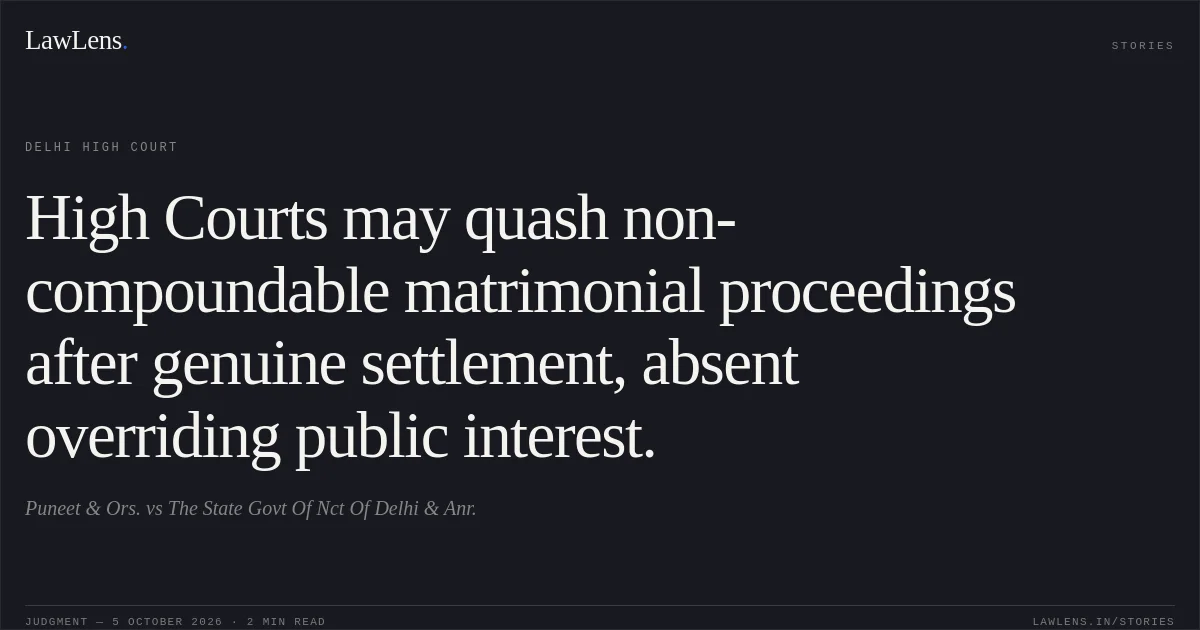
Whether the High Court could quash the FIR and consequential proceedings for non-compoundable offences arising from a matrimonial dispute where the parties had amicably settled their claims.
Source reference: p. 1, 4Whether the settlement and the parties’ stated willingness to resolve the dispute justified quashing the proceedings in the interests of justice.
Source reference: p. 3–5Law Applied
Section 528 BNSS, corresponding to Section 482 of the Code of Criminal Procedure, 1973, preserves the High Court’s inherent power to quash criminal proceedings to secure the ends of justice.
Source reference: p. 4Relying on Jitendra Raghuvanshi v. Babita Raghuvanshi, (2013) 4 SCC 58, the Court applied the principle that proceedings involving non-compoundable offences may be quashed where the dispute is matrimonial in nature, the parties have genuinely and voluntarily settled their differences, and quashing would not adversely affect an overarching public interest.
Source reference: p. 4Reasoning
The Court treated the case as a matrimonial dispute that the parties had resolved through mediation.
Source reference: p. 3–4Respondent no. 2 confirmed that she had entered the settlement freely and no longer wished to pursue the matter; the divorce had been granted, and the agreed settlement amount had been paid in full upon delivery of the balance demand draft.
Source reference: p. 3–4With the State raising no objection, the Court concluded that the settlement warranted exercise of its inherent power despite the non-compoundable nature of the charged offences.
Source reference: p. 3–5Holding
The Court allowed the petition and quashed FIR No. 0295/2025, registered at Police Station Nand Nagri under Sections 498A, 406, 506 and 34 IPC and Section 4 of the Dowry Prohibition Act, 1961, together with all consequential proceedings.
The parties remain bound by the mediation settlement dated 13 March 2026, and the petition and pending application were disposed of.
Source reference: p. 5Acts & Sections Cited
8 provisions across 5 statutes referred to in this judgment. Each provision opens on LawLens.
Bharatiya Nagarik Suraksha Sanhita, 20231
Code of Criminal Procedure, 19732
Indian Penal Code, 18603
Dowry Prohibition Act, 19611
Protection of Women from Domestic Violence Act, 20051
Original Court PDF
Puneet & Ors.vsThe State Govt Of Nct Of Delhi & Anr.
Click to open original judgment
Original judgment, available to read, download and summarize on LawLens.in