Facts
Respondent no. 2, the wife of petitioner no. 1 and relative by marriage of petitioners nos. 2 and 3, lodged FIR No. 711/2017 under Sections 498A/406 IPC at PS Uttam Nagar on 5 October 2017. The parties had married on 5 February 2017; they later lived separately, and no child was born of the marriage
Source reference: pp. 2–3, paras. 6–8They settled their disputes under an MoU dated 5 April 2023, providing for payment of ₹3,00,000 to respondent no. 2. After ₹2,00,000 had been paid earlier, petitioner no. 1 handed her a demand draft for the balance ₹1,00,000 in court. The parties had also obtained a mutual-consent divorce on 5 July 2025
Source reference: p. 3, paras. 9–12Respondent no. 2 confirmed the settlement was voluntary and stated that she did not wish to pursue the proceedings; the State had no objection to quashing
Source reference: pp. 3–4, paras. 13–14Issues
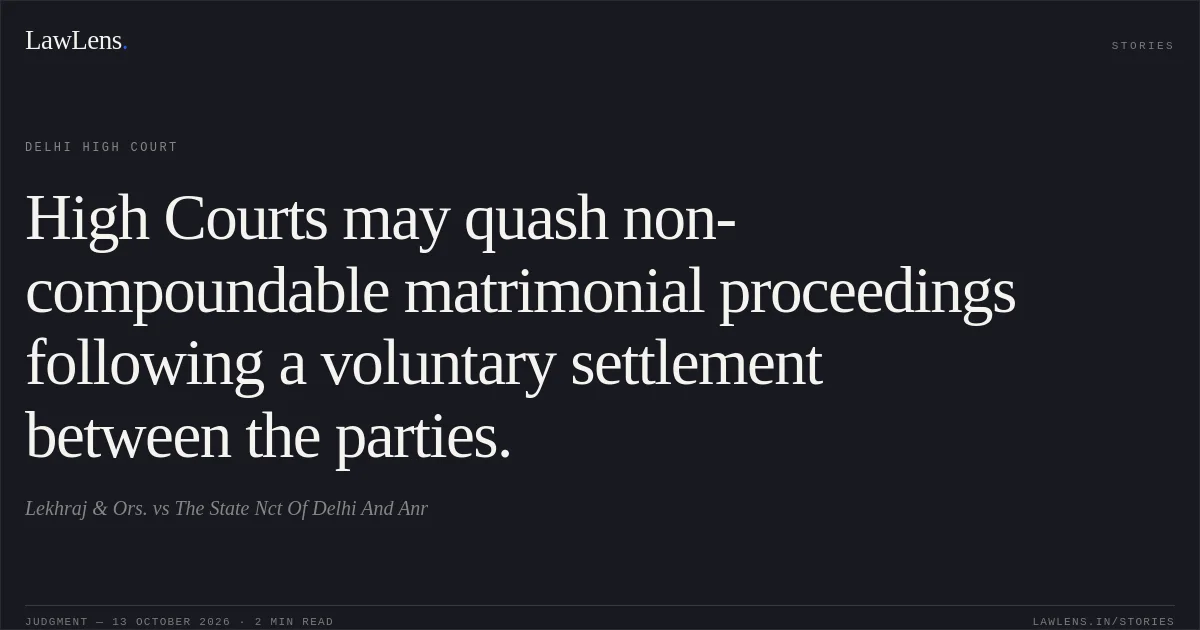
Whether the High Court could exercise its inherent jurisdiction under Section 528 BNSS to quash proceedings concerning non-compoundable matrimonial offences on the basis of an amicable settlement
Source reference: pp. 3–4, paras. 15–16Whether, in light of the parties’ settlement, completed mutual-consent divorce, and respondent no. 2’s voluntary decision not to proceed, the FIR and consequential proceedings should be quashed
Source reference: p. 4, para. 17Law Applied
Section 528 BNSS preserves the High Court’s inherent power to make orders necessary to secure the ends of justice.
Source reference: pp. 3–4, paras. 15–16Relying on Jitendra Raghuvanshi v. Babita Raghuvanshi, (2013) 4 SCC 58, the Court applied the principle that criminal proceedings arising from private matrimonial disputes may be quashed, including where the offences are non-compoundable, if the parties have amicably and voluntarily settled their differences and quashing would not adversely affect an overarching public interest
Source reference: pp. 3–4, paras. 15–16Reasoning
The dispute arose from the parties’ matrimonial relationship and had been fully settled under the MoU. The agreed amount had been paid in full, the parties were divorced, and respondent no. 2 confirmed in court that her consent was voluntary and that she did not wish to continue the case
Source reference: pp. 3–4, paras. 11–13Given the private matrimonial nature of the dispute, the completed settlement, and the State’s lack of objection, the Court found no impediment to quashing the proceedings in the interests of justice
Source reference: p. 4, paras. 14, 17Holding
The Court allowed the petition and quashed FIR No. 711/2017 and all consequential proceedings; the parties remain bound by the MoU dated 5 April 2023
The judgment identifies the FIR at the outset as registered under Sections 498A/406 IPC, but the operative paragraph describes the offences as Sections 498/406 IPC
Source reference: pp. 1–2, para. 1; p. 4, para. 18Acts & Sections Cited
3 provisions across 2 statutes referred to in this judgment. Each provision opens on LawLens.
Indian Penal Code, 18601
Code of Criminal Procedure, 19732
Original Court PDF
Lekhraj & Ors.vsThe State Nct Of Delhi And Anr
Click to open original judgment
Original judgment, available to read, download and summarize on LawLens.in