Facts
The applicant sought quashing of the charge-sheet dated 12 January 2021, the cognizance/order dated 19 February 2021, and the proceedings in Criminal Case No. 1839 of 2021, pending before the Additional Chief Judicial Magistrate, Haldwani.
Source reference: para. 1During the proceedings, the parties entered into an amicable settlement concerning a matrimonial dispute between Ajay Jatav, the applicant’s son, and Sarika Kumari, respondent no. 2.
Source reference: para. 2–4The parties had decided to separate and had filed a divorce proceeding before the Family Court.
Source reference: para. 3–4Respondent no. 2 stated that she no longer wished to prosecute the applicant and sought settlement of the criminal case.
Source reference: para. 3–4The State raised no objection to the settlement, and counsel for respondent no. 2 submitted that continuation of the criminal proceedings would serve no useful purpose.
Source reference: para. 5–7Issues
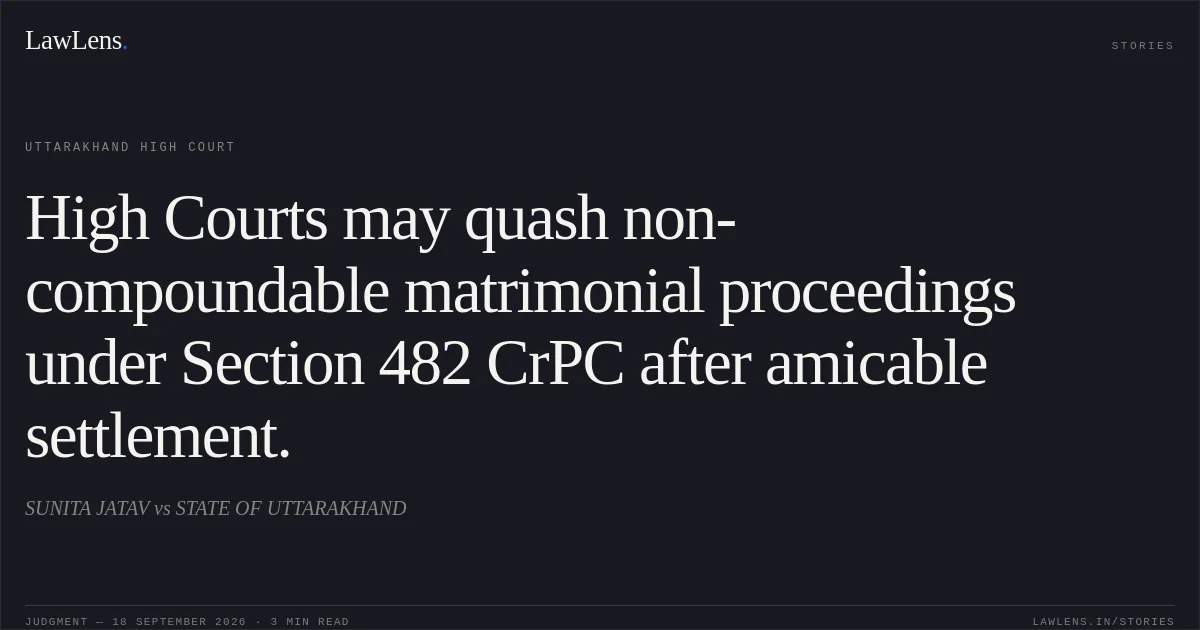
Whether the High Court could exercise its inherent jurisdiction under Section 482 of the Code of Criminal Procedure, 1973, to permit settlement/compounding and quash criminal proceedings arising from a matrimonial dispute, notwithstanding that the offences were not ordinarily compoundable?
Source reference: para. 8–10Whether the charge-sheet, the order dated 19 February 2021, and the consequential criminal proceedings should be quashed qua the applicant in view of the parties’ settlement and the complainant’s unwillingness to prosecute?
Source reference: para. 10–11Law Applied
The Court exercised its inherent jurisdiction under Section 482 of the Code of Criminal Procedure, 1973, to prevent abuse of the process of court and secure the ends of justice.
Source reference: para. 9–10It relied on B.S. Joshi v. State of Haryana, (2003) 4 SCC 675; Nikhil Merchant v. CBI, (2008) 9 SCC 650; Gian Singh v. State of Punjab, (2012) 10 SCC 303; and Dimpey Gujral v. Union Territory of Chandigarh, Transfer Petition (Criminal) No. 115 of 2012, decided on 6 December 2012, for the principle that the High Court may quash even non-compoundable criminal proceedings under Section 482 CrPC where the dispute is predominantly private or matrimonial, the parties have genuinely settled their differences, and continuation of the prosecution would be futile.
Source reference: para. 9The Court further applied the principle that the complainant’s voluntary decision not to pursue the case, coupled with an amicable settlement, may justify quashing when no useful purpose would be served by a trial.
Source reference: para. 8–10Reasoning
The Court found that the prosecution arose out of a matrimonial dispute and that the dispute had been amicably resolved through the parties’ decision to separate and pursue divorce proceedings.
Source reference: para. 3–4, 7Respondent no. 2, the complainant, personally confirmed the settlement and expressly stated that she did not wish to prosecute the applicant further.
Source reference: para. 4Since the State had no objection and the complainant was unwilling to continue, the Court concluded that proceeding with the criminal trial would be a futile exercise.
Source reference: para. 5, 8–10Applying the principles governing the exercise of inherent powers under Section 482 CrPC in matrimonial and privately settled disputes, the Court held that quashing was warranted in the interests of justice.
Source reference: para. 5, 8–10Holding
The compounding application was allowed under Section 482 CrPC.
Consequently, the charge-sheet dated 12 January 2021, the order dated 19 February 2021, and the entire proceedings in Criminal Case No. 1839 of 2021 were quashed qua the present applicant, Sunita Jatav only.
Source reference: para. 11The Criminal Miscellaneous Application and all pending applications were disposed of accordingly.
Source reference: para. 12–13Acts & Sections Cited
1 provisions across 1 statute referred to in this judgment. Each provision opens on LawLens.
Code of Criminal Procedure, 19731
Original Court PDF
SUNITA JATAVvsSTATE OF UTTARAKHAND
Click to open original judgment
Original judgment, available to read, download and summarize on LawLens.in