Facts
Petitioner No. 1 and respondent No. 2 married on 9 May 2021, separated on 12 March 2022, and had no children.
Source reference: p. 2Respondent No. 2’s complaint led to registration of FIR No. 673/2024 under Sections 85, 316, 351 and 3(5) of the Bharatiya Nyaya Sanhita, 2023, alleging dowry-related harassment and threats by the petitioners
Source reference: p. 2During the proceedings, the parties entered into a mediation settlement providing for a full and final payment of ₹3,50,000 and cooperation in quashing the FIR.
Source reference: pp. 2–3The parties had obtained a mutual-consent divorce; the remaining ₹1,00,000 was paid by demand draft in Court, and respondent No. 2 stated that she did not wish to pursue the case.
Source reference: p. 3The petition sought quashing under Section 528 of the Bharatiya Nagarik Suraksha Sanhita, 2023.
Source reference: p. 1Issues
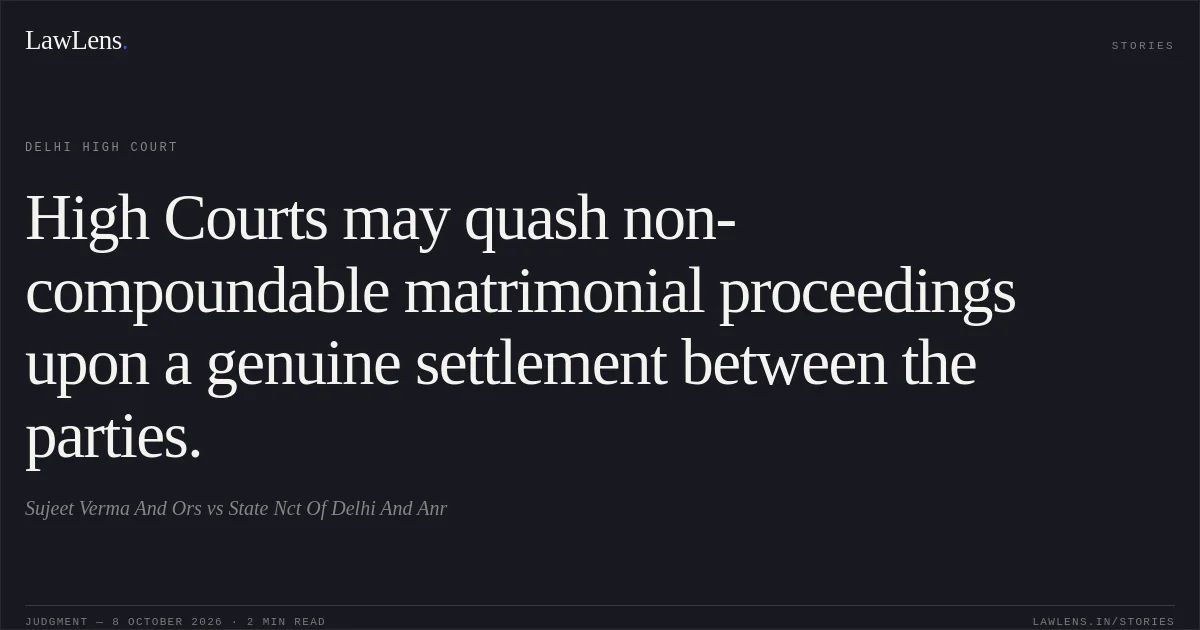
1. Whether the High Court may quash non-compoundable criminal proceedings arising from a matrimonial dispute under Section 528 BNSS when the parties have settled the dispute.
Source reference: pp. 4–5, paras 16–182. Whether the settlement and circumstances of this case warranted quashing the FIR and consequential proceedings.
Source reference: p. 5, paras 19–20Law Applied
Section 528 BNSS preserves the High Court’s inherent power to quash criminal proceedings, including proceedings for non-compoundable offences, where doing so serves the ends of justice and no overriding public interest is adversely affected.
Source reference: p. 4, paras 16–17In Jitendra Raghuvanshi and Others v. Babita Raghuvanshi and Another, (2013) 4 SCC 58, the Supreme Court held that the High Court may quash proceedings in matrimonial disputes following a genuine, voluntary settlement, notwithstanding the non-compoundable nature of the offences.
Source reference: pp. 4–5, para 18Reasoning
The Court found that the dispute was matrimonial and had been finally settled through mediation.
Source reference: pp. 3–4, paras 9–12The parties had divorced by mutual consent, the full settlement amount had been paid, and respondent No. 2 confirmed that she did not wish to pursue the matter.
Source reference: pp. 3–4, paras 9–12The State had no objection to the petition, and the Court considered the settlement sufficient to exercise its inherent power consistently with the principles in Jitendra Raghuvanshi.
Source reference: pp. 4–5, paras 14–18Holding
The Court held that the settled matrimonial dispute warranted exercise of its power under Section 528 BNSS.
It quashed FIR No. 673/2024, registered at PS Nand Nagri under Sections 85, 316, 351 and 3(5) BNS, together with all consequential proceedings, and allowed and disposed of the petition.
Source reference: p. 5, paras 19–20Acts & Sections Cited
7 provisions across 3 statutes referred to in this judgment. Each provision opens on LawLens.
Bharatiya Nagarik Suraksha Sanhita, 20231
Bharatiya Nyaya Sanhita, 20234
Code of Criminal Procedure, 19732
Original Court PDF
Sujeet Verma And OrsvsState Nct Of Delhi And Anr
Click to open original judgment
Original judgment, available to read, download and summarize on LawLens.in