Facts
Respondent No. 2 claimed ownership of an 80-square-yard portion of a plot in Harsh Vihar and alleged that petitioner No. 1 and his associates constructed a wall on it, forged property documents, and threatened him.
Source reference: paras. 5.1–5.5, pp. 2–3FIR No. 0330/2025 was registered under provisions of the BNS, and petitioner No. 1 had also filed a civil suit concerning the property.
Source reference: paras. 1, 5.1, 5.6–5.7, pp. 1, 3The parties later executed a settlement agreement: petitioner No. 1 agreed to remove the construction, pay ₹3 lakh, withdraw the civil suit, and relinquish any claim to the property.
Source reference: paras. 5.8–5.9, p. 4The petitioners stated that they had paid the amount and withdrawn the suit; respondent No. 2 confirmed receipt of the money and peaceful possession of the property, and did not wish to pursue the matter.
Source reference: paras. 6–9, p. 4The State also had no objection to quashing the FIR, though it sought costs for the investigative time spent.
Source reference: paras. 10–11, p. 4Issues
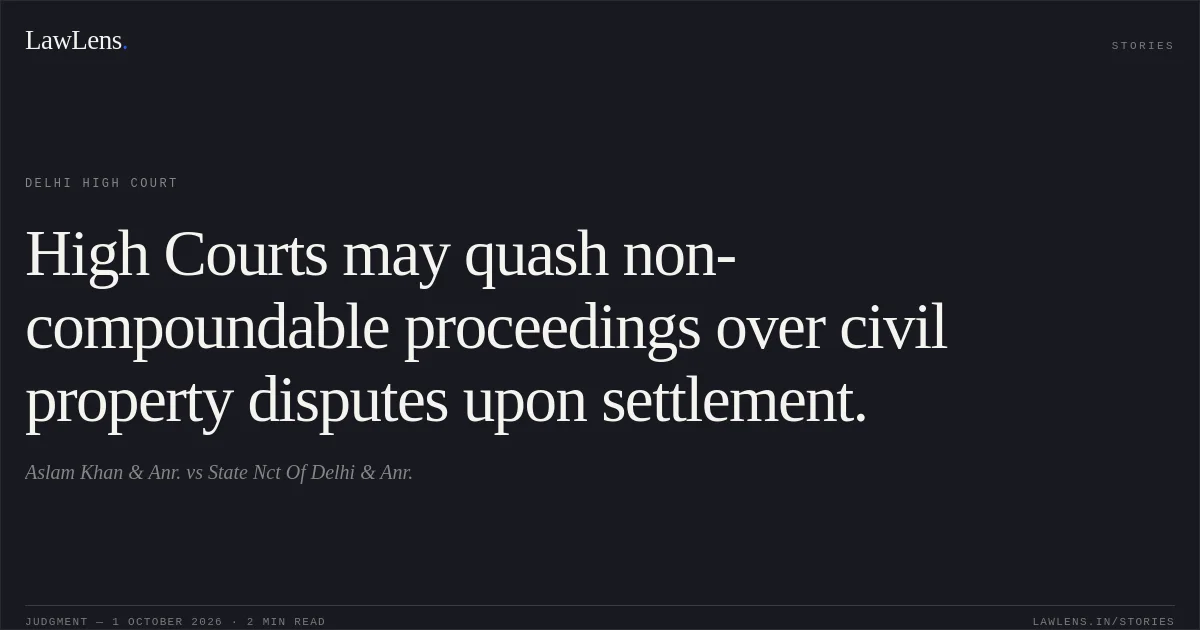
Whether the High Court could quash the FIR and proceedings for non-compoundable offences under Section 528 BNSS in view of the parties’ settlement.
Source reference: paras. 15–17, pp. 5–6Whether the settlement and surrounding circumstances justified quashing the proceedings, and whether costs should be imposed.
Source reference: paras. 14, 21–23, pp. 5, 8–9Law Applied
Article 226 of the Constitution and Section 528 BNSS (corresponding to Section 482 CrPC) empower the High Court to quash criminal proceedings, including for non-compoundable offences, where doing so serves the ends of justice or prevents abuse of process; this power is distinct from statutory compounding and must be exercised sparingly, having regard to the nature and gravity of the offence and its societal impact.
Source reference: paras. 1, 16–17, pp. 1, 5–6Gian Singh v. State of Punjab, (2012) 10 SCC 303, permits quashing where a dispute is predominantly private or civil in character, the parties have settled, and continuation would be futile or defeat justice, while excluding serious offences with substantial public impact.
Source reference: para. 18, pp. 5–6Narinder Singh v. State of Punjab, (2014) 6 SCC 466, requires consideration of the ends of justice, the character of the offence, and whether conviction is remote and continuation would cause oppression or injustice.
Source reference: para. 19, pp. 6–8The Court also cited Deepak Kumar v. State (Govt. of NCT) of Delhi, 2024 SCC OnLine Del 1305, for the case-specific assessment of the offence’s nature, gravity, and social impact.
Source reference: para. 20, p. 8Reasoning
The Court found that the parties had fully resolved their dispute over the property: the agreed payment had been made, the complainant was in peaceful possession, and the civil suit had been withdrawn.
Source reference: paras. 7–9, 14, p. 4Although some alleged offences were non-compoundable, the Court treated the dispute as settled between the parties and concluded that continuing the criminal proceedings would be contrary to the interests of justice; the State did not oppose quashing.
Source reference: paras. 10, 15–17, pp. 4–6In view of the investigative effort expended, the Court accepted the State’s request for costs.
Source reference: paras. 11, 22, pp. 4, 9Holding
The Court quashed FIR No. 0330/2025 and all proceedings arising from it on the basis of the settlement.
It directed the petitioners to deposit ₹10,000 with the Delhi High Court Advocates Welfare Trust within one week, and disposed of the petition.
Source reference: paras. 22–24, p. 9The operative paragraph identifies Section 329(2), whereas the petition’s opening identifies Section 392(2); the judgment contains this apparent inconsistency.
Source reference: no citationActs & Sections Cited
9 provisions across 3 statutes referred to in this judgment. Each provision opens on LawLens.
Bharatiya Nagarik Suraksha Sanhita, 20231
Bharatiya Nyaya Sanhita, 20236
Code of Criminal Procedure, 19732
Original Court PDF
Aslam Khan & Anr.vsState Nct Of Delhi & Anr.
Click to open original judgment
Original judgment, available to read, download and summarize on LawLens.in