Facts
The petitioners, accused Nos. 1–3, sought to quash proceedings in C.C. No. 181/2019 arising from Kittur Police Station Crime No. 6/2019 for offences under Sections 341, 324, 504 and 506 read with Section 34 of the IPC. The complaint alleged that the petitioners wrongfully restrained and assaulted respondent No. 3 with a wooden stick, causing simple injuries.
Source reference: p.14The parties, who were residents of the same village, filed a joint application and affidavits stating that they had settled the dispute voluntarily, with the intervention of village elders, and that the complainant and victim had no objection to quashing the proceedings.
Source reference: p.3–7Issues
1. Whether the High Court should exercise its inherent jurisdiction to quash the criminal proceedings on the basis of the parties’ settlement, although the alleged offences were treated as non-compoundable.
Source reference: p.8, p.152. Whether, in light of the settlement and circumstances of the case, continuation of the prosecution would amount to an abuse of process where the prospects of conviction were remote.
Source reference: p.14–15Law Applied
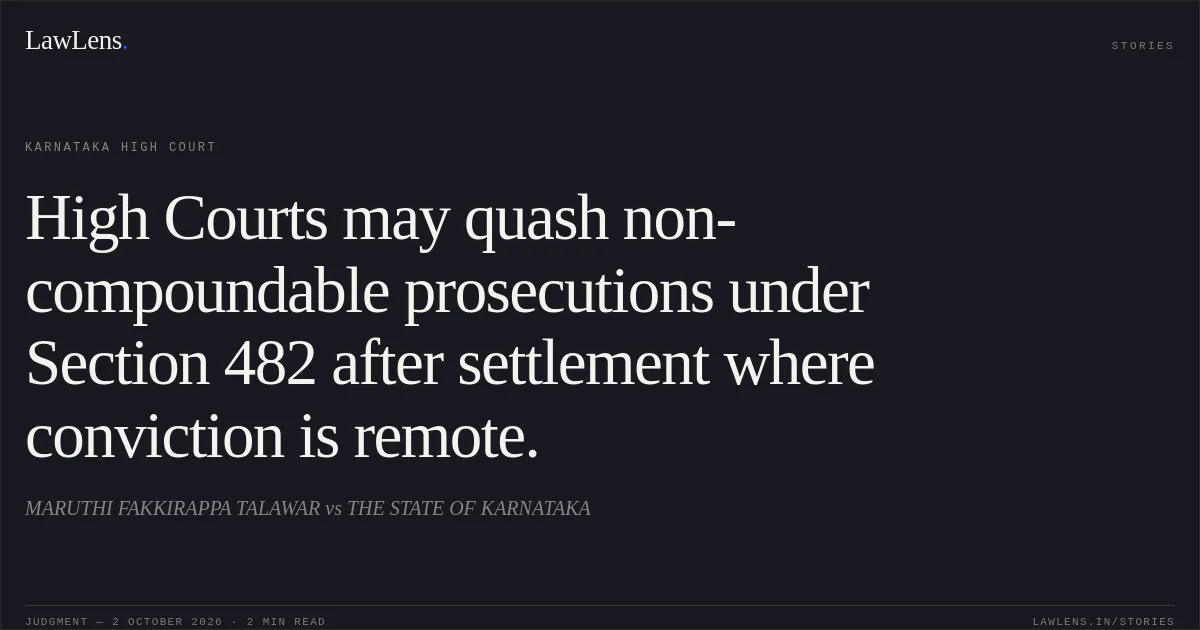
The Court considered Section 482 of the Code of Criminal Procedure, 1973, corresponding to Section 528 of the Bharatiya Nagarik Suraksha Sanhita, 2023, which preserves the High Court’s inherent power to quash proceedings to secure the ends of justice or prevent abuse of process. It distinguished that power from statutory compounding under Section 320 CrPC and referred to Section 359 BNSS.
Source reference: p.3, p.8–9Relying on Narinder Singh v. State of Punjab, (2014) 6 SCC 466, the Court applied the principles that settlement may justify quashing non-compoundable offences where the dispute is predominantly personal, the compromise is voluntary, and the likelihood of conviction is remote, but that quashing is generally inappropriate for heinous or serious offences affecting society.
Source reference: p.8–13Reasoning
The Court found that the allegations arose from a dispute between residents of the same village and concerned wrongful restraint, abuse and an assault alleged to have caused simple injuries. It accepted that the parties had settled voluntarily through village elders and that the complainant and victim no longer had a grievance against the petitioners.
Source reference: p.7, p.14–15Applying Narinder Singh, the Court considered the private nature of the dispute, the settlement and the resulting remoteness of conviction, and concluded that continuing the prosecution would serve no useful purpose and would amount to an abuse of process.
Source reference: p.8–13, p.15Holding
The Court answered the issues in favour of the petitioners, accepted the compromise and allowed the criminal petition.
It quashed the proceedings in C.C. No. 181/2019 pending before the Civil Judge and JMFC, Kittur, and allowed I.A. No. 1 of 2026.
Source reference: p.15Acts & Sections Cited
11 provisions across 3 statutes referred to in this judgment. Each provision opens on LawLens.
Code of Criminal Procedure, 19732
Bharatiya Nagarik Suraksha Sanhita, 20232
Indian Penal Code, 18607
Original Court PDF
MARUTHI FAKKIRAPPA TALAWARvsTHE STATE OF KARNATAKA
Click to open original judgment
Original judgment, available to read, download and summarize on LawLens.in