Facts
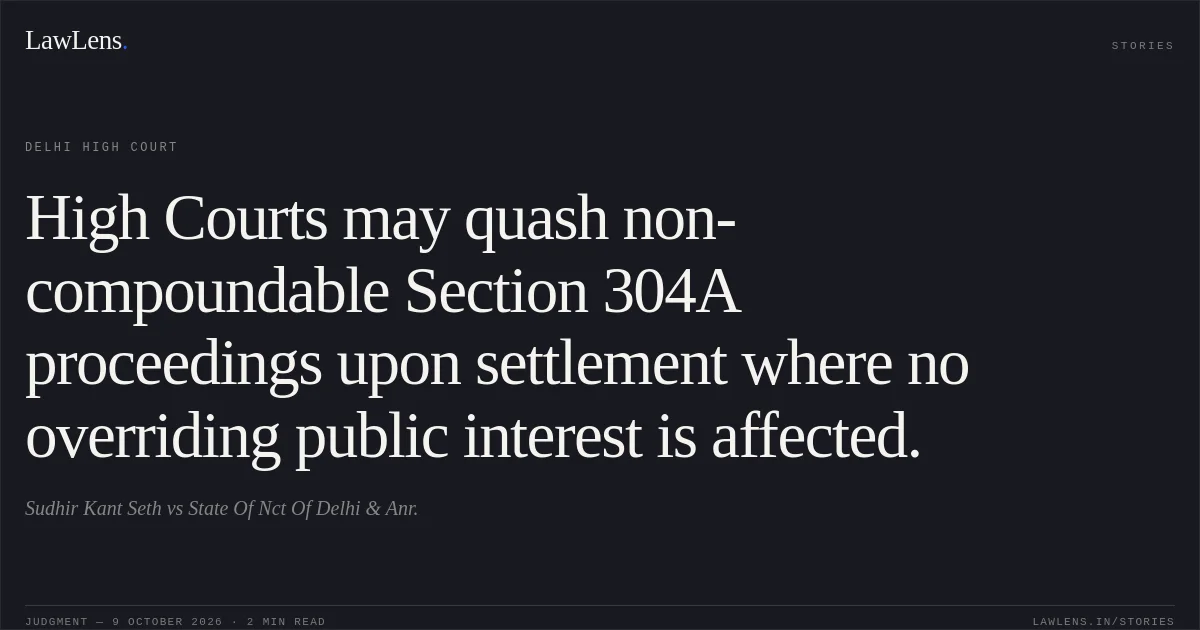
FIR No. 0442/2022 was registered at PS Anand Vihar under Sections 304A/287 IPC after Lalit died from electrocution caused by a live current flowing through an iron pole on a road.
Source reference: pp. 2–3, paras. 6.1–6.4Investigation attributed responsibility to the petitioner, whose firm held the maintenance contract for the pole; a chargesheet was subsequently filed.
Source reference: pp. 2–3, paras. 6.1–6.4During the proceedings, the petitioner and the deceased’s wife entered into an MoU under which the petitioner paid her ₹10 lakh in full and final settlement.
Source reference: p. 3, paras. 6.5–10She confirmed receipt of the amount and stated that she did not wish to pursue the case; the State also had no objection to quashing.
Source reference: p. 3, paras. 6.5–10Issues
1. Whether the High Court could exercise its inherent jurisdiction under Section 528 BNSS/Section 482 CrPC to quash proceedings for non-compoundable offences under Sections 304A/287 IPC on the basis of a settlement with the deceased’s wife.
Source reference: pp. 4–6, paras. 12–142. Whether, in the circumstances of this case, the settlement warranted quashing the FIR and consequential proceedings.
Source reference: pp. 3–4, paras. 7–11Law Applied
Section 528 BNSS, corresponding to Section 482 CrPC, preserves the High Court’s inherent power to quash criminal proceedings to secure the ends of justice or prevent abuse of process, including in appropriate cases involving non-compoundable offences settled between the parties.
Source reference: pp. 4–5, paras. 12–13Relying on Sunil Malhotra v. State (NCT of Delhi), 2023 SCC OnLine Del 7365, the Court noted that there is no categorical bar to quashing proceedings under Section 304A IPC where the circumstances justify such relief.
Source reference: pp. 4–5, para. 14The Court also referred to State of Madhya Pradesh v. Laxmi Narayan, (2019) 5 SCC 688, for the principles that quashing on settlement is generally inappropriate for heinous offences with serious societal impact, and that the Court should consider relevant circumstances, including the accused’s antecedents and conduct.
Source reference: p. 5, para. 14Reasoning
The Court found that the parties had finally settled their dispute through the MoU, that the deceased’s wife had received the agreed ₹10 lakh compensation, and that she did not wish to continue the prosecution.
Source reference: p. 3, paras. 6.5–9The State did not oppose the petition.
Source reference: p. 3, para. 10Applying its inherent jurisdiction and the principles governing settlement-based quashing, the Court concluded that the settlement justified quashing the proceedings in this case.
Source reference: pp. 3–4, paras. 11–14Holding
The Court held that the proceedings could be quashed in light of the settlement.
It quashed FIR No. 0442/2022 under Sections 304A/287 IPC and all proceedings emanating from it, and disposed of the petition and pending application.
Source reference: p. 8, paras. 15–16Acts & Sections Cited
6 provisions across 3 statutes referred to in this judgment. Each provision opens on LawLens.
Bharatiya Nagarik Suraksha Sanhita, 20231
Code of Criminal Procedure, 19732
Indian Penal Code, 18603
Original Court PDF
Sudhir Kant SethvsState Of Nct Of Delhi & Anr.
Click to open original judgment
Original judgment, available to read, download and summarize on LawLens.in