Facts
FIR No. 249 dated 25 August 2005 was registered at Police Station Abohar, District Ferozepur (now Fazilka), under Sections 364, 325, 324 and 323 of the Indian Penal Code, 1860 (“IPC”). The respondents were subsequently convicted by the Additional Sessions Judge, Ferozepur, under Sections 365/149, 324/149, 325/149 and 148 IPC and sentenced on 9 May 2012
Source reference: para. 2After conviction, the parties entered into a compromise. The respondents therefore invoked Section 482 of the Code of Criminal Procedure, 1973 (“CrPC”), seeking quashing of the FIR and all consequential proceedings, including the conviction and sentence
Source reference: paras. 2–3Pursuant to the High Court’s direction, the complainant and other parties made statements before the Trial Court confirming that the compromise was genuine, voluntary, and free from coercion or undue influence
Source reference: para. 4Relying on Gian Singh v. State of Punjab, the High Court quashed the FIR and all proceedings arising from it. The State of Punjab challenged that order before the Supreme Court.
Source reference: para. 5Issues
Whether the High Court could exercise its inherent jurisdiction under Section 482 CrPC to quash the FIR and consequential criminal proceedings, including a conviction and sentence, on the basis of a post-conviction compromise between the parties?
Source reference: paras. 2–7Whether, considering the nature of the offences, the voluntary character of the compromise, and the absence of wider societal impact, the quashing of the proceedings would secure the ends of justice or constitute an impermissible effacement of criminal liability?
Source reference: paras. 6–9Law Applied
Section 482 CrPC preserves the High Court’s inherent power to make orders necessary to secure the ends of justice or prevent abuse of the process of any court; this power is distinct from statutory compounding under Section 320 CrPC and may extend to non-compoundable offences in appropriate cases
Source reference: para. 6Under Narinder Singh v. State of Punjab, (2014) 6 SCC 466, the power must be exercised sparingly and cautiously, particularly by considering the nature and seriousness of the offence and its impact on society
Source reference: para. 6Ramgopal v. State of Madhya Pradesh, (2022) 14 SCC 531, further holds that criminal proceedings involving non-heinous offences or offences predominantly private in nature may be quashed even after conviction, provided the court examines the nature of the offence, seriousness of the injury, voluntariness of the compromise, and the accused’s conduct before and after the incident
Source reference: para. 7Serious or heinous offences, offences involving moral turpitude, or offences affecting public policy and the social fabric ordinarily cannot be quashed merely because the parties have settled their dispute
Source reference: para. 7Reasoning
The Supreme Court found that the incident was essentially an inter se dispute between individuals and did not involve a heinous offence, an economic offence, contraband under the NDPS Act, or a large-scale scam affecting society at large
Source reference: para. 8The complainant had confirmed before the Trial Court that the compromise was genuine, voluntary, and free from pressure or undue influence
Source reference: para. 4Applying the principles in Narinder Singh and Ramgopal, the Court treated the offences as non-heinous and predominantly private in character, and concluded that the compromise did not undermine any significant public interest or the administration of criminal justice
Source reference: paras. 6–9The fact that the respondents had already been convicted did not, in the circumstances, prevent the exercise of the High Court’s inherent jurisdiction
Source reference: para. 7Holding
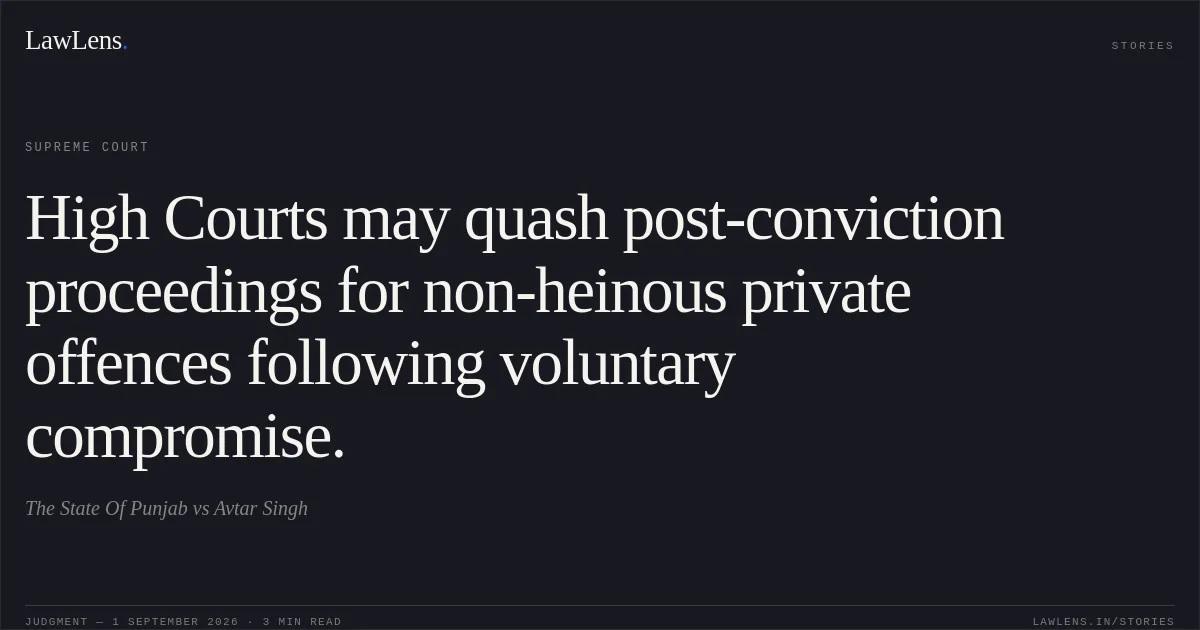
The Supreme Court held that the High Court had properly exercised its power under Section 482 CrPC to quash the FIR and all consequential proceedings, including the judgment of conviction and sentence, on the basis of the voluntary post-conviction compromise
Finding no ground for interference, the Court dismissed the State’s appeal and disposed of the pending applications, if any
Source reference: paras. 9–11Acts & Sections Cited
9 provisions across 2 statutes referred to in this judgment. Each provision opens on LawLens.
Indian Penal Code, 18607
Code of Criminal Procedure, 19732
Original Court PDF
The State Of PunjabvsAvtar Singh
Click to open original judgment
Original judgment, available to read, download and summarize on LawLens.in