Facts
The appellants were named as accused in an FIR registered at Police Station Kaptanganj, District Azamgarh, under Sections 323/34, 324, 504, 506, 307/34, 336 and 427 of the IPC and Sections 3(1)(d), 3(1)(r) and 3(2)(va) of the SC/ST Act. However, they were not shown as accused in the chargesheet filed after investigation on 3 October 2022.
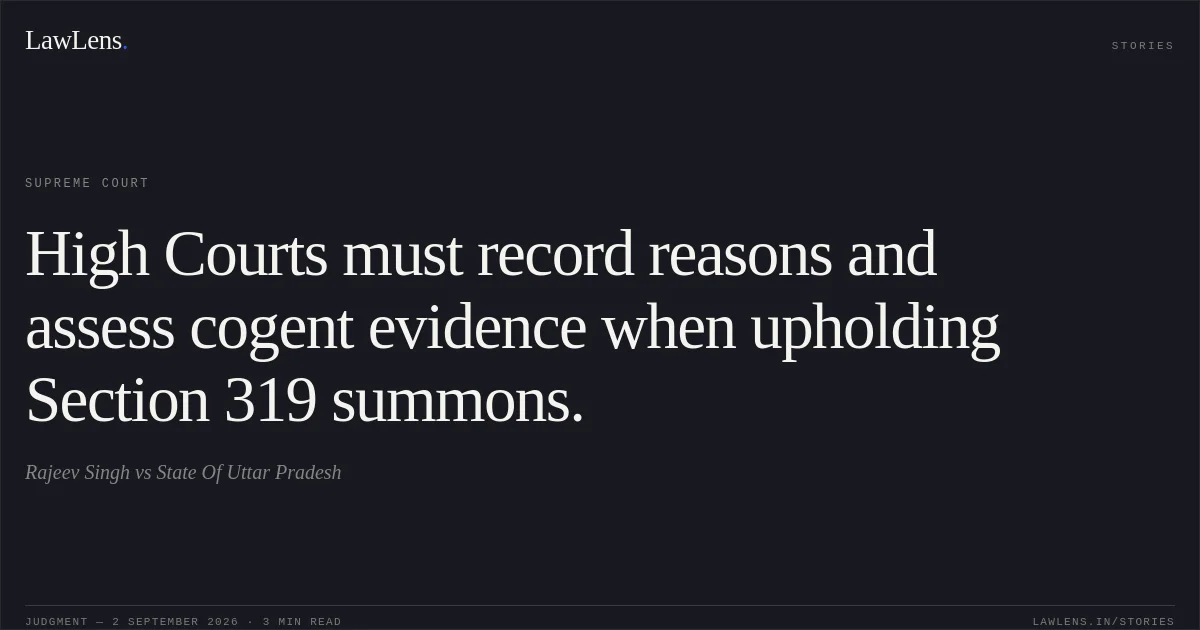
Source reference: p.1–2, para. 3After commencement of trial, the complainant moved an application under Section 319 CrPC. The Special Judge, SC/ST Act, allowed the application on 11 June 2025 and summoned the appellants to face trial. The Allahabad High Court dismissed their appeal under Section 14A(2) of the SC/ST Act, holding that there was no illegality or perversity in the summoning order, but without identifying or discussing the evidence relied upon. The appellants challenged the High Court’s order before the Supreme Court.
Source reference: p.2–3, paras. 3–4Issues
1. Whether the High Court’s dismissal of the appellants’ appeal against the Section 319 CrPC summoning order was legally sustainable when the order contained no reasons and did not refer to the evidence establishing their prima facie involvement.
Source reference: p.3–5, paras. 5–102. Whether a High Court, while deciding a criminal appeal concerning persons not named in the chargesheet but subsequently summoned under Section 319 CrPC, must provide a reasoned and speaking order applying the standard laid down in Hardeep Singh v. State of Punjab.
Source reference: p.3–5, paras. 7–10Law Applied
The Court applied Section 14A(2) of the Scheduled Castes and the Scheduled Tribes (Prevention of Atrocities) Act, 1989, governing appeals against orders of the Special Court, and Section 319 CrPC, which permits a court to summon a person who appears from the evidence to have committed an offence and is liable to be tried with the existing accused.
Source reference: p.1, paras. 2–3; p.2, para. 3Relying on the Constitution Bench decision in Hardeep Singh v. State of Punjab, (2014) 3 SCC 92, the Court reiterated that such power must be founded on the evidence recorded during trial and the applicable threshold for summoning an additional accused. It further relied on Asma Lateef v. Shabbir Ahmad, (2024) 4 SCC 696, holding that every judicial order determining the rights or liabilities of parties must disclose reasons, both to demonstrate application of mind and to enable effective appellate review.
Source reference: p.3–5, paras. 6–9Reasoning
The High Court’s order merely stated that it had considered the rival submissions and that, having regard to the gravity of the offence, the evidence, the appellants’ complicity and the specific allegations, there was no illegality or perversity in the summoning order. It did not identify the evidence recorded during trial, assess its quality, or explain how that evidence satisfied the standard under Hardeep Singh.
Source reference: p.2–3, para. 4This omission was particularly material because the appellants had not been included in the chargesheet, suggesting that the investigating officer had initially found no sufficient evidence against them. Since a person not initially sent for trial was being compelled to face criminal proceedings, the High Court was required to provide a reasoned examination of the evidence and the legality of the Section 319 order. Its laconic order failed to show application of mind and prevented meaningful appellate scrutiny.
Source reference: p.3–5, paras. 5–10Holding
The Supreme Court held that the High Court’s order was not a reasoned or speaking judicial order and could not be sustained.
The impugned order dated 11 August 2025 was quashed, and the criminal appeal was remanded to the roster Bench of the Allahabad High Court for fresh and expeditious disposal in accordance with law, after granting an opportunity of hearing to the appellants, the State and the complainant. The criminal appeal was accordingly allowed.
Source reference: p.5, paras. 11–12Acts & Sections Cited
10 provisions across 3 statutes referred to in this judgment. Each provision opens on LawLens.
Scheduled Castes and the Scheduled Tribes (Prevention of Atrocities) Act, 19891
Indian Penal Code, 18608
Code of Criminal Procedure, 19731
Original Court PDF
Rajeev SinghvsState Of Uttar Pradesh
Click to open original judgment
Original judgment, available to read, download and summarize on LawLens.in