Facts
The petitioner, proprietor of M/s Shekhar Arwa Polisher Mill, sought a direction requiring Punjab National Bank to act on a settlement dated 29 December 2021 for ₹25,70,000.
Source reference: p. 1–2He stated that he had paid ₹20,00,000 and was ready to pay the balance he claimed was due; he also sought leniency in recovery, citing the difficulties faced by businesses during the Covid-19 pandemic.
Source reference: p. 1–2The Bank opposed the writ petition.
Source reference: p. 2–4The High Court considered whether the petition could be entertained despite the availability of an alternative remedy.
Source reference: p. 2–4Issues
Whether the High Court should entertain a writ petition seeking relief concerning a bank’s recovery action when an alternative and effective remedy is available
Source reference: p. 2–4Whether the petitioner was entitled to a writ directing the Bank to implement the settlement and accept the claimed balance
Source reference: p. 1–2, 4Law Applied
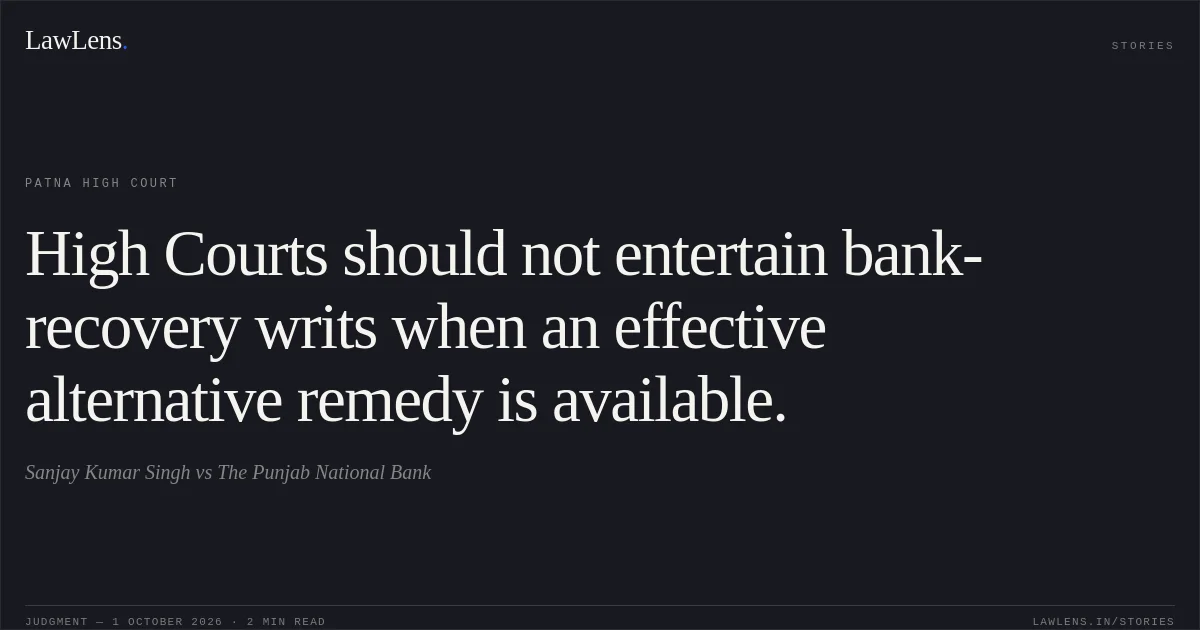
Under Article 226, the High Court will ordinarily decline to entertain a petition where an effective alternative remedy is available; this principle applies with particular force to recovery of public dues and bank debts.
Source reference: p. 2–3In United Bank of India v. Satyawati Tondon, (2010) 8 SCC 110, the Supreme Court stated that remedies under the relevant recovery legislation should ordinarily be exhausted before invoking Article 226.
Source reference: p. 2–3The Court also relied on Celir LLP v. Bafna Motors (Mumbai) (P) Ltd., (2024) 2 SCC 1, concerning the need to use an effective remedy under the SARFAESI Act, and PHR Invent Educational Society v. UCO Bank, 2024 INSC 297, which reiterated the alternative-remedy principle.
Source reference: p. 3–4Reasoning
Applying these authorities, the Court held that the petition was not maintainable because an alternative and effective remedy was available to the petitioner.
Source reference: p. 4It did not examine the merits of the claimed settlement, the amounts paid or remaining due, or the Bank’s refusal to accept further payment.
Source reference: p. 4Instead, it left the petitioner to pursue relief before the appropriate forum and directed that the question of limitation be considered by the concerned authority.
Source reference: p. 4Holding
The Court held the writ petition not maintainable in view of the alternative and effective remedy.
It disposed of the petition, leaving the petitioner at liberty to approach the appropriate forum, which was also to consider limitation.
Source reference: p. 4Original Court PDF
Sanjay Kumar SinghvsThe Punjab National Bank
Click to open original judgment
Original judgment, available to read, download and summarize on LawLens.in