Facts
The petitioners executed registered sale deeds in favour of respondent Nos. 4 and 5 concerning certain land.
Source reference: para. 2They alleged that the purchasers failed to pay the entire sale consideration because the cheques referred to in the sale deeds were either not delivered or were dishonoured.
Source reference: para. 2The petitioners claimed that they received only ₹85,00,000 out of ₹2,56,00,000 from respondent No. 4 and ₹50,00,000 out of ₹2,53,00,000 from respondent No. 5.
Source reference: para. 2Proceedings under Section 138 of the Negotiable Instruments Act were already pending before the concerned JMFC, Jabalpur.
Source reference: paras. 1–2The petitioners also submitted complaints dated 15 April, 30 April, 29 May, 1 June, 15 July and 19 July 2026 to the police authorities and the Economic Offences Wing, alleging fraud and seeking registration of an FIR or a preliminary enquiry.
Source reference: paras. 1–2As no action was allegedly taken, they invoked the writ jurisdiction of the High Court under Article 226 of the Constitution.
Source reference: para. 1The State opposed the petition on the ground that the petitioners had an efficacious statutory remedy under Sections 156(3), 200 and 202 of the CrPC.
Source reference: para. 3Issues
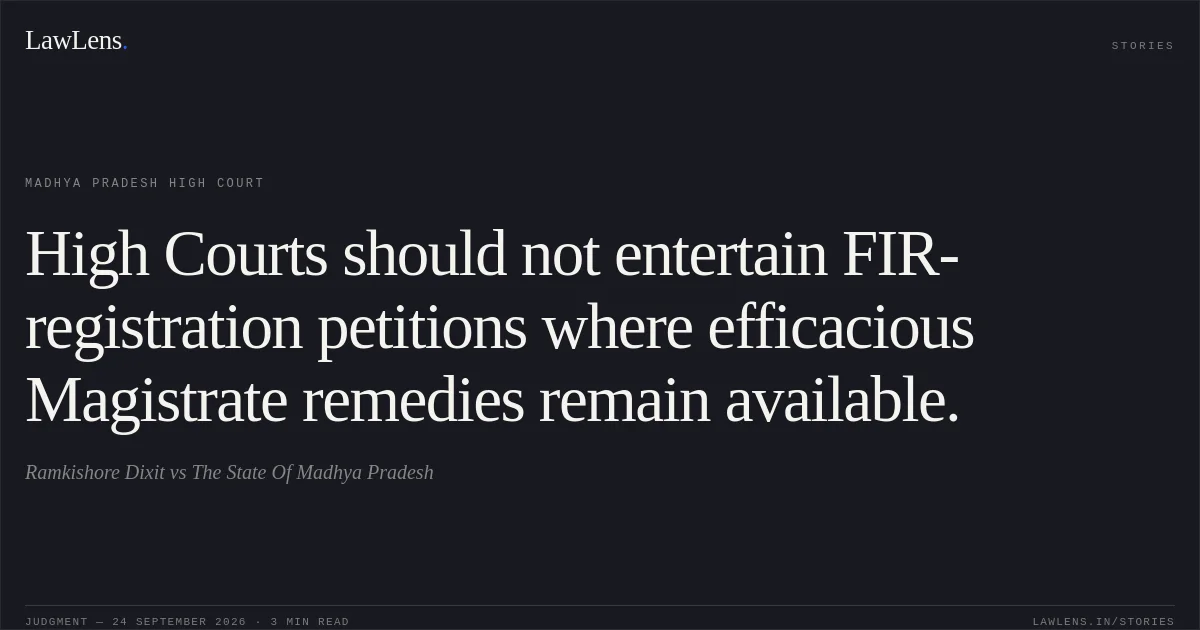
Whether the High Court should issue a writ directing the police authorities or the Economic Offences Wing to register an FIR or conduct a preliminary enquiry when the petitioners had not invoked the statutory remedies before the Magistrate under the CrPC/BNSS.
Source reference: paras. 3, 5–9Whether the pendency of proceedings under Section 138 of the Negotiable Instruments Act, concerning dishonoured cheques, affected the maintainability or grant of the requested writ relief.
Source reference: paras. 2–3Law Applied
The Court applied the statutory remedies under Sections 154(3), 156(3), 200 and 202 of the CrPC, corresponding substantially to Sections 173, 175 and 223 of the BNSS.
Source reference: para. 5Under Sakiri Vasu v. State of U.P., (2008) 2 SCC 409, a person aggrieved by non-registration of an FIR must ordinarily first approach the Superintendent of Police under Section 154(3) and thereafter the Magistrate under Section 156(3), who has the power to direct registration of an FIR, order proper investigation and monitor the investigation.
Source reference: para. 5The Court also relied on M. Subramaniam v. S. Janaki, Criminal Appeal No. 102 of 2011, decided on 20 March 2020, and Sudhir Bhaskarrao Tambe v. Hemant Yashwant Dhage, (2016) 6 SCC 277, reaffirming that writ jurisdiction should not ordinarily be invoked for grievances concerning non-registration or improper investigation of an FIR.
Source reference: para. 6The same approach was recognised in Shweta Bhadoriya v. State of M.P., (2017) 1 MPLJ (Cri) 338.
Source reference: para. 7The Court further referred to Ashwini Kumar Upadhyay v. Union of India, 2026 LiveLaw (SC) 437, which reiterated that registration of an FIR is mandatory where information discloses a cognizable offence, while also recognising the statutory remedies before the Superintendent of Police and Magistrate under the CrPC/BNSS.
Source reference: para. 8The existence of an alternative efficacious remedy ordinarily warrants refusal to exercise discretionary writ jurisdiction, although such remedy is not an absolute bar.
Source reference: para. 5Reasoning
The petitioners’ grievance principally concerned the alleged failure of the police to register an FIR or conduct an investigation into non-payment of sale consideration and alleged fraud.
Source reference: para. 2The Court held that such a grievance falls within the statutory mechanism under the CrPC/BNSS.
Source reference: paras. 5–8Even if the police failed to act on the complaints, the petitioners could approach the competent Magistrate under Section 156(3) of the CrPC, or pursue a complaint under Sections 200 and 202, where the Magistrate could direct registration of an FIR and ensure a proper investigation.
Source reference: paras. 5–8The pendency of proceedings under Section 138 of the Negotiable Instruments Act further demonstrated that the petitioners already had proceedings concerning the dishonoured cheques, although the Court did not decide whether any distinct cognizable offence was made out.
Source reference: paras. 2–3Since the petitioners had approached the High Court without availing the alternative statutory remedies, the Court declined to exercise its writ jurisdiction.
Source reference: paras. 3, 8–9Holding
The High Court held that the writ petition seeking a direction for registration of an FIR or a preliminary enquiry could not be entertained because the petitioners had not exhausted the efficacious remedies available under the CrPC/BNSS before the police authorities and the competent Magistrate.
The petition was accordingly dismissed.
Source reference: para. 10The petitioners were granted liberty to approach the concerned Magistrate under the applicable provisions of the CrPC/BNSS for redressal of their grievance.
Source reference: para. 10Acts & Sections Cited
19 provisions across 3 statutes referred to in this judgment. Each provision opens on LawLens.
Code of Criminal Procedure, 1973
Negotiable Instruments Act, 18811
Bharatiya Nagarik Suraksha Sanhita, 20237
Original Court PDF
Ramkishore DixitvsThe State Of Madhya Pradesh
Click to open original judgment
Original judgment, available to read, download and summarize on LawLens.in