Facts
The petitioners invoked Section 528 of the Bharatiya Nagarik Suraksha Sanhita, 2023 (“BNSS”), read with Article 227 of the Constitution, seeking quashing of M.R. (D.V.) Case No. 115/2025 pending before the Civil Judge (Jr. Div.) No. 2, Hailakandi, under Section 12 of the Protection of Women from Domestic Violence Act, 2005 (“D.V. Act”), along with the order dated 1 September 2025 issuing notice to them.
Source reference: p.2Petitioner No. 1 was the husband of the complainant, while Petitioners Nos. 2, 3 and 4 were her brother-in-law, father-in-law and mother-in-law, respectively.
Source reference: pp.1, 3The petitioners contended that the reliefs under Sections 18–22 of the D.V. Act were directed only against the husband and that no specific allegations had been made against Petitioners Nos. 2–4.
Source reference: p.3The husband was not pressing the petition insofar as it concerned him.
Source reference: p.3The complainant opposed quashing, contending that she had resided with Petitioners Nos. 3 and 4 and that their residence could constitute a shared household under the D.V. Act.
Source reference: p.3The petitioners also relied on the age and medical condition of some of the petitioners to seek relief from regular court attendance.
Source reference: p.4Issues
1. Whether the High Court could exercise its inherent jurisdiction under Section 528 of the BNSS and Article 227 of the Constitution to quash proceedings arising from an application under Section 12 of the D.V. Act.
Source reference: pp.2, 4–52. Whether the proceedings against Petitioners Nos. 2–4 were liable to be quashed on the ground that the complaint contained no specific allegations or reliefs against them.
Source reference: pp.3–53. Whether the regular appearance of Petitioners Nos. 2–4 could be dispensed with in view of their age and medical circumstances.
Source reference: p.4Law Applied
The Court applied Section 528 of the BNSS, corresponding to the High Court’s inherent power to prevent abuse of process and secure the ends of justice, read with Article 227 of the Constitution.
Source reference: p.2It considered the provisions of Sections 12, 18, 19, 20, 21 and 22 of the D.V. Act, which enable an aggrieved woman to seek protection, residence, monetary, custody and compensation-related reliefs in domestic-violence proceedings.
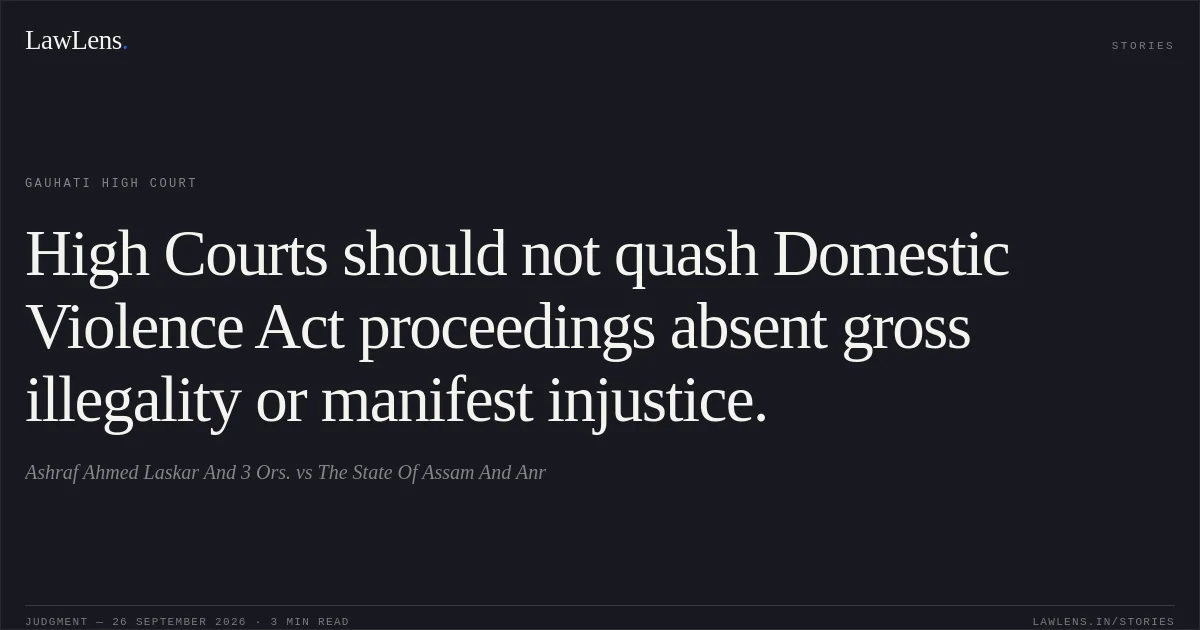
Source reference: pp.2–3Relying on Shaurabh Kumar Tripathi v. Vidhi Rawal, 2025 SCC OnLine SC 1158, the Court recognised that the High Court may quash proceedings arising from a Section 12(1) D.V. Act application, but must exercise that jurisdiction with caution and circumspection, ordinarily intervening only in cases of gross illegality or injustice.
Source reference: p.4The Court distinguished Achin Gupta v. State of Haryana, 2025 3 SCC 756 and Kashan Kausar @ Sonam v. State of Bihar, 2022 6 SCC 599, as those decisions concerned quashing of FIRs and charge-sheets in regular criminal cases, whereas D.V. Act proceedings are quasi-criminal and do not ordinarily entail penal consequences for the respondents.
Source reference: p.4Reasoning
Although the petitioners argued that the complaint contained no specific allegations against Petitioners Nos. 2–4 and that the substantive reliefs were directed against the husband, the Court declined to terminate the proceedings at the threshold.
Source reference: pp.4–5The Court accepted that it possessed jurisdiction to interfere with D.V. Act proceedings but held that such power had to be exercised cautiously, particularly because the proceedings were quasi-criminal in nature and the record did not disclose the gross illegality or injustice required for extraordinary intervention.
Source reference: pp.4–5The complainant’s assertion that she had resided with Petitioners Nos. 3 and 4, potentially bringing their residence within the concept of a shared household, further militated against prematurely resolving the matter in their favour.
Source reference: p.3As to attendance, the Court considered that the petitioners could seek exemption before the Trial Court, which was directed to consider such an application appropriately.
Source reference: p.4Holding
The High Court declined to exercise its inherent jurisdiction to quash M.R. (D.V.) Case No. 115/2025 or the notice order dated 1 September 2025.
The petition was disposed of with liberty to Petitioners Nos. 2–4 to apply before the Trial Court for dispensing with their regular appearance; the Trial Court was directed to consider such an application duly.
Source reference: p.5The Court further expected the D.V. proceedings to be concluded expeditiously, preferably within six months from communication of the order.
Source reference: p.5Acts & Sections Cited
9 provisions across 3 statutes referred to in this judgment. Each provision opens on LawLens.
Bharatiya Nagarik Suraksha Sanhita, 20232
Protection of Women from Domestic Violence Act, 20056
Code of Criminal Procedure, 19731
Original Court PDF
Ashraf Ahmed Laskar And 3 Ors.vsThe State Of Assam And Anr
Click to open original judgment
Original judgment, available to read, download and summarize on LawLens.in