Facts
The petitioner claimed ownership over land comprised in Khasra Nos. 73, 72/2/2, 67/2 and other parcels at Village Gureya.
Source reference: para. 2Although he had allegedly sold only a plot measuring 70 × 18 feet, he asserted that Respondent Nos. 6 to 8 had encroached upon the remaining portion of his private land and had also constructed upon Government land bearing Khasra No. 74.
Source reference: para. 2Following an application for demarcation, a Patwari prepared a panchnama allegedly recording the encroachment.
Source reference: para. 2The Tehsildar thereafter passed an order under Section 248 of the Madhya Pradesh Land Revenue Code directing removal of the encroachment, but the order remained unimplemented.
Source reference: para. 9The petitioner further alleged that on 9 August 2026 the private respondents abused and threatened him with false implication in criminal cases.
Source reference: para. 2He claimed that his complaint dated 17 August 2026 to the police authorities had not resulted in registration of an FIR.
Source reference: para. 2He therefore filed the writ petition seeking implementation of the Tehsildar’s orders, action on his police complaint, and disciplinary proceedings against the concerned public servant.
Source reference: para. 2Issues
1. Whether the High Court should issue a writ of mandamus directing the police authorities to register an FIR or act upon the petitioner’s criminal complaint when statutory remedies under the Cr.P.C./B.N.S.S. are available?
Source reference: paras. 2–3, 5–102. Whether the High Court should direct the Tehsildar to implement an eviction order passed under Section 248 of the Madhya Pradesh Land Revenue Code?
Source reference: paras. 2–3, 93. Whether the petitioner was entitled to directions for disciplinary action against the concerned public servant in the writ proceedings?
Source reference: para. 2; para. 10Law Applied
The Court applied the alternative-remedy doctrine governing writ jurisdiction under Article 226 of the Constitution.
Source reference: paras. 5–7Relying principally on Sakiri Vasu v. State of U.P., (2008) 2 SCC 409, Sudhir Bhaskarrao Tambe v. Hemant Yashwant Dhage, (2016) 6 SCC 277, and M. Subramaniam v. S. Janaki, it held that a person aggrieved by non-registration or improper investigation of an FIR should ordinarily approach the Superintendent of Police under Section 154(3) Cr.P.C. and thereafter the Magistrate under Section 156(3) Cr.P.C., or file a complaint under Section 200 Cr.P.C.
Source reference: paras. 5–7Section 156(3) empowers the Magistrate to direct registration of an FIR, order proper investigation, and monitor such investigation.
Source reference: paras. 5–7The Court also referred to Ashwini Kumar Upadhyay v. Union of India, which reaffirmed the corresponding remedies under Sections 173, 175 and 223 of the B.N.S.S. and the mandatory duty to register an FIR where information discloses a cognizable offence.
Source reference: para. 8In relation to land encroachment, the Court held that the petitioner must pursue the remedies available under the Madhya Pradesh Land Revenue Code against or for enforcement of the Tehsildar’s order.
Source reference: para. 9Reasoning
The Court found that the petitioner had approached the High Court directly for relief concerning alleged police inaction, without exhausting the statutory mechanism before the Magistrate under Sections 156(3), 200 and 202 Cr.P.C., or the corresponding provisions of the B.N.S.S.
Source reference: paras. 3, 8 and 10Applying Sakiri Vasu and the subsequent authorities, the Court held that such statutory remedies were efficacious and that the writ jurisdiction should not ordinarily be invoked merely because an FIR had not been registered or an investigation was allegedly inadequate.
Source reference: paras. 5–8As to the encroachment, the Court noted that the Tehsildar had already passed an order under Section 248 of the Madhya Pradesh Land Revenue Code directing removal of the encroachment and that the matter was still pending.
Source reference: para. 9Consequently, no further mandamus to the Tehsildar was necessary; any grievance regarding the order or its implementation had to be pursued before the appropriate authority under the land-revenue framework.
Source reference: para. 9The claim for disciplinary action likewise did not justify exercise of writ jurisdiction in the absence of exhaustion of the appropriate statutory or departmental remedies.
Source reference: paras. 2 and 10Holding
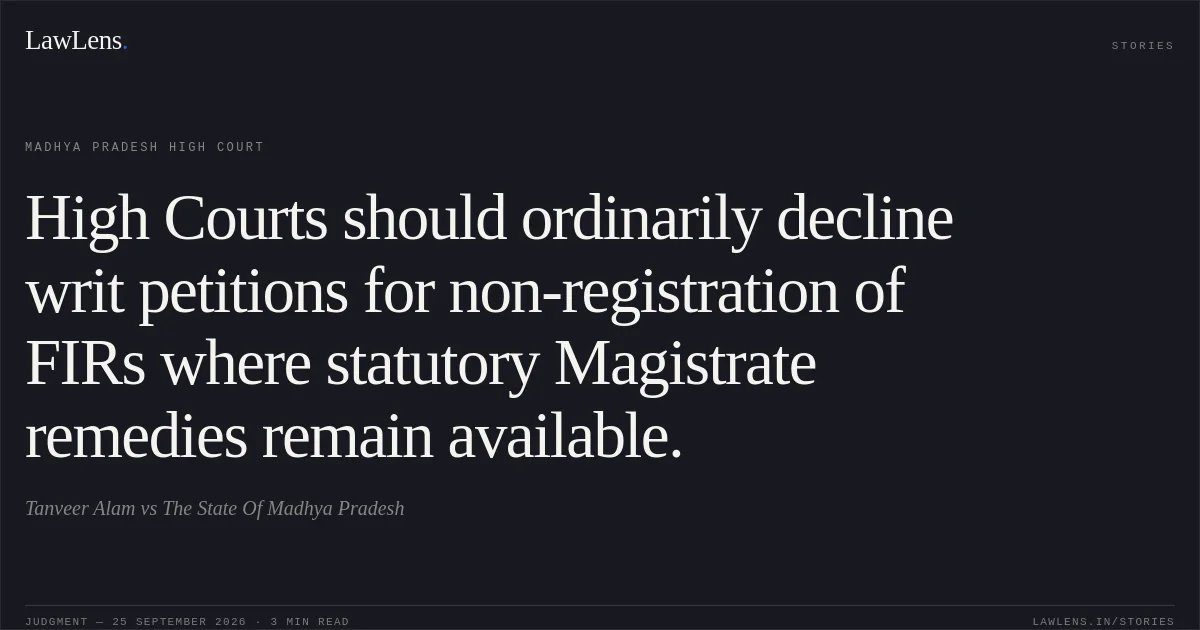
The High Court dismissed the writ petition on the ground that the petitioner had an alternative and efficacious remedy under the Cr.P.C./B.N.S.S. for the alleged non-registration of the FIR or inadequate police action.
The Court declined to issue directions for implementation of the Tehsildar’s eviction order, observing that the petitioner could pursue the remedies available under the Madhya Pradesh Land Revenue Code.
Source reference: para. 9The petitioner was granted liberty to approach the competent Magistrate under the applicable provisions of the Cr.P.C./B.N.S.S. for redressal of his criminal grievance.
Source reference: para. 11Acts & Sections Cited
19 provisions across 3 statutes referred to in this judgment. Each provision opens on LawLens.
Code of Criminal Procedure, 1973
Bharatiya Nagarik Suraksha Sanhita, 20237
MP Land Revenue Code 19591
Original Court PDF
Tanveer AlamvsThe State Of Madhya Pradesh
Click to open original judgment
Original judgment, available to read, download and summarize on LawLens.in