Facts
The State appealed an acquittal order dated 05.10.2013 passed by the Metropolitan Magistrate regarding an accident that occurred on 04.12.1995.
Source reference: p.2The prosecution alleged that the respondent, Ganga Sharan, drove a truck (UP-15D-9150) in a rash and negligent manner, hitting a scooter and running over the head of the rider, Pawan Kumar Jaiswal, causing his instant death.
Source reference: p.2PW3, the deceased's cousin, claimed to be an eyewitness who saw the truck being driven at high speed.
Source reference: p.6-7The trial court acquitted the accused under Section 255(1) Cr.P.C., leading to the present appeal.
Source reference: p.4Issues
1. Whether there is any legal infirmity in the trial court's judgment acquitting the accused of offences under Sections 279 and 304A of the IPC.
Source reference: p.5, para 122. Whether the mere allegation of "high speed" or "rough driving" is sufficient to establish criminal rashness or negligence.
Source reference: p.12, para 20Law Applied
The Court applied Section 279 IPC (rash driving) and Section 304A IPC (causing death by negligence), noting that the latter requires a direct causal link between the rash/negligent act and the death.
Source reference: p.9-10It relied on Naresh Giri v. State of Madhya Pradesh (2008), which mandates gross and culpable neglect or failure to exercise required care.
Source reference: p.10-11It followed State of Karnataka v. Satish (1998), establishing that "high speed" is a relative term and does not per se prove rashness or negligence; the prosecution must prove specific circumstances of reckless conduct.
Source reference: p.12The court also noted that the maxim res ipsa loquitur is generally not invoked to presume criminality in the absence of evidence.
Source reference: p.13Reasoning
The Court found the prosecution's evidence insufficient to prove the essential elements of rashness or negligence beyond a reasonable doubt. While PW3 identified the driver and stated the truck was at "high speed," the Court observed that "high speed" is relative and requires contextual details.
Source reference: p.12The prosecution failed to provide material evidence such as the width of the road, the density of traffic at the time, the exact position of the vehicles, or whether the accused was on the wrong side of the road.
Source reference: p.13-14The site plan (Mark X) was significantly silent on these crucial spatial details.
Source reference: p.13The Court noted that a statement given by the owner of the vehicle (PW2) identification of the driver under Section 133 of the MV Act is hit by the bar under Section 162 Cr.P.C. regarding statements made during investigation.
Source reference: p.14Ultimately, the court held that even if the identity of the driver was accepted, the lack of evidence regarding the manner of driving necessitated an acquittal.
Source reference: p.14Holding
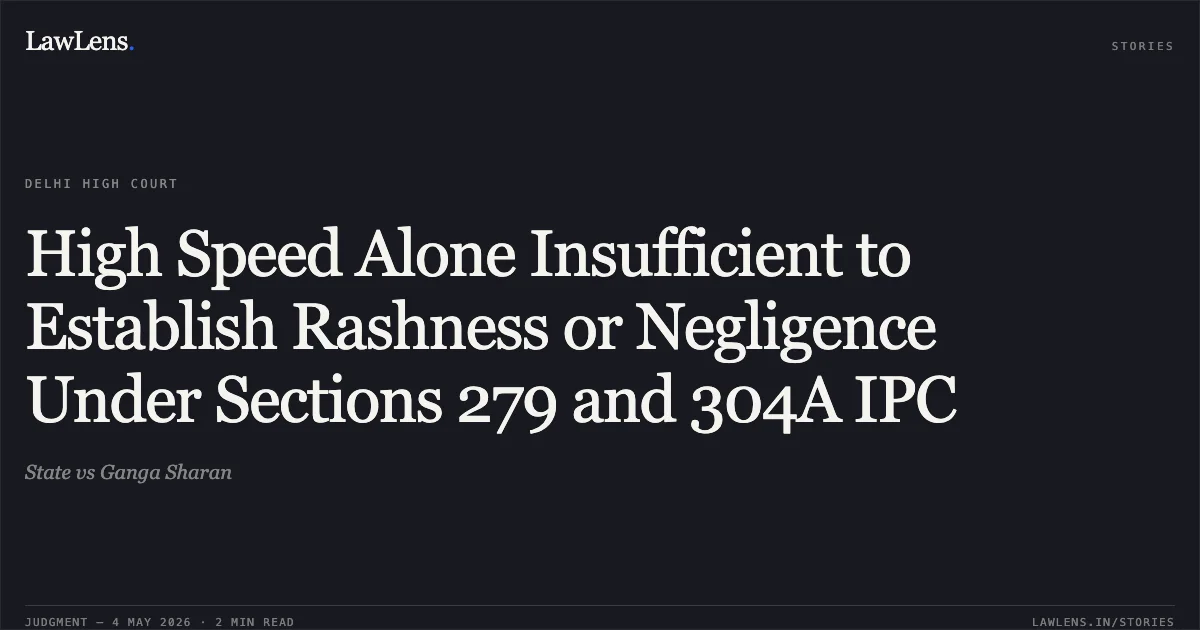
The Court answered the issues by holding that "high speed" alone cannot sustain a conviction under Sections 279/304A IPC without detailed evidence of the surrounding circumstances and the specific nature of the negligence.
The High Court dismissed the appeal and upheld the acquittal.
Source reference: p.14Acts & Sections Cited
12 provisions across 3 statutes referred to in this judgment. Each provision opens on LawLens.
Code of Criminal Procedure, 19737
Indian Penal Code, 18603
Motor Vehicles Act, 19882
Original Court PDF
StatevsGanga Sharan
Click to open original judgment
Original judgment, available to read, download and summarize on LawLens.in