Facts
On 3 November 2014 at approximately 7:00 a.m., the appellant was driving a private bus on the Durgabai Deshmukh Flyover, Chennai.
Source reference: p.2; paras. 3–4The prosecution alleged that the bus was driven at high speed and in a rash and negligent manner and collided with an autorickshaw proceeding ahead of it.
Source reference: p.2; paras. 3–4The autorickshaw driver sustained head and elbow injuries and subsequently died at the hospital.
Source reference: p.2; paras. 3–4The appellant was charged under Sections 279 and 304(ii) of the Indian Penal Code, 1860, and Section 185 of the Motor Vehicles Act.
Source reference: p.4; paras. 5–6The Trial Court held that the charges under Section 304(ii) IPC and Section 185 of the Motor Vehicles Act were not proved, but convicted the appellant under Sections 279 and 304-A IPC, sentencing him to six months’ simple imprisonment under Section 279 and one year’s simple imprisonment under Section 304-A, with a fine of ₹1,000.
Source reference: p.4; paras. 5–6The appellant challenged the conviction, contending that the prosecution had failed to independently establish rashness or negligence and that “high speed” alone was insufficient.
Source reference: pp.5–6; paras. 7–8Issues
Whether the prosecution proved beyond reasonable doubt that the appellant drove the bus rashly or negligently so as to attract liability under Sections 279 and 304-A IPC.
Source reference: pp.10–16; paras. 17–26Whether the evidence of the eyewitnesses, particularly the assertions that the bus was driven at “high speed,” was sufficient to establish the appellant’s rash or negligent driving and its causal connection with the deceased’s death.
Source reference: pp.13–16; paras. 21–26Law Applied
The Court applied Sections 279 and 304-A IPC, which respectively criminalise driving on a public way in a rash or negligent manner endangering human life and causing death by a rash or negligent act not amounting to culpable homicide.
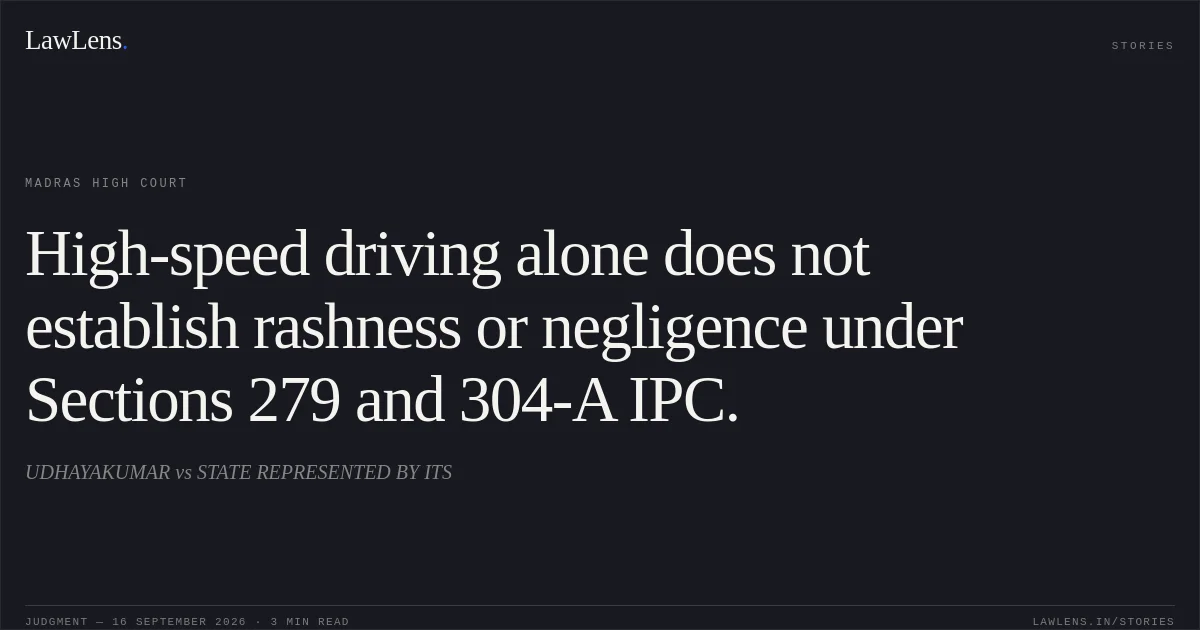
Source reference: p.10; para. 17Relying on State of Karnataka v. Satish, (1998) 8 SCC 493, the Court held that “high speed” is a relative expression and that speed alone does not establish rashness or negligence; the prosecution must prove the specific rash or negligent conduct beyond reasonable doubt.
Source reference: pp.10–11; para. 18The Court also relied on Ravi Kapur v. State of Rajasthan, (2012) 9 SCC 284, recognising that negligence may be inferred from attendant circumstances or circumstantial evidence, including the doctrine of res ipsa loquitur, only where the accident is proved and the evidence excludes the possibility that the victim or a third party caused it.
Source reference: pp.11–12; para. 19The burden remained on the prosecution, consistent with the presumption of innocence.
Source reference: p.11; para. 18Reasoning
The Court found that PW1’s evidence did not reliably establish the manner of driving because, in cross-examination, he admitted that he had not noticed which side of the road the autorickshaw was using and had not stated the approximate speed of the bus.
Source reference: pp.13–14; paras. 21–22The rough sketch showed a bifurcation near the place of the accident, making it necessary for the prosecution to establish the position and conduct of the autorickshaw immediately before the collision; that evidence was absent.
Source reference: p.14; para. 22PW2’s testimony that the bus overtook him at high speed and struck the autorickshaw did not specifically describe rash or negligent driving and was inconsistent with PW1’s account regarding the relative positions of the bus, car, two-wheeler, and autorickshaw.
Source reference: pp.14–15; para. 23The absence of mechanical defects in the vehicles did not, by itself, prove negligent driving by the appellant.
Source reference: p.15; paras. 24–25The Trial Court had therefore impermissibly inferred negligence merely from the alleged high speed and the fact that the accident occurred on a one-way bridge.
Source reference: p.15; paras. 24–25Since no independent and cogent evidence established the appellant’s rash or negligent act as the cause of the accident, the prosecution failed to prove the essential ingredients of Sections 279 and 304-A IPC beyond reasonable doubt.
Source reference: p.16; para. 26Holding
The High Court allowed the appeal and set aside the appellant’s conviction and sentences under Sections 279 and 304-A IPC.
It held that mere high-speed driving, without proof of a specific rash or negligent act causing the accident, was insufficient for conviction.
Source reference: p.16; para. 27The appellant was acquitted of all charges; any bail bond was cancelled and any fine paid was directed to be refunded.
Source reference: p.16; para. 27Acts & Sections Cited
7 provisions across 3 statutes referred to in this judgment. Each provision opens on LawLens.
Code of Criminal Procedure, 19734
Indian Penal Code, 18602
Motor Vehicles Act, 19881
Original Court PDF
UDHAYAKUMARvsSTATE REPRESENTED BY ITS
Click to open original judgment
Original judgment, available to read, download and summarize on LawLens.in