Facts
The petitioner challenged the pendency of his statutory petition under Section 74 of the Chhattisgarh Town and Country Planning Act, 1973, concerning Development Permission No. 8519/P.L.131/1/Nagrani/2000/Raipur dated 9 October 2000, relating to Khasra Nos. 271/3, 271/5 and 271/6 situated at Village Tikrapara, Raipur.
Source reference: paras. 3–4The petitioner claimed an interest in Khasra No. 271/3 as a legal heir of Shyamkumari Pujari and alleged that the development permission had been obtained without the consent of all co-heirs or lawful owners.
Source reference: para. 3On 20 May 2026, the petitioner filed a statutory petition under Section 74 before the Special Secretary, Housing and Environment Department, along with an application under Section 5 of the Limitation Act for condonation of delay.
Source reference: paras. 3–4The authority had only called for a report from the Director, Town and Country Planning, by letter dated 29 May 2026, and had not issued notice to the affected parties or proceeded to decide the matter.
Source reference: para. 4The petitioner therefore invoked Articles 226 and 227 of the Constitution seeking expeditious consideration and disposal of the statutory petition and the delay-condonation application.
Source reference: paras. 3–4Issues
Whether the competent authority should be directed to consider and decide the petitioner’s statutory petition under Section 74 of the Chhattisgarh Town and Country Planning Act, 1973, along with the application for condonation of delay?
Source reference: paras. 2–4Whether such consideration must take place after notice and opportunity of hearing to all affected persons, without the High Court expressing any opinion on maintainability or merits?
Source reference: para. 6Law Applied
The Court applied Section 74 of the Chhattisgarh Town and Country Planning Act, 1973, which provides the statutory remedy invoked by the petitioner, and Section 5 of the Limitation Act, under which delay-condonation was sought.
Source reference: paras. 3–4The Court exercised its supervisory and constitutional jurisdiction under Articles 226 and 227 of the Constitution to ensure that the competent statutory authority considers and decides a pending proceeding.
Source reference: no citationThe governing procedural principle was that affected parties must receive prior notice and an opportunity of hearing before an order affecting their interests is passed.
Source reference: para. 6The Court also recognised that questions of maintainability and merits were matters for the statutory authority in the first instance, and therefore refrained from adjudicating them.
Source reference: para. 6Reasoning
The Court noted that the petitioner had invoked the statutory remedy on 20 May 2026, but the competent authority had not yet taken effective steps to decide either the Section 74 petition or the accompanying application for condonation of delay.
Source reference: paras. 3–4Since the writ petition sought only a direction for consideration and disposal, and not adjudication of the validity of the development permission on merits, the Court considered it appropriate to direct the authorities to process the matter in accordance with law.
Source reference: para. 6To protect procedural fairness, the authority was required to issue prior notice to all affected persons, specifically including respondent No. 6, and to decide both maintainability and merits independently.
Source reference: para. 6Holding
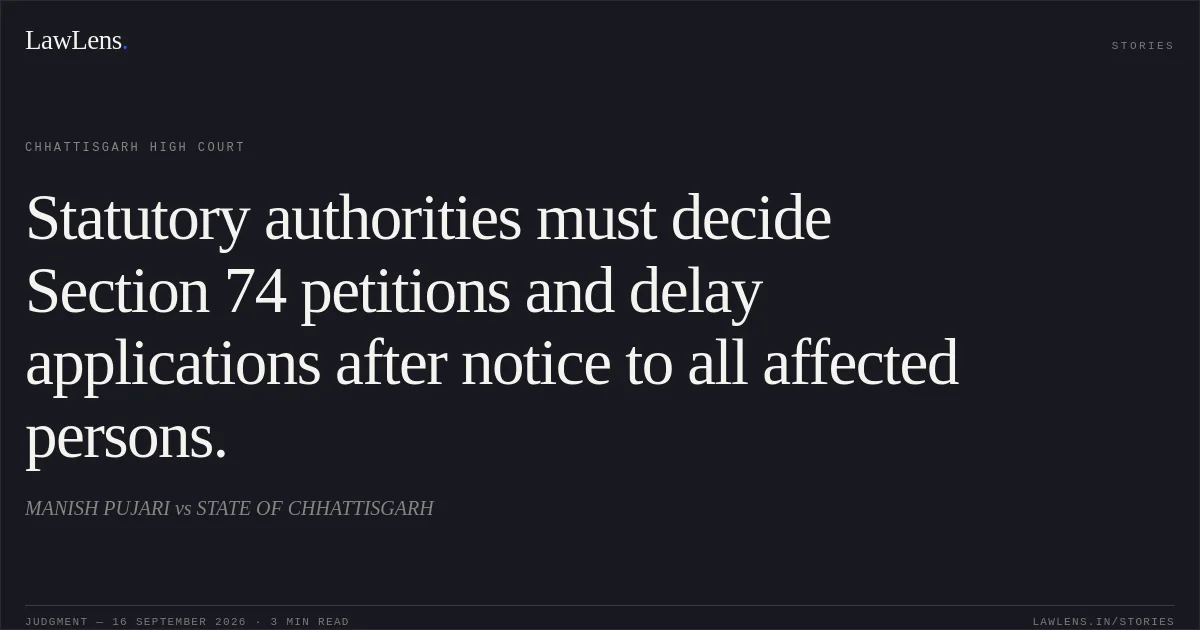
The writ petition was disposed of with a direction to the competent respondent authority to consider and decide the petitioner’s Section 74 statutory petition, along with the application for condonation of delay, after issuing prior notice to all affected persons and providing them an opportunity of hearing.
The authority was left free to decide maintainability and merits in accordance with law, and the High Court expressed no opinion on either issue.
Source reference: para. 6The entire exercise was directed to be completed within 90 days from the date of receipt of a copy of the order.
Source reference: para. 7The petition was accordingly disposed of, with liberty to respondents who had approached the Court without filing vakalatnama to appear before the competent authority.
Source reference: paras. 8–9Acts & Sections Cited
1 provisions across 1 statute referred to in this judgment. Each provision opens on LawLens.
Limitation Act, 19631
Original Court PDF
MANISH PUJARIvsSTATE OF CHHATTISGARH
Click to open original judgment
Original judgment, available to read, download and summarize on LawLens.in
![Non-submission of online self-appraisal cannot automatically disqualify an employee from EPP financial upgradation.. Ashok Kumar Sahu vs Bharat Sanchar Nigam Limited. CAT - ['Jabalpur']. LawLens](/stories/thumbnails/non-submission-of-online-self-appraisal-cannot-automatically-disqualify-an-employee-from-e-211b98f9eb684a569412a8a970828971.webp)