Facts
The Himachal Pradesh Board of School Education ("the Board") issued a recruitment advertisement in 2016 for the post of Computer Hardware Engineer
Source reference: para. 5The essential qualifications prescribed were a B.E./B.Tech degree and "at least 5 years’ experience in computer manufacturing/maintenance from a company of repute," with a preference for candidates holding an M.Tech degree
Source reference: para. 5The appellant (Himakshi) possessed an M.Tech but had only one year of experience
Source reference: para. 6Respondent No. 1 (Rahul) possessed approximately six years of experience but scored lower marks than Himakshi
Source reference: para. 7The Board selected Himakshi based on her merit and higher qualification
Source reference: para. 8Rahul challenged the selection before the Tribunal (later transferred to the High Court).
Source reference: para. 13A Single Judge initially set aside the selection but later restored it on review, citing the Board's power to relax experience requirements for well-qualified candidates under the Recruitment and Promotion (R&P) Rules
Source reference: para. 13The Division Bench subsequently set aside Himakshi’s appointment, holding that she lacked essential experience and that no formal relaxation was recorded
Source reference: para. 14Issues
1. Whether a candidate lacking the essential five-year work experience could be selected based on a preferred higher academic qualification (M.Tech)
Source reference: para. 192. Whether the power of relaxation under the R&P Rules was validly exercised in favor of the selected candidate
Source reference: para. 193. Whether the selection and appointment of the appellant can be sustained on equitable grounds due to her length of service, and if not, whether the unsuccessful candidate is entitled to appointment
Source reference: para. 19Law Applied
The Court applied Rule 7 of the R&P Rules, which defines "minimum educational and other qualifications" as mandatory threshold conditions for recruitment
Source reference: para. 21It relied on Zahoor Ahmad Rather v. Sheikh Imtiyaz Ahmad, establishing that a higher qualification cannot substitute for a prescribed essential qualification unless specifically permitted by statute
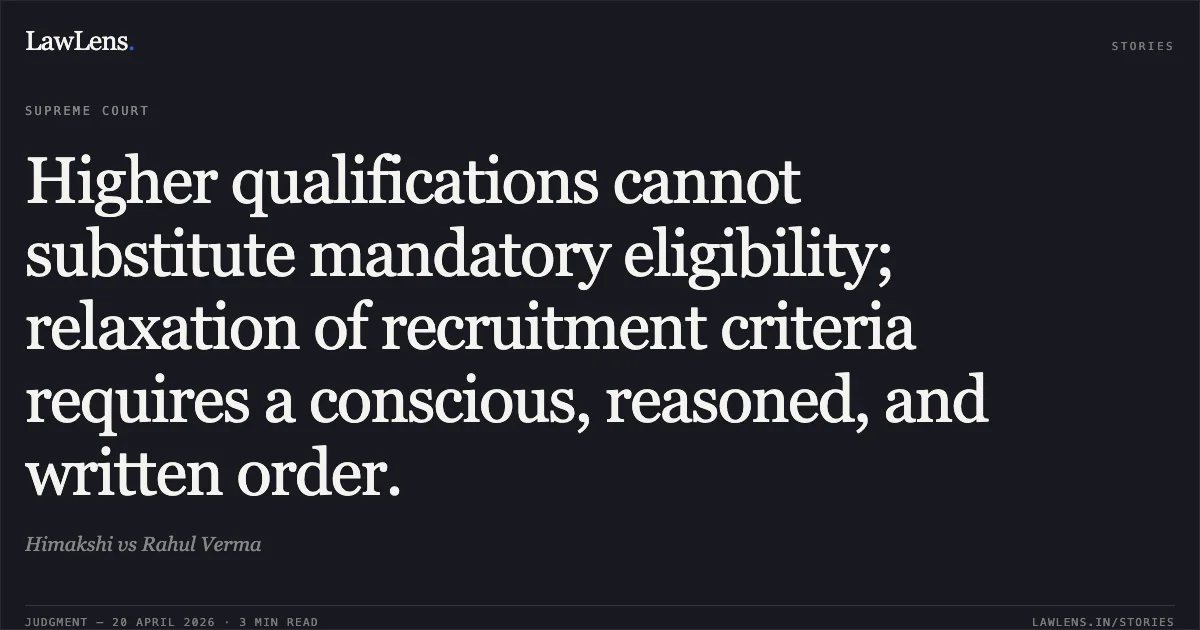
Source reference: para. 26Regarding the power of relaxation, the Court applied Rule 18 of the R&P Rules and the guidelines from Rekha Chaturvedi v. University of Rajasthan, which mandate that any relaxation of eligibility criteria must be a conscious, reasoned exercise recorded in writing
Source reference: para. 28, 35The Court considered the principles of equity in service matters from Ram Sarup v. State of Haryana and Buddhi Nath Chaudhary v. Abahi Kumar, noting that such relief is discretionary and depends on whether the eligibility defect is marginal or goes to the root of the appointment
Source reference: para. 43-44Reasoning
The Court observed that "experience" was an essential threshold condition under Rule 7, and the term "minimum" indicated it could not be bypassed by comparative merit or higher academic degrees
Source reference: para. 23, 25It clarified that "preference" for M.Tech holders only applies when candidates are otherwise eligible and at par in merit; it does not enlarge the zone of eligibility
Source reference: para. 24Although Rule 18 granted a power to relax experience requirements, the Court found—after reviewing the Board's records—that no such power was ever formally exercised or reasoned in writing
Source reference: para. 33-34The selection was thus made without due application of mind to the candidate’s ineligibility
Source reference: para. 38The Court distinguished this case from precedents where long service protected irregular appointments, noting that Himakshi’s lack of experience was a fundamental defect involving specialized external experience that could not be "cured" by serving in the post itself
Source reference: para. 48Furthermore, the Court refused to appoint Rahul, noting that the entire selection process was flawed as the eligibility of all candidates was not rigorously scrutinized at the threshold
Source reference: para. 52-53Holding
The Supreme Court dismissed both appeals and upheld the Division Bench's judgment setting aside Himakshi's appointment
(i) an essential qualification cannot be substituted by a preferential higher qualification
Source reference: para. 38(ii) the power of relaxation must be exercised consciously with recorded reasons, which was absent here
Source reference: para. 39(iii) equitable relief could not be granted because the eligibility defect went to the "root of the matter"
Source reference: para. 48The Court declined to direct the appointment of Rahul, finding no indefeasible right to appointment in a vitiated process
Source reference: para. 51, 54The Board was granted liberty to issue a fresh advertisement for the post in accordance with the R&P Rules
Source reference: para. 58Original Court PDF
HimakshivsRahul Verma
Click to open original judgment
Original judgment, available to read, download and summarize on LawLens.in