Facts
The petitioner participated in a public auction for Plot No. 1094/1, Sector 6, Gandhinagar, held on 17.10.2003, and was declared the highest bidder with a bid of Rs. 6,235/- per sq. mtr. against an upset price of Rs. 4,175/-
Source reference: p. 3The District Collector rejected the bid on 13.04.2004, stating that the price fetched was lower than similar plots in nearby sectors, causing financial loss to the Government
Source reference: p. 4An initial writ petition (SCA No. 16449/2005) was withdrawn to make a departmental representation
Source reference: p. 5After obtaining documents via RTI in 2008, the petitioner filed a representation in 2010, which was rejected by the Collector on 08.09.2010. This rejection was upheld by the Secretary (Appeals), Revenue Department (SSRD) on 11.03.2011
Source reference: p. 6Issues
1. Whether the principle of res judicata bars the present petition following the withdrawal of the earlier writ petition
Source reference: p. 182. Whether the Collector has the power to set aside a sale under Section 179 of the Bombay Land Revenue Code after the 30-day period prescribed for third-party applications
Source reference: p. 39-403. Whether a highest bidder acquires a vested right to the allotment of property in the absence of a concluded contract
Source reference: p. 23Law Applied
Sections 178 and 179 of the Bombay Land Revenue Code, 1879, which govern the setting aside and confirmation of sales; the proviso to Section 179 allows the Collector to set aside a sale suo motu for recorded reasons
Source reference: p. 40-41The court relied on Daryao v. State of U.P. [AIR 1961 SC 1457] and V.D. Barot v. State of Gujarat [(2002) 10 SCC 668] regarding the non-applicability of res judicata to withdrawn petitions
Source reference: p. 19-20The court further applied the principle that a highest bidder has no vested right to a contract until the bid is accepted and an allotment letter is issued, as established in HUDA v. Orchid Infrastructure Developers [(2017) 4 SCC 243] and Indore Vikas Praadhikaran v. Shri Humud Jain Samaj Trust [2024 SCC OnLine SC 3511]
Source reference: p. 24, 33-35Reasoning
The Court first resolved the procedural bar, holding that since the previous petition was withdrawn with liberty to file a representation and not decided on merits, res judicata does not apply
Source reference: p. 20-21On the merits, the Court observed that Section 178's 30-day limitation applies only to third-party applications; however, the Collector’s suo motu power under the proviso to Section 179 is not strictly time-bound, provided it is exercised within a reasonable time
Source reference: p. 41The Court found that the Collector's three-month window to reject the bid was reasonable
Source reference: p. 41Crucially, the Court held that the petitioner, as a mere highest bidder, lacked a "concluded contract" because the authority had not issued an allotment letter or formal acceptance
Source reference: p. 39The Court distinguished the petitioner's cited precedent (Rameshchandra B. Amin), noting that it involved a civil suit where evidence was led, whereas the current writ petition involved disputed questions of fact better suited for a civil court
Source reference: p. 22-23Finally, the petition was marred by delay, as the petitioner waited two years (2008 to 2010) to file her representation after receiving RTI documents
Source reference: p. 42Holding
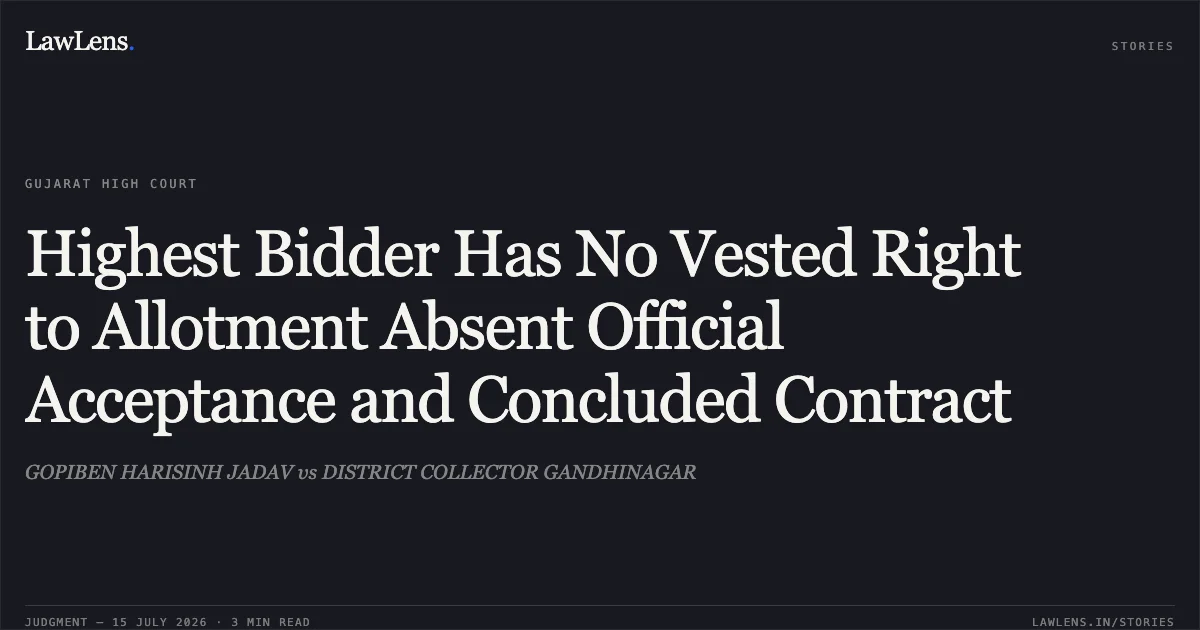
The Court answered the issues by holding that the petitioner had no vested right to the plot and the Collector was within his legal authority to reject the bid in the interest of the public exchequer
The petition was dismissed, and the Rule was discharged. The Court concluded that the discretionary writ jurisdiction under Article 226 could not be used to enforce a non-existent contract or resolve factual disputes regarding market valuation
Source reference: p. 23, 42-43Acts & Sections Cited
2 provisions across 1 statute referred to in this judgment. Linked provisions open on LawLens.
Right to Information Act, 20052
Original Court PDF
GOPIBEN HARISINH JADAVvsDISTRICT COLLECTOR GANDHINAGAR
Click to open original judgment
Original judgment, available to read, download and summarize on LawLens.in