Facts
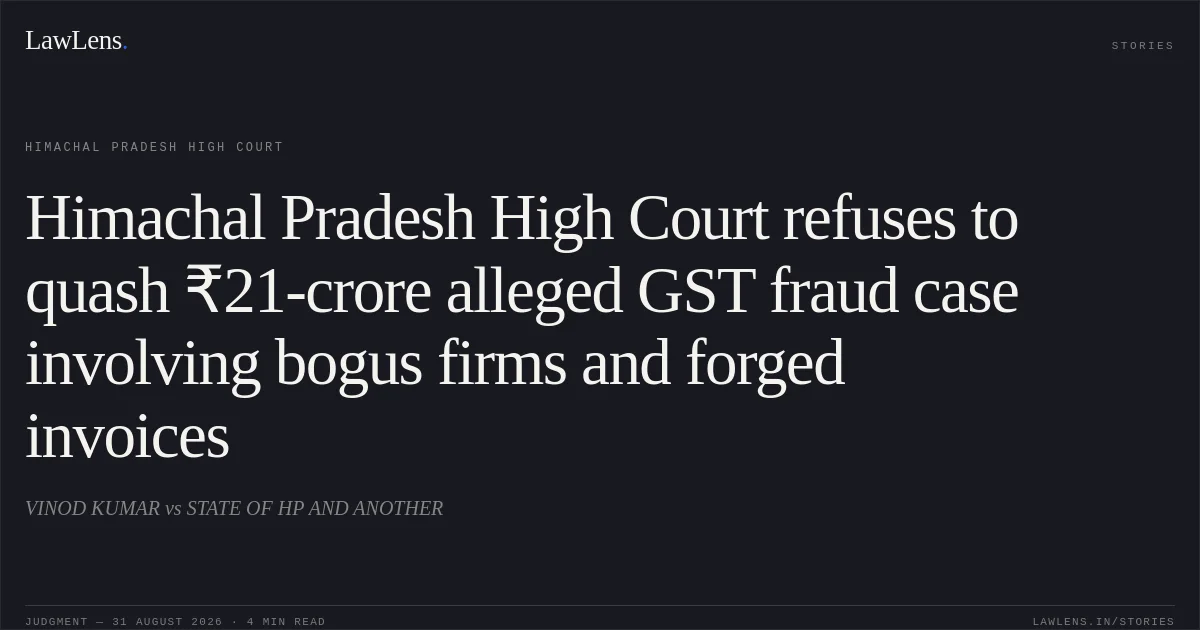
Respondent No. 2, a director of M/s Amba Shakti Ispat Limited, alleged that the petitioner, proprietor of M/s GT Iron Store and an agent engaged to arrange MS scrap supplies, introduced M/s Mahesh Trading Company and M/s Rajshree Trading Company as suppliers under agreements dated 1 April 2019 and 1 January 2021.
Source reference: paras. 2–4The petitioner allegedly supplied KYC documents, GST registrations, invoices, e-way bills, bilties and other documents to establish the suppliers’ genuineness.
Source reference: paras. 4, 20–21The company thereafter paid approximately ₹11.03 crore to M/s Mahesh Trading Company and ₹10.44 crore to M/s Rajshree Trading Company, while the petitioner received commission of approximately ₹6.05 lakh.
Source reference: paras. 4, 20–21Following a GST raid on 20 July 2021, the transactions and invoices were allegedly found to be bogus, resulting in ITC-related liabilities of approximately ₹1 crore and a further demand of ₹2.66 crore against the company.
Source reference: paras. 5, 21Although the agreements contained indemnity and contractual-remedy clauses, the petitioner allegedly failed to compensate the company and instead initiated proceedings before the NCLT for recovery of ₹1,22,08,204.
Source reference: paras. 5, 22–26An FIR dated 2 June 2022 was registered under Sections 420, 406 and 120-B IPC, corresponding to Sections 318(4), 316(2) read with Section 61(2) BNS. The petitioner invoked Section 528 BNSS, corresponding to Section 482 CrPC, seeking quashing of the FIR and consequential proceedings on the ground that the dispute was purely civil.
Source reference: paras. 1, 5–6Issues
Whether the allegations in the FIR, taken at face value, disclosed the ingredients of cheating, criminal breach of trust and criminal conspiracy, or merely constituted a contractual/civil dispute?
Source reference: paras. 31–37Whether the indemnity and contractual-remedy clauses barred or precluded criminal prosecution against the petitioner?
Source reference: paras. 24–29, 38–39Whether the High Court should exercise its inherent jurisdiction under Section 528 BNSS to quash the FIR and subsequent proceedings?
Source reference: paras. 8–15, 40–41Law Applied
The Court applied Section 528 BNSS, corresponding to Section 482 CrPC, which empowers the High Court to prevent abuse of the process of court and secure the ends of justice.
Source reference: paras. 8–15Relying on State of Karnataka v. L. Muniswamy, 1977 (2) SCC 699, and State of Haryana v. Bhajan Lal, 1992 Supp (1) SCC 335, the Court held that quashing is permissible where the allegations, even if accepted in entirety, do not constitute an offence, are inherently improbable, are legally barred, or constitute mala fide abuse of process.
Source reference: paras. 9–10, 14Vineet Kumar v. State of U.P. was relied upon for the principle that criminal proceedings must not become instruments of harassment or persecution.
Source reference: para. 10Prashant Bharti v. State (NCT of Delhi) and Rajiv Thapar v. Madan Lal Kapoor establish that quashing may be undertaken at different stages, but only where unimpeachable material conclusively demolishes the prosecution case.
Source reference: para. 11The Court also relied on Anand Kumar Mohatta v. State (NCT of Delhi) for the proposition that the High Court’s power under Section 482 CrPC extends even after investigation and filing of a charge-sheet.
Source reference: para. 13On the substantive offence of cheating, the Court applied Sections 415 and 420 IPC: deception and fraudulent or dishonest inducement must cause delivery or retention of property, and dishonest intention must exist at the inception of the representation or promise; a subsequent breach of contract alone does not constitute cheating.
Source reference: paras. 32–35Civil and criminal remedies may coexist where the allegations disclose fraud, cheating, forgery or conspiracy.
Source reference: paras. 29, 31Reasoning
The Court held that the allegations went beyond a mere failure to perform contractual obligations.
Source reference: no citationThe petitioner was alleged to have introduced two firms that were subsequently found to be bogus or non-existent and to have furnished KYC documents, GST registrations, invoices, e-way bills and related records to create an appearance of genuine transactions.
Source reference: paras. 20, 27–29, 36Since the petitioner acted as the agent responsible for arranging and managing the supplies, his alleged knowledge of the suppliers’ non-existence, coupled with the use of allegedly fabricated documents and the receipt of commission, prima facie indicated dishonest intention from the inception.
Source reference: paras. 33–36The alleged transactions involved more than ₹21 crore and reportedly facilitated wrongful ITC claims and loss to both the company and the public exchequer, thereby disclosing cognizable economic offences rather than a simple indemnity dispute.
Source reference: paras. 28–31, 36–37The indemnity clauses imposed contractual liability on the petitioner but expressly preserved other remedies available in law; they therefore did not immunise him from prosecution for alleged cheating, forgery or conspiracy.
Source reference: paras. 24–29, 39Whether the petitioner had actually conspired with the co-accused, and whether the ingredients of criminal breach of trust under Section 406 IPC were ultimately established, were matters for trial and could not be conclusively determined in a quashing petition.
Source reference: para. 37The allegations thus satisfied the prima facie threshold and did not fall within the Bhajan Lal categories warranting quashing.
Source reference: paras. 14–15, 40Holding
The Court answered the issues against the petitioner.
It held that the FIR prima facie disclosed offences under Sections 420, 406 and 120-B IPC, corresponding to Sections 318(4), 316(2) read with Section 61(2) BNS, and that the contractual indemnity provisions did not bar criminal prosecution for alleged fraudulent and criminal conduct.
Source reference: paras. 29–31, 40The petition under Section 528 BNSS was accordingly dismissed, and the FIR and consequential criminal proceedings were permitted to proceed to their logical conclusion before the competent court.
Source reference: para. 41The Court clarified that its observations were confined to disposal of the quashing petition and would not prejudice the merits of the trial.
Source reference: para. 42Acts & Sections Cited
15 provisions across 4 statutes referred to in this judgment. Each provision opens on LawLens.
Bharatiya Nagarik Suraksha Sanhita, 20231
Indian Penal Code, 18608
Bharatiya Nyaya Sanhita, 20233
Code of Criminal Procedure, 19733
Original Court PDF
VINOD KUMARvsSTATE OF HP AND ANOTHER
Click to open original judgment
Original judgment, available to read, download and summarize on LawLens.in