Facts
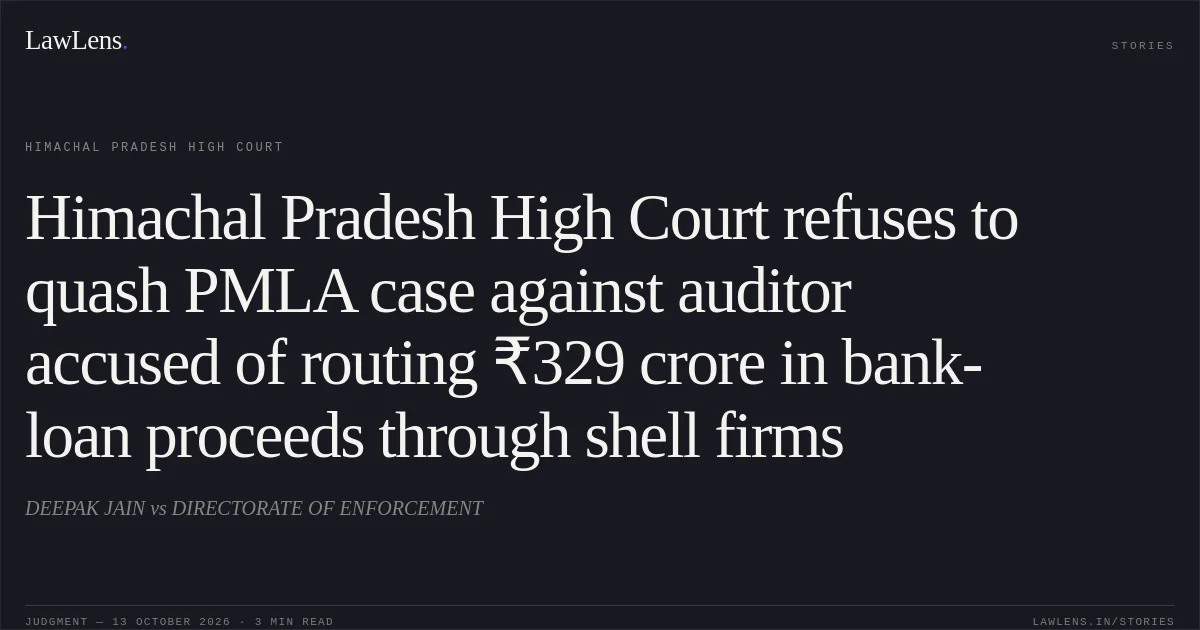
The Directorate of Enforcement filed a complaint under Sections 3 and 4 of the Prevention of Money Laundering Act, 2002 (PMLA), alleging that Indian Technomac Company Limited (ITCOL) fraudulently obtained bank loans and routed funds through shell companies.
Source reference: paras. 2, 13–19The petitioner was alleged to have controlled or beneficially owned entities that received approximately ₹329.16 crore from ITCOL, layered and transferred the funds, and charged commission; he was also alleged to have acted as auditor for family-linked companies involved in the transactions.
Source reference: paras. 2, 13–19The petitioner sought quashing of the complaint under Section 482 CrPC, contending, among other things, that he was not an accused in the scheduled-offence FIRs, had no role in the transactions, and could not be prosecuted under Section 70 PMLA; he also raised a temporal objection concerning the scheduled offences. The Special Court had taken cognizance of the complaint.
Source reference: paras. 8–12Issues
Whether the complaint disclosed a prima facie case of money laundering against the petitioner, although he was not named as an accused in the scheduled-offence FIRs.
Source reference: paras. 25–27, 33–36Whether the allegations and material concerning the petitioner’s alleged role as an auditor and facilitator of transactions through shell companies justified prosecution under Sections 3 and 70 PMLA, or warranted quashing under Section 482 CrPC.
Source reference: paras. 22–24, 37–49Whether the proceedings should be quashed on the petitioner’s contention that the relevant scheduled offences were not included in the PMLA Schedule during the period of the alleged conduct.
Source reference: para. 10Law Applied
Section 3 PMLA criminalises a person’s direct or indirect attempt, knowing assistance, participation, or actual involvement in a process or activity connected with proceeds of crime, including concealment, possession, acquisition, use, or projection or claiming as untainted property; its Explanation treats such activity as continuing while the person continues to enjoy the proceeds in the specified ways.
Source reference: paras. 34–36Section 70(1) addresses persons in charge of and responsible for a company’s business, while Section 70(2) extends liability to a director, manager, secretary, or other officer where the contravention is attributable to that person’s consent, connivance, or neglect.
Source reference: paras. 37–39Relying on *Pavana Dibbur v. Directorate of Enforcement* and *Pradeep Nirankarnath Sharma v. Directorate of Enforcement*, the Court held that a person who assists in dealing with proceeds of crime after the scheduled offence may be prosecuted under the PMLA even if not an accused in that offence, provided the scheduled offence exists.
Source reference: para. 36Under *Neeharika Infrastructure Pvt. Ltd. v. State of Maharashtra*, the High Court’s quashing power is to be exercised sparingly; it should not assess the reliability of allegations at the threshold.
Source reference: paras. 50–51Reasoning
The Court considered the complaint and investigation material to disclose specific allegations that the petitioner’s entities received funds from ITCOL, routed them through other entities, and returned some amounts to ITCOL as purported capital investment; it also noted the alleged commission and the petitioner’s statements recorded under Section 50 PMLA.
Source reference: paras. 17–19, 45–47It held that absence from the predicate-offence FIRs did not, by itself, preclude prosecution under Section 3, since the alleged assistance in layering or using proceeds could occur after the scheduled offence.
Source reference: para. 36The Court further found that the petitioner’s asserted role as auditor did not justify quashing: it treated him, at least prima facie, as an “other officer” for Section 70(2), and considered the alleged transactions and his relationship to the companies sufficient to require examination at trial.
Source reference: paras. 40–47Given the seriousness of the allegations and the limits on threshold review under Section 482 CrPC, the Court declined to determine the petitioner’s factual defences at this stage.
Source reference: paras. 48–52Although the petitioner raised a temporal objection concerning the Schedule, the judgment did not separately analyse that contention in its reasons for dismissal.
Source reference: para. 10; paras. 48–53Holding
The Court held that the petitioner had not established a legally sustainable basis to quash the PMLA complaint at the preliminary stage.
It dismissed the petition, leaving the allegations and the petitioner’s culpability to be determined in the pending proceedings; any pending applications were also disposed of.
Source reference: paras. 52–54Acts & Sections Cited
10 provisions across 3 statutes referred to in this judgment. Each provision opens on LawLens.
Code of Criminal Procedure, 19731
Prevention of Money-Laundering Act, 20027
Companies Act, 20132
Original Court PDF
DEEPAK JAINvsDIRECTORATE OF ENFORCEMENT
Click to open original judgment
Original judgment, available to read, download and summarize on LawLens.in