Facts
O.S. No. 205 of 2022 was instituted to challenge a notice convening a Society general-body meeting on 4 May 2022 and to restrain the meeting and election.
Source reference: para. 2After the meeting and election took place, the plaint was amended to seek declarations that the meeting and election were null and void.
Source reference: paras. 2–4The original plaintiff died, and other members continued the suit.
Source reference: paras. 2–4During trial, S. Vaikunda Rajan, who had already testified as P.W.2, sought impleadment as a plaintiff; the trial court allowed his application, prompting C.R.P.(MD) No. 343 of 2026.
Source reference: paras. 9–11In C.R.P.(MD) No. 468 of 2026, certain defendants challenged the refusal to dismiss the suit as infructuous, arguing that the elected body’s three-year tenure had expired and a further election had been held in 2025.
Source reference: paras. 17–19, 35–36Issues
Whether Vaikunda Rajan, in the circumstances of the case, could be impleaded as a plaintiff in the pending suit despite the objection that he had been removed from Society membership and had applied at a late stage.
Source reference: paras. 9–11, 32–38Whether the suit had become infructuous because the challenged meeting and election had occurred, the elected body’s tenure had expired, and a subsequent election had been held.
Source reference: paras. 17–19, 39–42Law Applied
Order I Rule 10(2) CPC permits impleadment where a person is a necessary or proper party to the effective adjudication of the dispute.
Source reference: no citationSection 151 CPC preserves the court’s inherent power to take account of subsequent events and dispose of litigation that has genuinely become infructuous, provided no provision of the Code prohibits that course; Shipping Corporation of India v. Machado Brothers, (2004) 11 SCC 168, was cited for this principle.
Source reference: para. 20The Court also relied on its earlier order in the same litigation, which treated the challenge to the Society meeting and election as a common cause available to aggrieved members.
Source reference: para. 36Section 55 of the Tamil Nadu Societies Registration Act, 1975, was raised in argument concerning defects in Society proceedings, but the Court did not rely on it to determine these revisions.
Source reference: paras. 13–15The authorities cited on infructuous litigation were distinguished on the facts.
Source reference: para. 42Reasoning
On impleadment, the Court considered that Vaikunda Rajan was a Society member when he sought to join the proceedings, had already testified in support of the Society-related challenge, and was not asserting an independent personal cause.
Source reference: paras. 36–38His removal from membership was itself disputed and its validity could be determined at trial.
Source reference: paras. 36–38In light of the earlier ruling that the challenge concerned a common cause of members, the Court found no sufficient basis to disturb the trial court’s decision to implead him.
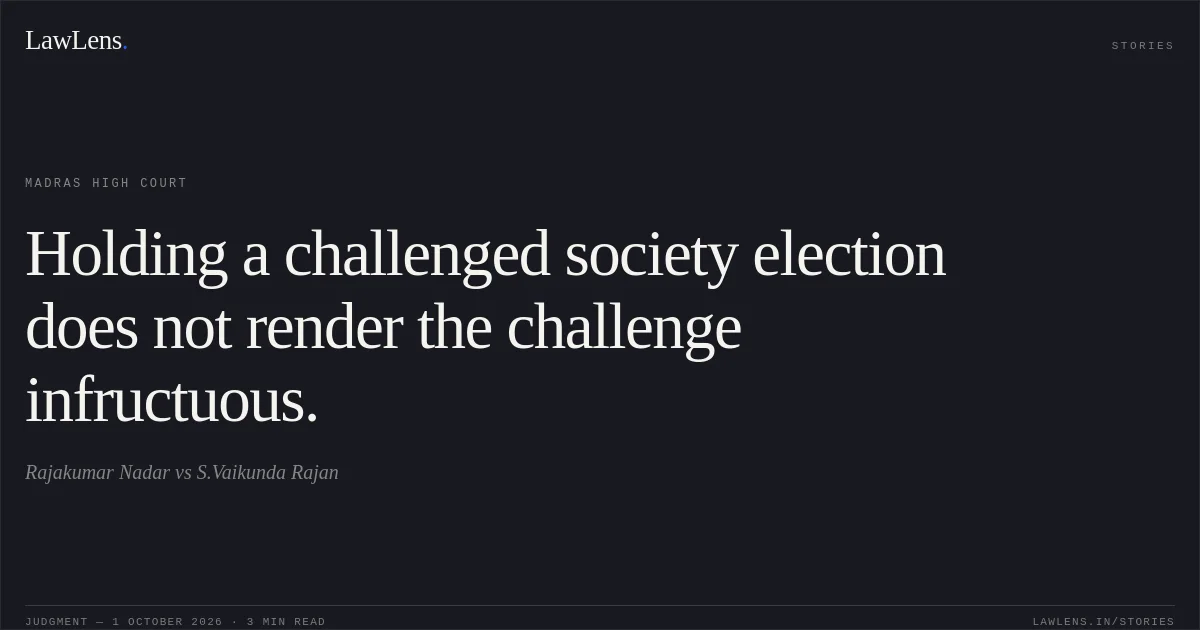
Source reference: paras. 36–38On infructuousness, the subsequent holding of the meeting and election did not resolve the plaintiffs’ substantive challenge to their validity.
Source reference: paras. 39–42The later election and expiry of the elected body’s tenure therefore did not, by themselves, extinguish the live questions in the amended suit.
Source reference: paras. 39–42Holding
Both civil revision petitions were dismissed.
The order allowing Vaikunda Rajan’s impleadment was upheld, and the Court declined to dismiss the suit as infructuous.
Source reference: paras. 38, 42, 45The trial court was directed to allow the plaintiffs to carry out the amendment and file the amended plaint within 14 days; to complete pleadings and, if necessary, frame additional issues within one month thereafter; and then to proceed day-to-day and dispose of the suit within three months.
Source reference: paras. 43–45The trial court could impose appropriate costs for unnecessary or frivolous applications.
Source reference: paras. 43–45Acts & Sections Cited
2 provisions across 1 statute referred to in this judgment. Each provision opens on LawLens.
Code of Civil Procedure, 19082
Original Court PDF
Rajakumar NadarvsS.Vaikunda Rajan
Click to open original judgment
Original judgment, available to read, download and summarize on LawLens.in