01Facts
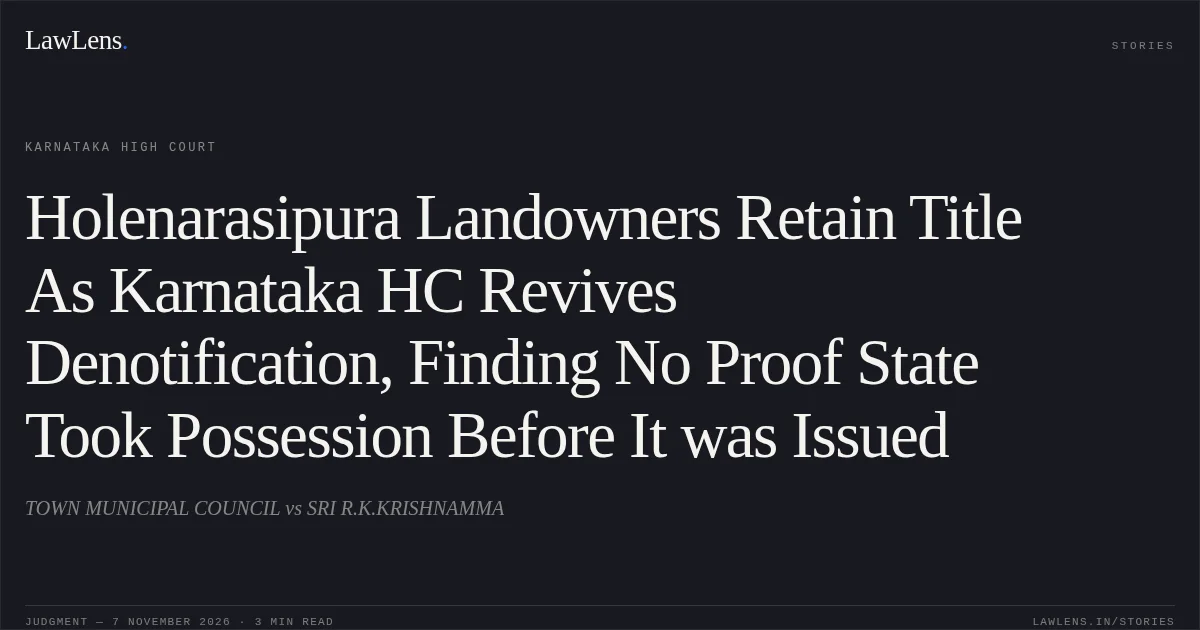
In 1996, the State acquired 87.23 acres at Dakshinanala Village for a residential layout under the Ashraya Scheme. The authorities relied on correspondence, acknowledgments and revenue entries to assert that possession had been delivered to the Municipality in 1998. In 1999, however, the Municipality resolved to abandon the acquisition because compensation was expected to exceed the scheme’s available funding and alternative land was available. The State issued a notification under Section 48(1) of the Land Acquisition Act, 1894 (“1894 Act”) on 22 July 2000, withdrawing the lands from acquisition.
¶ 6–9After earlier proceedings, a Division Bench remitted the possession question to the Principal Secretary, who found that possession had been taken. The landowners successfully challenged that finding before a Single Judge; the State and Municipality appealed (Batch I).
¶ 13–17In Batch II, the Municipality appealed against a separate decision concerning a 2007 acquisition for road widening over part of the lands. The Single Judge had set aside the award insofar as it favoured the Municipality and permitted fresh acquisition and compensation under the Right to Fair Compensation and Transparency in Land Acquisition, Rehabilitation and Resettlement Act, 2013 (“2013 Act”).
¶ 46–49, 54–5602Issues
i.1. Whether the State and Municipality established that possession of the acquired lands had been taken before the Section 48(1) notification dated 22 July 2000, such that the Single Judge’s decision setting aside the Principal Secretary’s finding warranted interference.
¶ 29–30ii.2. Whether, given the finding on possession and the resulting effect of the denotification, the Municipality could claim ownership or compensation for the lands in the subsequent acquisition proceedings.
¶ 62–6403Law Applied
Section 16 of the 1894 Act provides for vesting of acquired land in the Government, free from encumbrances, upon the Collector taking possession after making the award; possession must be actual, though the appropriate method depends on the nature and circumstances of the land.
¶ 31–32A panchnama or mahazar may evidence possession, but no single form of documentation is an inflexible requirement; the evidence must demonstrate that possession was in fact taken.
¶ 33–35Mutation and RTC entries are fiscal records and do not, by themselves, prove actual possession for Section 16 purposes.
¶ 37The Court relied on *Balwant Narayan Bhagde v. M.D. Bhagwat*, (1976) 1 SCC 700; *Tamil Nadu Housing Board v. A. Viswam*, (1996) 8 SCC 259; and *Banda Development Authority v. Moti Lal Agarwal*, (2011) 5 SCC 394, concerning the nature and proof of possession.
¶ 31–34It also applied the doctrine of restitution, relying on *Union of India v. Pramod Gupta*, (2005) 12 SCC 1, to require return of compensation received by a party not entitled to it.
¶ 65The Court upheld liberty to undertake fresh acquisition under the 2013 Act.
¶ 55, 66Provisions in the judgment · 1 · Linked ones open on LawLens
KARNATAKA HIGH COURT ACT, 1961 Section 4
04Reasoning
The Court held that the correspondence directing delivery of possession, the acknowledgment of receipt and later official communications did not, without a mahazar or other contemporaneous evidence showing the act of taking possession, establish that possession had actually been taken. The absence of a Section 16(2) notification or mahazar was not conclusive by itself, but was material in the circumstances; the revenue entries could not cure the evidentiary gap.
¶ 35–37The Municipality’s 1999 resolution to abandon the acquisition, citing financial unviability and alternative land, was also inconsistent with its later assertion that possession had already been taken. Its 2007 resolution revoking the earlier one did not establish possession retrospectively.
¶ 38–42Accordingly, the State had not proved possession before the 2000 denotification. In Batch II, the Municipality therefore could not rely on the earlier acquisition or revenue entries to claim ownership or compensation for the landowners’ lands; any compensation it had received for those lands had to be returned under the restitution principle.
¶ 62–6505Holding
The Court dismissed W.A. No. 2631 of 2015 and the connected Batch-I appeals, and dismissed the Municipality’s W.A. No. 1496 of 2014 in Batch II.
Order, clauses (i)–(ii)It held that the State had failed to establish that possession was taken before the 22 July 2000 notification, which therefore stood revived.
¶ 62The State was at liberty to initiate fresh acquisition under the 2013 Act after identifying the rightful landowners and determining fair compensation. The Municipality was directed to return the deposited amount to the State, which was to disburse it to the landowners without delay.
Order, clauses (iii)–(iv)No order was made as to costs.
Order, clause (vi)Original Court PDF
TOWN MUNICIPAL COUNCILvsSRI R.K.KRISHNAMMA
Click to open original judgment
Original judgment, available to read, download and summarize on LawLens.in