01Facts
The respondent purchased the suit property under a registered sale deed dated 22 August 2016.
pp. 3–7The appellant had been a tenant of the vendor.
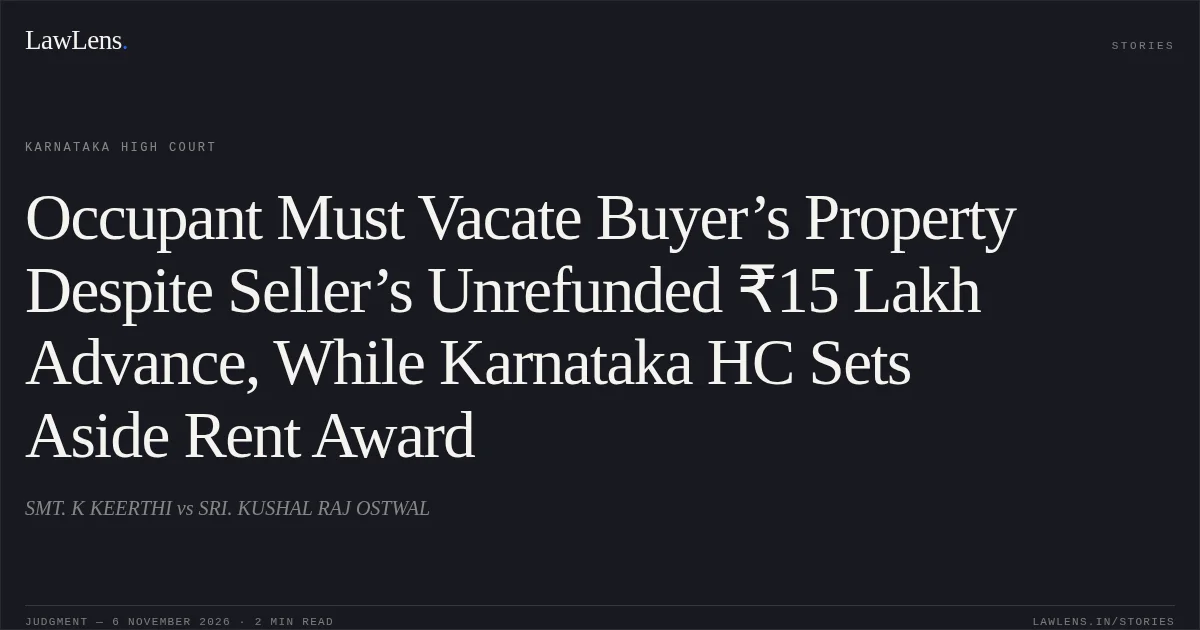
pp. 3–7A memorandum of understanding dated 19 July 2016 recorded that the vendor would refund her advance of ₹15 lakh and that she would vacate after the sale; the vendor did not refund the amount, and she remained in possession.
pp. 3–7The respondent sued for ejectment and monetary relief.
pp. 3–7The trial court ordered her to vacate and awarded arrears of rent.
pp. 3–7She appealed both the possession decree and the trial court’s treatment of her counterclaim concerning the advance.
pp. 3–702Issues
i.Whether the trial court was correct in directing the appellant to deliver vacant possession of the suit property to the respondent.
p. 10 · ¶ 14(i)ii.Whether the trial court could award arrears of rent to the respondent in the absence of a landlord–tenant relationship between them.
p. 10 · ¶ 14(ii)iii.Whether the trial court’s judgment and decree required appellate interference.
p. 10 · ¶ 14(iii)03Law Applied
The appeals were brought under Section 96 read with Order XLI Rules 1 and 2 of the Code of Civil Procedure.
p. 2It applied the principles that an owner may recover possession from a person whose continued occupation is permissive, and that rent cannot be awarded by a claimant who has no landlord–tenant relationship with the occupier.
pp. 11–13The court also observed that damages or mesne profits would have been the relevant claim for the respondent’s case, but that relief had not been sought in the plaint.
p. 13 · ¶ 18Provisions in the judgment · 1 · Linked ones open on LawLens
Code of Civil Procedure, 1908 Section 96
04Reasoning
The respondent’s registered purchase established his ownership, while the appellant’s tenancy had been with the former owner, not with the respondent.
pp. 11–13 · ¶ 15–17The court accepted that the respondent had permitted her to remain in possession; her continued occupation was therefore permissive, and the respondent was entitled to recover possession.
pp. 11–13 · ¶ 15–17But because the appellant was not the respondent’s tenant, the trial court could not award the respondent arrears of rent.
p. 13 · ¶ 18As the respondent had not claimed damages or mesne profits, the rent award could not be sustained.
p. 13 · ¶ 18Although one appeal challenged the treatment of the counterclaim for the advance, the judgment did not grant the appellant a refund or otherwise expressly determine that claim in its final order.
pp. 3, 6–7, 14–1505Holding
The appeals were allowed in part.
pp. 14–15 · ¶ 19The decree requiring the appellant to deliver vacant possession was confirmed, but the award of arrears of rent was set aside.
pp. 14–15 · ¶ 19The appellant was permitted four months from the date of judgment to hand over the property, including the furniture and dining table, and was directed to file an affidavit of undertaking within three weeks.
p. 15 · ¶ 19No costs were ordered.
p. 15 · ¶ 19Original Court PDF
SMT. K KEERTHIvsSRI. KUSHAL RAJ OSTWAL
Click to open original judgment
Original judgment, available to read, download and summarize on LawLens.in