01Facts
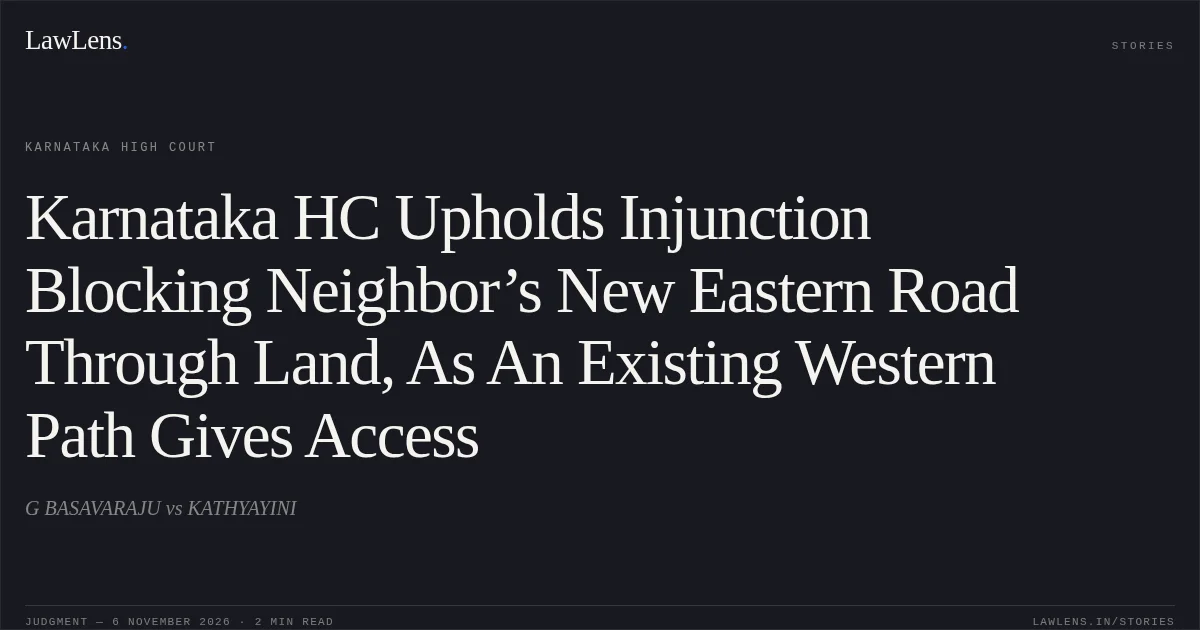
The original plaintiff, Shadakshari, sued for a permanent injunction concerning land in Sy. No. 29/5, claiming that the defendant was attempting to form a road through its eastern portion.
pp. 2–8, paras 2–6The defendant asserted a right of access by a pathway on the eastern side.
pp. 2–8, paras 2–6The Trial Court dismissed the suit, finding that the revenue records and village map showed pathways in the survey land and concluding that the plaintiff had not established entitlement to an injunction.
pp. 2–8, paras 2–6On the plaintiff’s appeal, the First Appellate Court reversed, finding evidence of a pathway on the western side and no acceptable evidence of one on the eastern side; it decreed the suit.
pp. 9–18, para 7The defendant appealed to the High Court under Section 100 CPC.
pp. 19, paras 8–902Issues
i.1. Whether the First Appellate Court was justified in reversing the Trial Court’s decree without assigning adequate reasons to overcome its findings
p. 19, para 8ii.2. Whether the evidence supported the finding that a pathway existed on the western side of the suit land, but not on its eastern side
pp. 20–22, paras 10–1303Law Applied
The appeal was governed by Section 100 CPC, under which the High Court considers a second appeal on a substantial question of law.
pp. 19, paras 8–9The Court’s reasoning applied the principle that a first appellate court may reverse a trial court’s decree where the trial court has overlooked material evidence and the appellate court gives an evidentiary basis for its contrary findings.
pp. 20–22, paras 10–13Provisions in the judgment · 2 · Linked ones open on LawLens
Code of Civil Procedure, 1908 Section 100Section 42
04Reasoning
The High Court found that the First Appellate Court had considered the plaintiff’s ownership, the sketch and revenue records, the village map, and the photographs.
pp. 20–21, paras 10–11Those materials supported its finding that a pathway existed west of the suit property and connected the defendant’s northern land to the main road to the south; the defendant had not established an eastern pathway.
pp. 20–21, paras 10–11The Trial Court had failed to appreciate material evidence concerning the western pathway and the defendant’s access to his land.
pp. 21–22, paras 12–13The High Court therefore held that the First Appellate Court was justified in interfering with the Trial Court’s decision.
pp. 21–22, paras 12–1305Holding
The Court answered the substantial question of law against the defendant-appellant, holding that the First Appellate Court was justified in reversing the Trial Court’s decree.
pp. 21–22, paras 13–14It dismissed the second appeal, leaving in place the decree restraining the defendant from illegally damaging the suit property, removing the fence, or forming a road there; the Court’s reasoning recognized the defendant’s use of the western pathway for access.
pp. 18–19, para 7 · p. 22, para 14Original Court PDF
G BASAVARAJUvsKATHYAYINI
Click to open original judgment
Original judgment, available to read, download and summarize on LawLens.in