01Facts
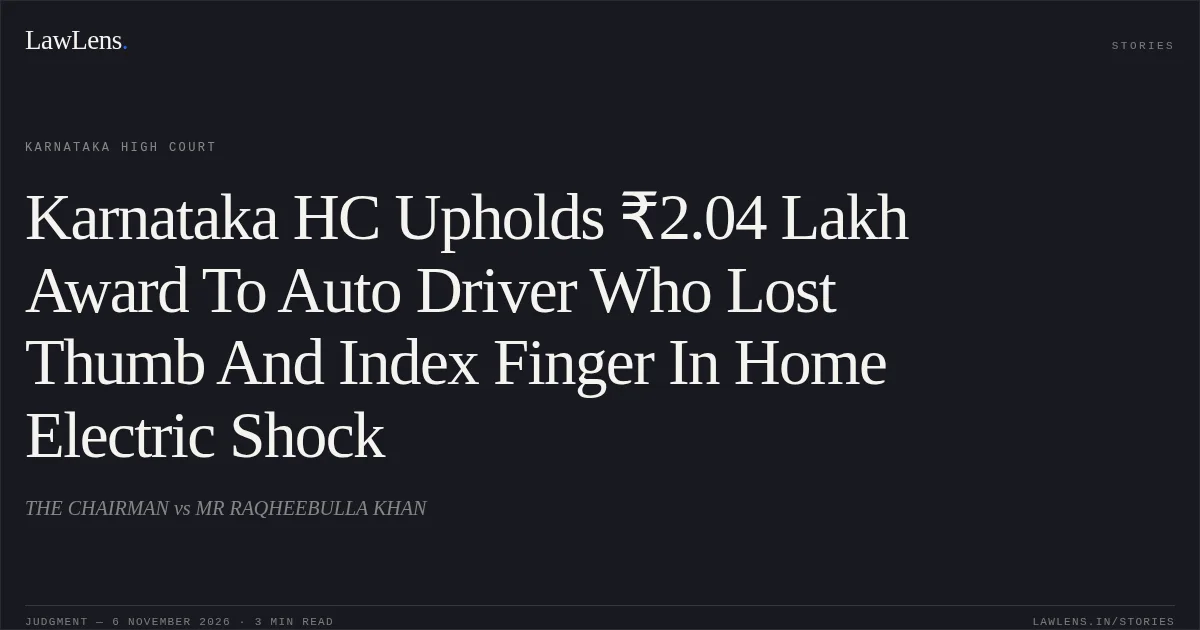
The plaintiff, an auto-rickshaw driver, suffered electrical burns and permanent injuries when an electrical incident occurred in his home on 18 April 2004.
pp. 2–5, 21The electricity authorities denied negligence, attributing the incident to a lorry striking an electric pole and contending that the plaintiff’s home lacked an MCB.
pp. 2–5, 21The trial court dismissed the compensation suit; on appeal, the first appellate court set aside that decision and awarded Rs. 2,04,503 with interest at 6% per annum from the date of suit, after deducting Rs. 44,000 already paid.
pp. 2–5, 21The electricity authorities challenged that decree in this regular second appeal.
pp. 2–302Issues
i.Whether the electricity authorities could avoid liability for the plaintiff’s injuries on the grounds that a lorry struck the electric pole and that the plaintiff’s home lacked an MCB.
pp. 10–15, 22–23ii.Whether the first appellate court’s findings on liability and compensation raised a substantial question of law warranting interference under Section 100 of the Code of Civil Procedure.
pp. 22–2303Law Applied
Under the doctrine of strict liability in Rylands v. Fletcher, a party that brings onto its land and keeps something likely to cause harm if it escapes is prima facie liable for the resulting damage, subject to recognized exceptions, including an unforeseeable act of a stranger.
pp. 12–13In Madhya Pradesh Electricity Board v. Shail Kumari, the Supreme Court applied strict liability to the hazardous activity of supplying electricity, holding that liability may arise irrespective of negligence.
pp. 11–14M.C. Mehta v. Union of India further established absolute liability for harm caused by an enterprise engaged in hazardous or inherently dangerous activity, without the exceptions applicable to strict liability.
p. 13Section 161 of the Electricity Act, 2003, and the applicable accident-intimation rules placed the reporting obligation on the relevant person or licensee responsible for the electrical lines or plant.
pp. 15–17A second appeal under Section 100 CPC requires a substantial question of law; the High Court also referred to Order XXXIII Rule 10 CPC regarding recovery of court fees from compensation awarded to an indigent plaintiff.
pp. 21–23Provisions in the judgment · 7 · Linked ones open on LawLens
Code of Civil Procedure, 1908 Section 100
Indian Penal Code, 1860 Section 279Section 337Section 427Section 176
Electricity Act, 2003 Section 161Section 176
04Reasoning
The High Court accepted the first appellate court’s findings that the plaintiff was injured by an electrical accident and that the electricity authorities were engaged in the inherently risky activity of supplying electricity.
pp. 10–14, 22The authorities’ reliance on the lorry’s collision with the pole and the alleged absence of an MCB did not, on the findings sustained by the High Court, establish an applicable defence to strict liability; the court also noted the authorities’ failure to ensure that the MCB installation remained intact.
pp. 14–15, 22–23The plaintiff’s failure to notify the Electrical Inspector did not defeat the claim because the relevant statutory reporting duty rested on the authorities, not the injured plaintiff.
pp. 15–17, 23The High Court found that the first appellate court had properly assessed the evidence and compensation, and that its factual findings disclosed no substantial question of law.
pp. 18–2305Holding
The High Court dismissed the regular second appeal, finding no substantial question of law warranting interference with the first appellate court’s decree.
pp. 22–23The award of Rs. 2,04,503, with interest at 6% per annum from 26 March 2008 until realization, therefore stood.
p. 21The decree also directed recovery of Rs. 33,375 in court fees from the compensation amount under Order XXXIII Rule 10 CPC.
p. 21Original Court PDF
THE CHAIRMANvsMR RAQHEEBULLA KHAN
Click to open original judgment
Original judgment, available to read, download and summarize on LawLens.in