01Facts
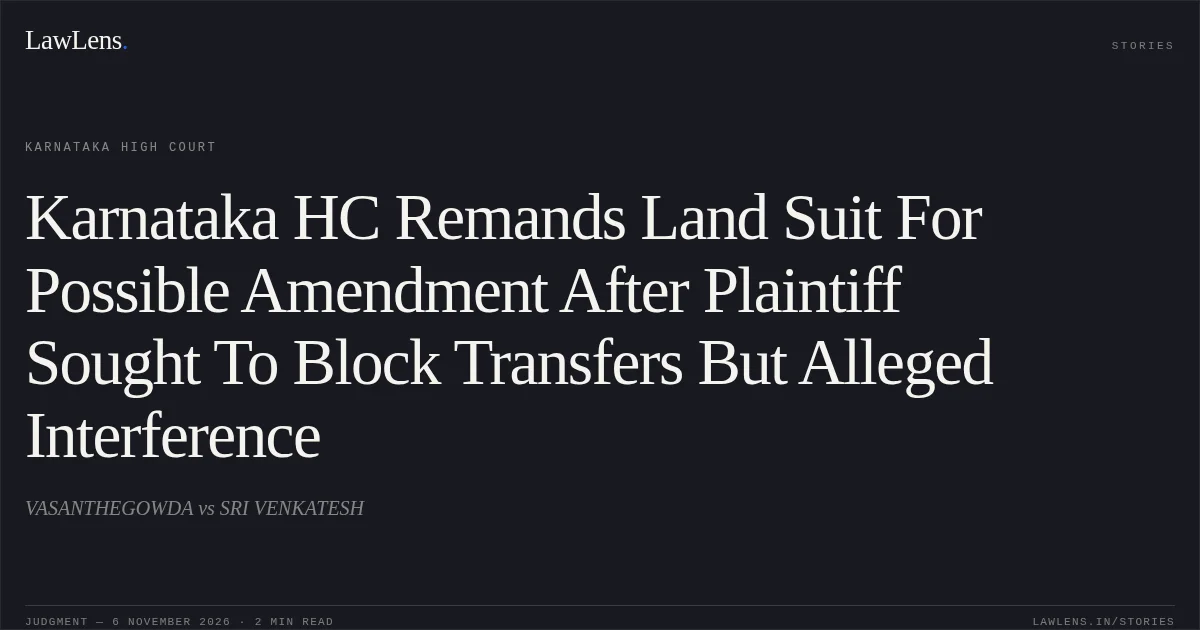
The original plaintiff sued the defendant, Vasanthegowda, seeking a permanent injunction restraining him from alienating or encumbering the suit property.
The plaint alleged interference with the plaintiff’s possession, but did not seek a specific injunction against such interference.
The Trial Court decreed the suit, and the First Appellate Court dismissed the defendant’s appeal and affirmed that decree.
pp. 3–5In the second appeal, the defendant challenged the grant of relief absent a specific prayer.
pp. 5–7The plaintiff’s legal representatives acknowledged the omission and sought remand to apply to amend the pleadings and relief; the defendant consented to remand, while reserving the right to oppose any applications.
pp. 5–702Issues
i.1. Whether the courts below were justified in granting an injunction against interference with the plaintiffs’ possession when the original suit sought an injunction against alienation and contained no specific prayer against interference.
pp. 6–7ii.2. Whether the judgments and decrees should be set aside and the matter remitted to the Trial Court to permit applications, including for amendment of the pleadings and prayers, to be considered according to law.
pp. 5–7, 8–903Law Applied
The appeal was before the High Court under Section 100 of the Code of Civil Procedure, 1908, and the Court framed a substantial question of law concerning the relief granted in relation to the prayer made in the suit.
p. 6The judgment states no substantive legal test or precedent governing the grant of an injunction without a corresponding prayer, and cites no case law.
pp. 7–9It leaves the parties’ contentions, including any applications to amend the pleadings or prayers, open for determination by the Trial Court in accordance with law.
pp. 7–9Provisions in the judgment · 1 · Linked ones open on LawLens
Code of Civil Procedure, 1908 Section 100
04Reasoning
The Court did not decide whether the courts below had erred in granting an injunction or express any view on the merits of the parties’ positions.
pp. 5–8Given the plaintiff’s representatives’ acknowledgment that the relevant prayer had been omitted, and the defendant’s lack of objection to remand while reserving the right to contest any applications, the Court considered it appropriate to set aside both decrees and remit the matter for fresh consideration.
pp. 5–8The Trial Court was left to decide any applications and the parties’ rival contentions according to law.
pp. 8–905Holding
The appeal was allowed; the First Appellate Court’s judgment and decree and the Trial Court’s judgment and decree were set aside, and the suit was remitted to the Trial Court for fresh consideration.
pp. 8–9Both parties were given liberty to file appropriate interlocutory applications, including applications to amend pleadings and prayers. The opposing party must have an opportunity to object, and all contentions were kept open.
p. 9The parties were directed to appear before the Trial Court on 7 December 2026, without awaiting further notice.
p. 9Original Court PDF
VASANTHEGOWDAvsSRI VENKATESH
Click to open original judgment
Original judgment, available to read, download and summarize on LawLens.in