Facts
On 7 October 2019, at approximately 3:30 p.m., Ronharam Rohidas proceeded towards a field carrying a tangi, sickle and rope.
Source reference: paras. 2, 14–20The prosecution alleged that appellants Suritram and Muritram, armed with a lathi, iron rod and tangi, assaulted him on the head near the field of Raghunath Rohidas, causing fatal head injuries.
Source reference: paras. 2, 14–20When Gorelal Rohidas intervened, the appellants allegedly assaulted him as well, causing simple injuries.
Source reference: paras. 2, 14–20The post-mortem disclosed a cut injury, skull fracture and intracranial haemorrhage; the medical officer opined that the death was homicidal and resulted from head and brain injuries.
Source reference: paras. 3, 11, 13The First Additional Sessions Judge, Katghora, convicted both appellants under Sections 302/34 and 323 of the IPC and sentenced them to life imprisonment for murder and six months’ rigorous imprisonment for voluntarily causing hurt, with the sentences to run concurrently.
Source reference: paras. 1, 5–7Issues
Whether the appellants’ conviction under Sections 302/34 of the IPC should be sustained, or whether the homicidal act was covered by Exception 4 to Section 300 IPC and therefore amounted to culpable homicide not amounting to murder punishable under Section 304 Part I read with Section 34 IPC?
Source reference: paras. 22, 29, 31Whether the conviction and sentence under Section 323 IPC for causing simple hurt to Gorelal Rohidas warranted interference?
Source reference: para. 30Law Applied
The Court applied Sections 302, 304 Part I, 323 and 34 of the IPC, together with Exception 4 to Section 300 IPC.
Source reference: paras. 26, 28Exception 4 applies where the death is caused without premeditation, in a sudden fight, in the heat of passion, and without the offender taking undue advantage or acting cruelly or unusually.
Source reference: paras. 26, 28Relying on Sukhbir Singh v. State of Haryana, the Court recognised that a culpable homicide committed during a sudden quarrel may fall under Section 304 Part I where the offender acted with intention but without the circumstances constituting murder.
Source reference: para. 23Gurmukh Singh v. State of Haryana was relied upon for the relevant sentencing factors, including motive, premeditation, intention or knowledge, nature of the weapon and injury, and the accused’s conduct.
Source reference: para. 24State v. Sanjeev Nanda and Arjun v. State of Chhattisgarh distinguish Section 304 Part I, involving intention to cause such bodily injury as is likely to cause death, from Section 304 Part II, involving knowledge without such intention.
Source reference: paras. 25–27Rambir v. State (NCT of Delhi) reaffirmed the four cumulative requirements of Exception 4.
Source reference: para. 28Reasoning
The Court found that the eyewitness testimony consistently established the presence and participation of both appellants, while the medical evidence corroborated the infliction of a fatal head injury and the homicidal nature of the death.
Source reference: paras. 11–21The testimony of injured witness Gorelal, supported by his medical examination, independently established that the appellants caused simple hurt to him during the occurrence.
Source reference: para. 30However, regarding the offence against Ronharam, the Court held that the existing land dispute did not, by itself, prove a premeditated design to commit murder.
Source reference: para. 29It further found no clear evidence that the appellants repeatedly assaulted the deceased after he had fallen or otherwise acted in a cruel or unusual manner.
Source reference: para. 29Applying Exception 4, the Court treated the occurrence as arising in the heat of the moment during a sudden altercation, without established premeditation or undue advantage.
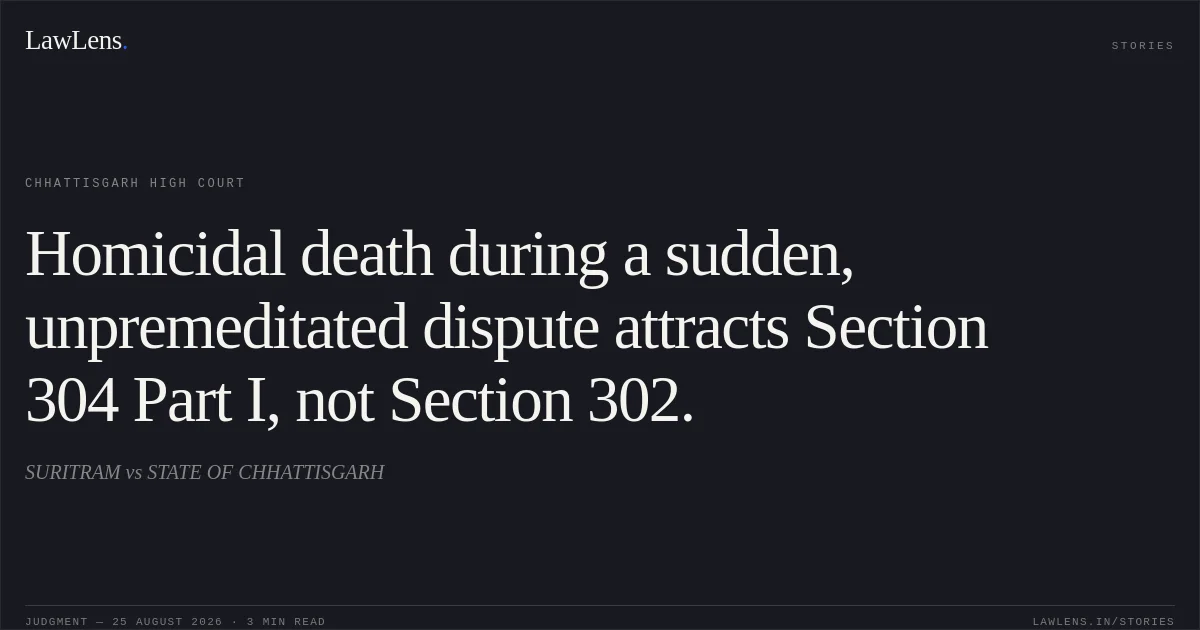
Source reference: para. 29Since the appellants’ participation and responsibility for the homicidal death were proved, but the case fell within Exception 4, the conviction was altered from Section 302/34 to Section 304 Part I read with Section 34 IPC.
Source reference: paras. 29, 31The conviction under Section 323 IPC was maintained because it was supported by the injured witness’s evidence and medical corroboration.
Source reference: para. 30Holding
The appeal was partly allowed.
The conviction of both appellants under Sections 302/34 IPC was set aside and altered to Section 304 Part I read with Section 34 IPC.
Source reference: para. 32Each appellant was sentenced to 10 years’ rigorous imprisonment and a fine of ₹5,000, with three months’ further rigorous imprisonment in default of payment of fine.
Source reference: para. 32Their conviction under Section 323 IPC and the corresponding sentence were maintained.
Source reference: para. 32Both sentences were directed to run concurrently, and the period already undergone in custody was ordered to be set off in accordance with law.
Source reference: paras. 32–33Acts & Sections Cited
9 provisions across 2 statutes referred to in this judgment. Linked provisions open on LawLens.
Code of Criminal Procedure, 19732
Indian Penal Code, 18607
Original Court PDF
SURITRAMvsSTATE OF CHHATTISGARH
Click to open original judgment
Original judgment, available to read, download and summarize on LawLens.in
![Courts will not interfere with transfers absent mala fides or violation of statutory rules.. M Ramya vs EMPLOYEES STATE INSURANCE CORPORATION (ESIC). CAT - ['Chennai']. LawLens](/stories/thumbnails/courts-will-not-interfere-with-transfers-absent-mala-fides-or-violation-of-statutory-rules-a6845e9ca6f548fca284c51c8351957f.webp)
![Courts cannot direct one-time recruitment age relaxation absent authority in the governing rules or advertisement.. UT OF PUDUCHERRY vs M ANDAL. CAT - ['Chennai']. LawLens](/stories/thumbnails/courts-cannot-direct-one-time-recruitment-age-relaxation-absent-authority-in-the-governing-895d78fde47143e2a8ed0207c4b6a44f.webp)
![A review cannot correct an allegedly erroneous decision absent an error apparent on the record.. Ajit Kumar Jha vs RAILWAY BOARD. CAT - ['Delhi']. LawLens](/stories/thumbnails/a-review-cannot-correct-an-allegedly-erroneous-decision-absent-an-error-apparent-on-the-re-8ac952fd4eba470c92f7da20af72a220.webp)