Facts
The Petitioner was prosecuted under Section 83(2) of the Juvenile Justice (Care and Protection of Children) Act, 2015, and Section 201 of the IPC
Source reference: para. 3The prosecution alleged that the Petitioner conducted an illegal gambling (Satta-Patti) business through a juvenile, based on the juvenile’s memorandum statement
Source reference: para. 3During the trial (Criminal Case No. 1007/2016), eight out of nine witnesses were examined; however, all independent witnesses turned hostile
Source reference: para. 3Consequently, the Trial Court acquitted the Petitioner on 24.04.2018 by granting the "benefit of doubt"
Source reference: para. 3The Petitioner, seeking an "honourable acquittal" to remove the stigma of "benefit of doubt," filed a Criminal Revision, which was dismissed by the First Additional Sessions Judge, Baloda Bazar, on 23.03.2019
Source reference: para. 2, 3The Petitioner then moved the High Court under Section 482 of the CrPC
Source reference: para. 2Issues
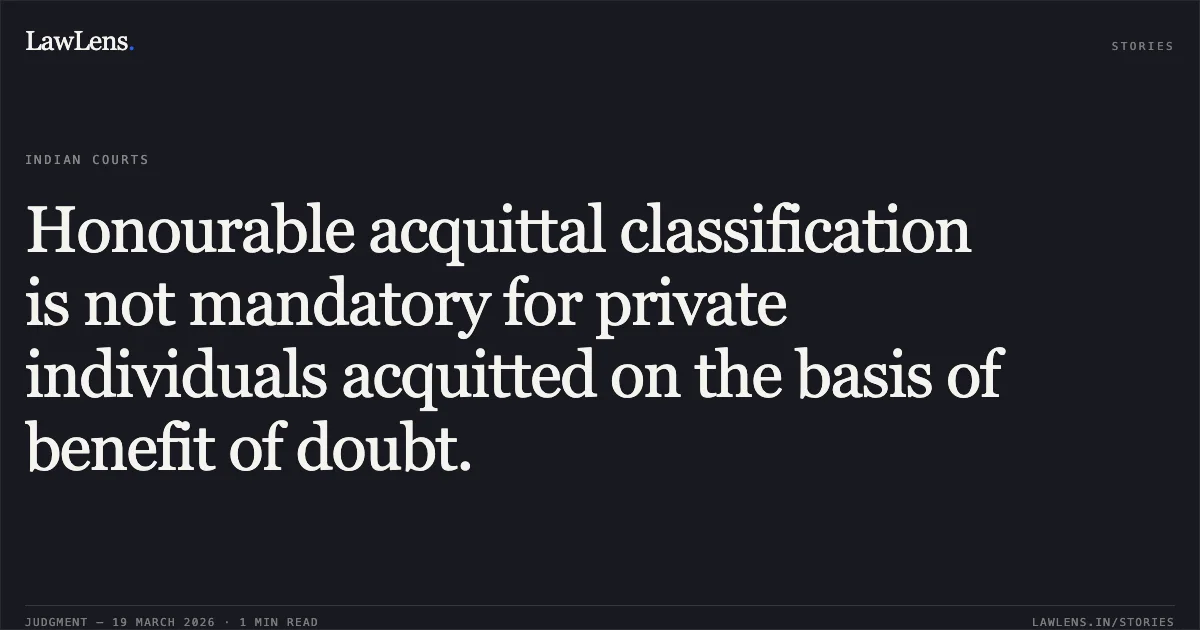
1. Whether the Trial Court and Revisional Court erred in granting an acquittal based on "benefit of doubt" instead of an "honourable acquittal" when the case rested solely on an uncorroborated memorandum statement
Source reference: para. 42. Whether the High Court should exercise its inherent powers under Section 482 CrPC to modify the nature of the acquittal
Source reference: para. 8, 9Law Applied
The Court considered the scope of Section 482 of the CrPC, which grants inherent powers to the High Court to prevent abuse of the process of any court or to secure the ends of justice
Source reference: para. 2, 8It further referred to the evidentiary principle that a memorandum statement of a co-accused is inadmissible as substantive evidence unless corroborated by independent evidence or discovery
Source reference: para. 3, 4Finally, the Court applied the legal distinction between an "honourable acquittal" and an acquittal based on the "benefit of doubt," noting that the former is typically relevant in the context of employment or government service
Source reference: para. 8Reasoning
The Petitioner argued that because the independent witnesses turned hostile and the case was built entirely on an inadmissible memorandum statement, the acquittal should be classified as "honourable"
Source reference: para. 4The High Court, however, observed that while the independent witnesses did not support the prosecution’s version, they admitted their signatures on relevant documents, and the Investigating Officer fully supported the prosecution's actions
Source reference: para. 7The Court reasoned that these factors indicated the case was not entirely fabricated
Source reference: para. 7Furthermore, the Court noted that the Petitioner was not in government service, and thus there was no specific legal requirement or necessity to classify the acquittal as "honourable"
Source reference: para. 8Since the lower courts had evaluated the evidence and reached a plausible conclusion, the High Court found no jurisdictional error, illegality, or perversity that would warrant the exercise of its inherent powers under Section 482
Source reference: para. 8, 9Holding
The High Court dismissed the petition and affirmed the orders of the Trial Court and Revisional Court
It held that the grant of acquittal based on the "benefit of doubt" was justified under the circumstances and that no exceptional grounds existed to interfere with the concurrent findings of the subordinate courts
Source reference: para. 8, 9The Court directed that a copy of the order be sent to the Trial Court for compliance
Source reference: para. 11Acts & Sections Cited
4 provisions across 4 statutes referred to in this judgment. Each provision opens on LawLens.
Public Gambling Act, 18671
Indian Penal Code, 18601
Code of Criminal Procedure, 19731
Juvenile Justice (Care and Protection of Children) Act, 2015.1
Original Court PDF
RAJNARAYAN @ RAJU SAHUvsSTATE OF CHHATTISGARH
Click to open original judgment
Original judgment, available to read, download and summarize on LawLens.in


