01Facts
Respondent No. 2 lodged a suo motu complaint alleging that the petitioners possessed and sold hookah products and e-cigarettes from “Smoker’s Zone” without the requisite licence and without adequate fire-safety measures.
pp. 3–6A charge sheet was filed for offences under Sections 52, 59 and 63 of the Food Safety and Standards Act, 2006 (FSSA); Sections 7 and 20(2) of the Cigarettes and Other Tobacco Products Act, 2003 (COTPA); and Sections 284, 285, 328 and 511 of the Indian Penal Code, 1860 (IPC).
pp. 3–6The petitioners sought quashing of the proceedings.
pp. 3–6Petitioner No. 3 was the wife of petitioner No. 1; petitioners Nos. 1 and 2 claimed to be employees rather than the shop’s owners.
pp. 16–1802Issues
i.1. Whether Sections 52, 59 and 63 of the FSSA applied to the alleged e-cigarette and hookah products.
¶ 10(i) · p. 18ii.2. Whether the charge-sheet allegations disclosed the ingredients of offences under Sections 284, 285, 328 and 511 IPC.
¶ 10(ii) · p. 18iii.3. Whether proceedings under Sections 7 and 20(2) of COTPA could be quashed insofar as the petitioners were concerned.
¶ 10(iii) · p. 1803Law Applied
Under Section 3(1)(j) of the FSSA, a product must be intended for human consumption as food to fall within the statutory definition; Sections 52, 59 and 63 consequently require, respectively, misbranded food, unsafe food, or a food business requiring a licence.
¶ 12.1–12.15 · pp. 19–26Sections 284 and 285 IPC require particular rash or negligent conduct involving, respectively, a poisonous substance or fire/combustible matter, with the danger specified by those provisions; Section 328 requires administering or causing a person to take a specified substance with the requisite intention or knowledge; and Section 511 requires an act towards commission of an identified substantive offence, beyond mere preparation.
¶ 13.1–13.20 · pp. 27–37COTPA’s Section 3(p) and Schedule include hookah tobacco as a tobacco product, while Sections 7 and 20(2) regulate trade, supply or distribution of covered products without the prescribed warnings and particulars.
¶ 14.1–14.8 · pp. 38–43Criminal liability under COTPA depends on material indicating the accused’s participation in the prohibited activity; relationship to an accused or mere employment, without such participation, is insufficient.
¶ 14.12–14.14 · pp. 44–46Provisions in the judgment · 16 · Linked ones open on LawLens
Code of Criminal Procedure, 1973 Section 482
Bharatiya Nagarik Suraksha Sanhita, 2023 Section 528
Indian Penal Code, 1860 Section 284Section 285Section 328Section 511
Food Safety and Standards Act, 2006 Section 3Section 31Section 41Section 42Section 52Section 59Section 63
Cigarettes and Other Tobacco Products (Prohibition of Advertisement and Regulation of Trade and Commerce, Production, Supply and Distribution) Act, 2003 Section 3Section 7Section 20
04Reasoning
The Court held that e-cigarettes, hookah apparatus and hookah tobacco, as described in the charge sheet, were intended for inhalation or smoking, not consumption as food; no notification declaring them food was produced. The foundational requirements of the FSSA offences were therefore absent.
¶ 12.4–12.15 · pp. 20–26The IPC allegations were general: they did not identify the relevant poisonous substance or specific rash or negligent conduct, the particular fire hazard and dangerous act or omission, or any person to whom a substance was administered with the required mental element. Nor did they identify an act beyond preparation towards an IPC offence. Those deficiencies meant the alleged offences’ essential ingredients were not disclosed.
¶ 13.5–13.21 · pp. 29–38By contrast, the allegations that petitioners Nos. 1 and 2 possessed and sold tobacco products without prescribed warnings, together with the seizure material, required examination at trial. Their asserted status as employees and the non-joinder of the shop owner did not, by themselves, warrant quashing.
¶ 14.9–14.23 · pp. 43–50No specific material showed that petitioner No. 3 participated in the business or the alleged sale, supply or distribution; her relationship to petitioner No. 1 was insufficient to sustain liability.
¶ 14.9–14.23 · pp. 43–5005Holding
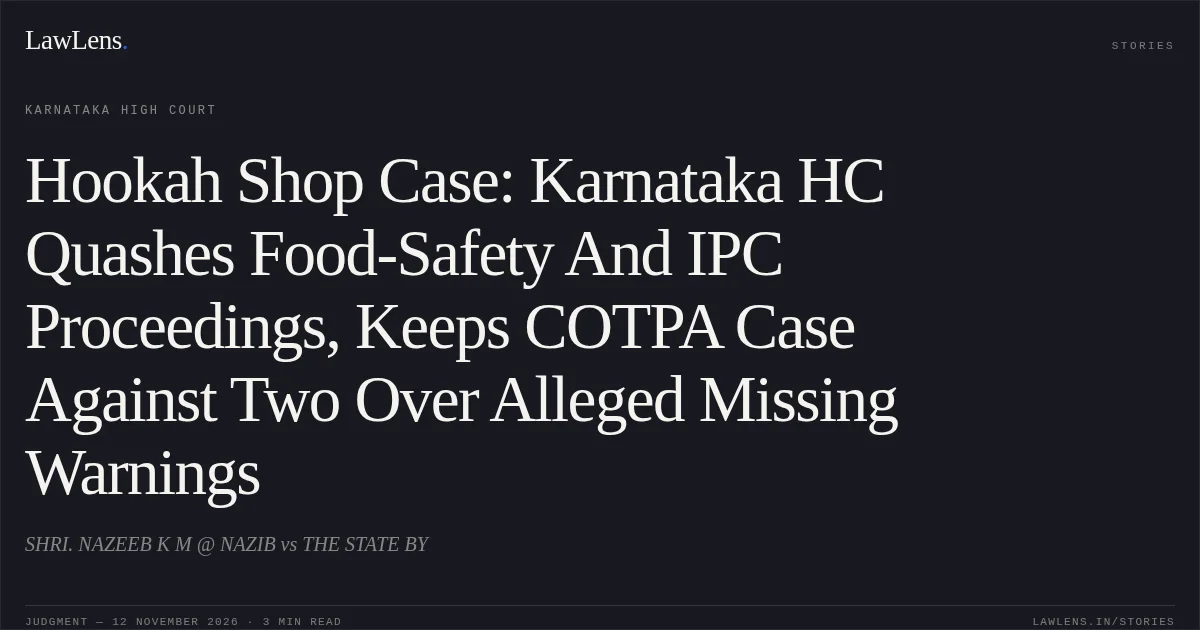
The petition was partly allowed. Proceedings under Sections 52, 59 and 63 FSSA and Sections 284, 285, 328 and 511 IPC were quashed.
¶ 15.1 · p. 51Proceedings under Sections 7 and 20(2) COTPA were permitted to continue against petitioners Nos. 1 and 2, with their guilt and the products’ statutory status and packaging compliance left for trial.
¶ 15.1 · p. 51The COTPA proceedings were quashed against petitioner No. 3.
¶ 15.1 · p. 51Original Court PDF
SHRI. NAZEEB K M @ NAZIBvsTHE STATE BY
Click to open original judgment
Original judgment, available to read, download and summarize on LawLens.in