01Facts
The complainant first lodged a complaint in Chennai on 30 October 2019, alleging offences under Sections 498A IPC and Sections 3 and 4 of the Dowry Prohibition Act against the petitioners; the petitioners stated that proceedings arising from that complaint were pending there.
pp. 3–4 · ¶ 3On 8 November 2019, she lodged a further complaint in Bengaluru alleging substantially similar conduct, including physical harassment and threats; Bengaluru Police registered Crime No. 123/2019 for offences under Sections 498A and 506 IPC and Sections 3 and 4 of the Dowry Prohibition Act.
pp. 4–5 · ¶ 3, 5A charge sheet was filed in the Bengaluru case on 27 September 2020, and the petitioners sought to quash the FIR and subsequent proceedings under Section 482 CrPC.
p. 6 · ¶ 802Issues
i.1. Whether the Bengaluru FIR could be maintained when an earlier complaint concerning a similar set of allegations against the same petitioners had been lodged in Chennai.
pp. 5–6 · ¶ 6–7ii.2. Whether the Bengaluru FIR and subsequent charge sheet should be quashed as an abuse of process.
p. 6 · ¶ 803Law Applied
The Court referred to Sections 498A and 506 IPC, Sections 3 and 4 of the Dowry Prohibition Act, and Section 162 CrPC.
pp. 5–6 · ¶ 6–7It applied the principle that, where an earlier complaint has already been registered concerning the same set of facts, a subsequent complaint raising similar allegations should not result in a separate registration or prosecution; any further statements concerning those facts should be dealt with in the earlier investigation under Section 162 CrPC. The Court cited no specific precedent.
pp. 5–6 · ¶ 6–7Provisions in the judgment · 5 · Linked ones open on LawLens
Code of Criminal Procedure, 1973 Section 482Section 162
Indian Penal Code, 1860 Section 506
04Reasoning
The Court found that the Chennai and Bengaluru complaints involved the same complainant, the same petitioners, and a similar set of allegations, and noted that the State did not dispute the similarity.
pp. 5–6 · ¶ 5–8It held that the Bengaluru complaint should have formed part of the earlier proceedings rather than giving rise to a separate case. Because a charge sheet had also been filed in Bengaluru, the Court considered the resulting prosecution impermissible in light of the earlier Chennai case and concluded that interference was warranted.
pp. 5–6 · ¶ 5–805Holding
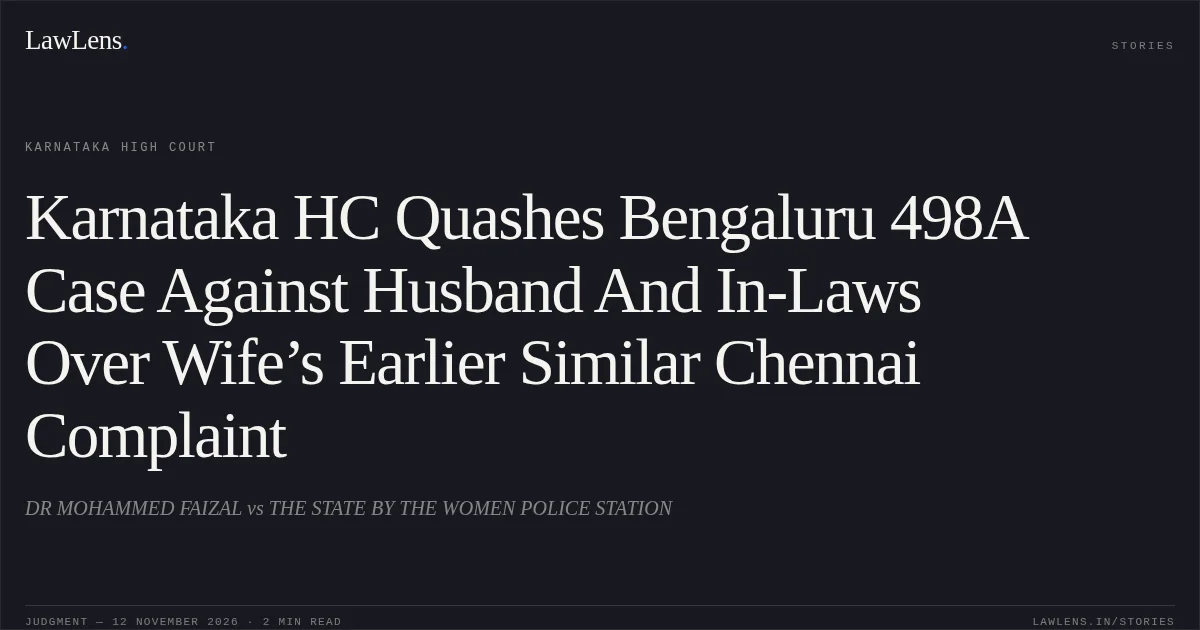
The Court allowed the petition and quashed the FIR in Bengaluru Crime No. 123/2019 under Sections 498A and 506 IPC and Sections 3 and 4 of the Dowry Prohibition Act.
p. 6 · ¶ 9 and orderIt also quashed the subsequent charge sheet in C.C. No. 3645/2021, leaving the complainant to pursue the earlier complaint in Chennai.
p. 6 · ¶ 9 and orderOriginal Court PDF
DR MOHAMMED FAIZALvsTHE STATE BY THE WOMEN POLICE STATION
Click to open original judgment
Original judgment, available to read, download and summarize on LawLens.in