Facts
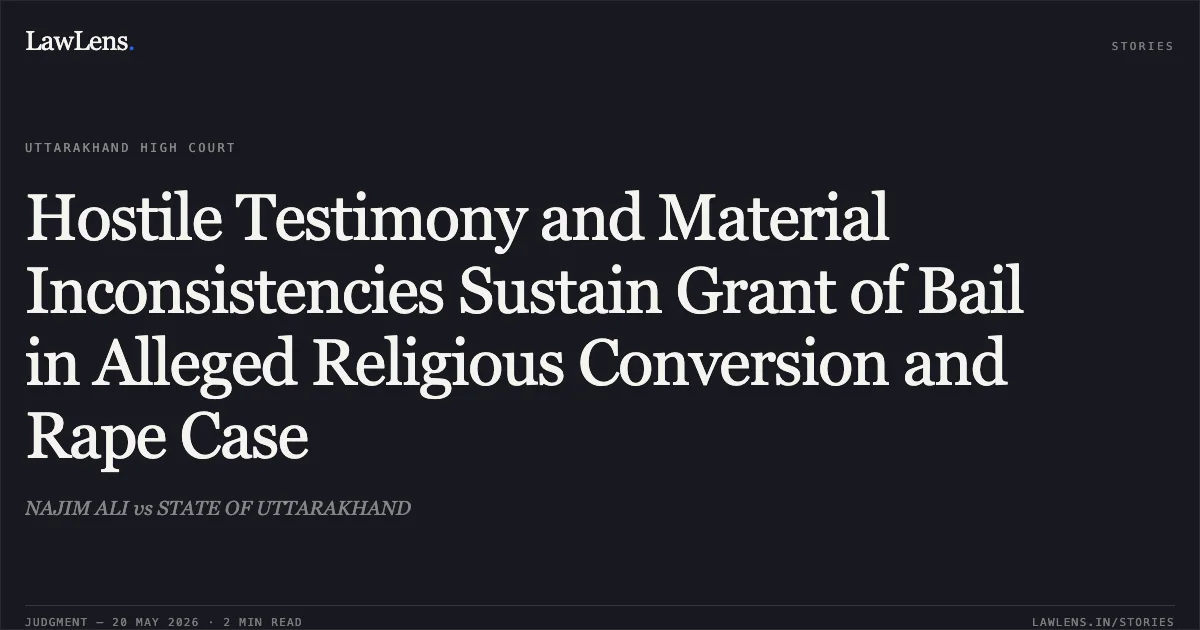
The applicant, Najim Ali, was in judicial custody since May 8, 2025, in connection with F.I.R. No. 181 of 2025 involving alleged rape and forced religious conversion
Source reference: para. 3, 9The victim (aged 20) was initially reported missing by her father on May 3, 2025, and was later recovered from the company of a co-accused, Tanveer
Source reference: para. 5In her statements under Sections 180 and 183 of the B.N.S.S., the victim alleged the applicant committed rape and pressured her to convert her religion
Source reference: para. 5medical examinations showed no external injuries or presence of spermatozoa
Source reference: para. 6During trial, while the victim initially supported the prosecution in her examination-in-chief, she turned hostile during cross-examination and subsequent re-examination on April 16, 2026, denying the occurrence of any such incident
Source reference: para. 6The applicant’s prior bail application was rejected by the lower court on August 21, 2025
Source reference: para. 8Issues
1. Whether the applicant is entitled to bail given the material inconsistencies and the hostile nature of the prosecutrix's testimony during trial
Source reference: para. 7, 102. Whether the lack of medical evidence and the voluntary conduct of the victim justify the applicant's release pending the conclusion of the trial
Source reference: para. 6, 7Law Applied
The Court applied the principles governing the grant of bail under the Bhartiya Nagarik Suraksha Sanhita (B.N.S.S.), specifically considering the gravity of offenses under Sections 70(1) (Rape) and 351(3) of the B.N.S.
Source reference: para. 3It further considered the statutory provisions of Section 3(2)(v) of the Scheduled Castes and Scheduled Tribes (Prevention of Atrocities) Act, 1989, and Sections 3(1) and 5 of the Uttarakhand Freedom of Religion and Prohibition of Unlawful Conversion of Religion Act, 2018
Source reference: para. 3The court relied on the evidentiary principle that material inconsistencies and self-contradictory statements by a prosecutrix during cross-examination can diminish the reliability of the prosecution's case for the purpose of granting bail
Source reference: para. 7, 10Reasoning
The court weighed the severity of the allegations (rape and forced conversion) against the evidentiary lapses presented during the trial. It noted that the medical report failed to corroborate the allegation of sexual assault, as no injuries or spermatozoa were detected
Source reference: para. 6the court observed that the victim (PW-1) categorically denied the incident during cross-examination and re-examination, stating she did not know why the F.I.R. was lodged
Source reference: para. 6The court reasoned that since the victim’s statements were "materially inconsistent and self-contradictory," they failed to inspire confidence at this stage
Source reference: para. 7, 10Furthermore, the court considered the applicant's year-long incarceration since May 2025, his lack of criminal history, and the fact that since the victim's testimony was complete, there was no risk of tampering with evidence
Source reference: para. 8, 9Holding
The Court held that the applicant made out a fit case for bail
The first bail application was allowed, and the Court ordered the release of Najim Ali upon furnishing a personal bond and two reliable sureties
Source reference: para. 11, 12The court clarified that this order was passed without expressing any final opinion on the merits of the case
Source reference: para. 10Acts & Sections Cited
7 provisions across 4 statutes referred to in this judgment. Each provision opens on LawLens.
Bharatiya Nyaya Sanhita, 20232
Bharatiya Nagarik Suraksha Sanhita, 20232
Scheduled Castes and the Scheduled Tribes (Prevention of Atrocities) Act, 19891
Original Court PDF
NAJIM ALIvsSTATE OF UTTARAKHAND
Click to open original judgment
Original judgment, available to read, download and summarize on LawLens.in