Facts
The prosecution alleged that on the night of August 16, 1982, the accused, Munna, locked himself in a room (kothari) with his uncle (Sri Ram) and stepmother (Smt. Jai Devi), and subsequently murdered Sri Ram and injured Jai Devi using a wooden pestle (moosal).
Source reference: para. 3-4While the FIR stated the accused was caught inside the room by villagers who broke a wall to rescue the informant, the trial court acquitted the accused on April 30, 1983.
Source reference: para. 2, 4-5The State appealed, contending that the trial court ignored incriminating circumstances, such as the accused being found locked inside the room with the deceased.
Source reference: para. 15-16Notably, during the trial, the informant (PW-3) turned hostile, claiming the attack was committed by 15-16 dacoits and that the accused himself was injured.
Source reference: para. 18-20Issues
1. Whether the appellate court can interfere with an order of acquittal when the trial court's view is a possible and reasonable one.
Source reference: para. 172. Whether the testimony of witnesses PW-4 and PW-6 can sustain a conviction in the absence of support from the central injured witness (PW-3).
Source reference: para. 25-363. Whether the prosecution’s failure to explain the injuries on the accused and the non-examination of natural witnesses is fatal to its case.
Source reference: para. 39-40Law Applied
Section 378 of the Cr.P.C. regarding appeals against acquittal, governed by the principle that judgments of acquittal should not be disturbed unless they are "palpably wrong" or "manifestly unjust," as established in Union of India v. Sepoy Pravat Kumar Behuria and Mathai Mathews v. State of Maharashtra.
Source reference: para. 17-18Sections 302 (Murder) and 323 (Voluntary causing hurt) of the IPC.
Source reference: para. 2The "Sterling Witness" quality test from Rai Sandeep v. State (NCT of Delhi).
Source reference: para. 35The principle from Vaibhav v. State of Maharashtra that while motive is not always mandatory, its complete absence leans in favor of the accused in doubtful cases.
Source reference: para. 24Reasoning
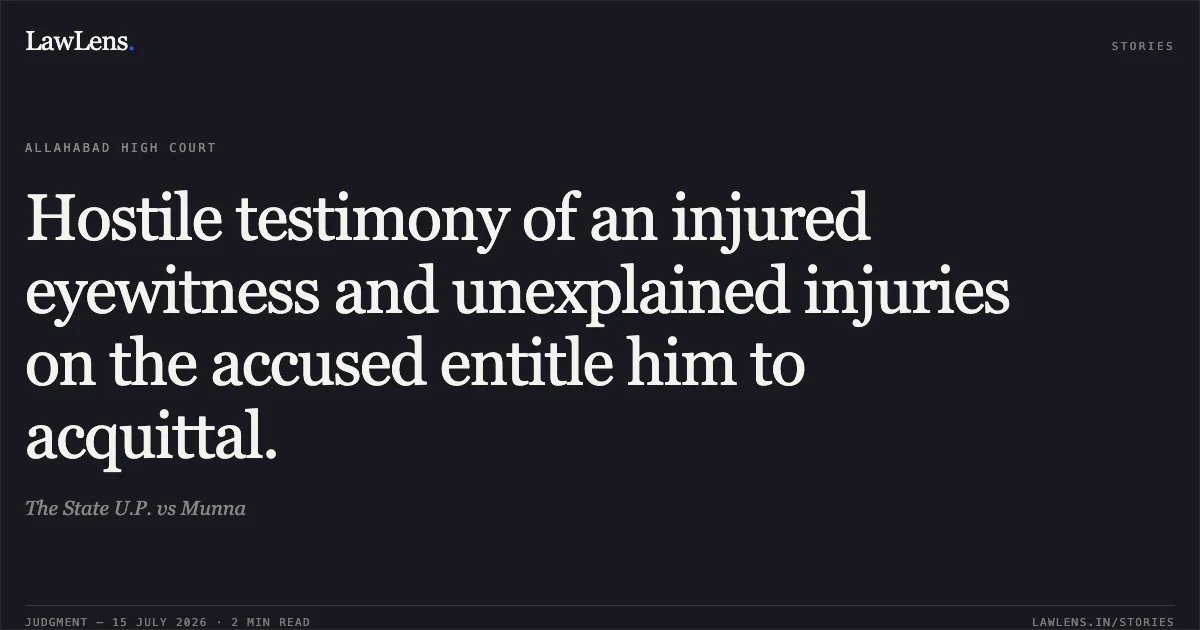
The Court found that the prosecution's "star witness" (PW-3) completely resiled from the FIR, testifying that dacoits, not the accused, committed the crime.
Source reference: para. 18-20, 31The court noted that PW-4 and PW-6 were not "sterling witnesses" because they did not actually see the assault; their knowledge was derivative and contradicted by the informant.
Source reference: para. 30, 34-36Crucially, the court observed that the prosecution failed to explain the injuries found on the person of the accused, failed to produce FSL reports for blood-stained items, and suppressed evidence by not examining other family members present in the house.
Source reference: para. 38, 39, 40These omissions, combined with the hostile testimony of the injured stepmother, created a reasonable doubt regarding the genesis of the incident.
Source reference: para. 42-44Holding
The Court answered the issues in the negative, holding that the trial court's conclusion was a "highly plausible and reasonable view" that warranted no interference.
The High Court upheld the acquittal, ruling that when the prosecution suppresses the origin and genesis of an occurrence and fails to explain the accused's injuries, the benefit of doubt must go to the accused and the Government Appeal was dismissed.
Source reference: para. 44-47Acts & Sections Cited
6 provisions across 2 statutes referred to in this judgment. Each provision opens on LawLens.
Code of Criminal Procedure, 19734
Indian Penal Code, 18602
Original Court PDF
The State U.P.vsMunna
Click to open original judgment
Original judgment, available to read, download and summarize on LawLens.in