Facts
On March 29, 2001, police raided the house of the appellant, Riyaz Ansari, based on confidential information regarding a planned crime
Source reference: p. 2During the raid, two live "Dabba Bombs" were recovered from a room
Source reference: p. 2A seizure list was prepared in the presence of independent witnesses, and the appellant allegedly confessed to preparing the bombs to commit crimes
Source reference: p. 2-3The Trial Court (Sessions Case No. 21 of 2003) convicted the appellant under Sections 4 and 5 of the Explosive Substance Act, sentencing him to five and three years of Rigorous Imprisonment, respectively
Source reference: p. 1The appellant challenged this on the grounds that independent witnesses turned hostile and the forensic capacity of the bombs was not sufficiently proved
Source reference: p. 3-4Issues
1. Whether the conviction can be sustained based solely on the testimony of official (police) witnesses when independent seizure witnesses have turned hostile
Source reference: p. 72. Whether the sentence of imprisonment should be modified considering the nature of the recovery, the appellant’s lack of criminal antecedents, and the time elapsed since the occurrence
Source reference: p. 8Law Applied
Section 4 of the Explosive Substance Act (punishment for attempt to cause explosion or making/keeping explosives with intent) and Section 5 (punishment for making or possessing explosives under suspicious circumstances)
Source reference: p. 1-3The court reaffirmed the principle that the testimony of "interested witnesses" (raiding party members) cannot be discarded solely because independent witnesses turned hostile, provided their testimony is consistent and corroborated by scientific evidence like a Forensic Science Laboratory (FSL) report
Source reference: p. 7-8Reasoning
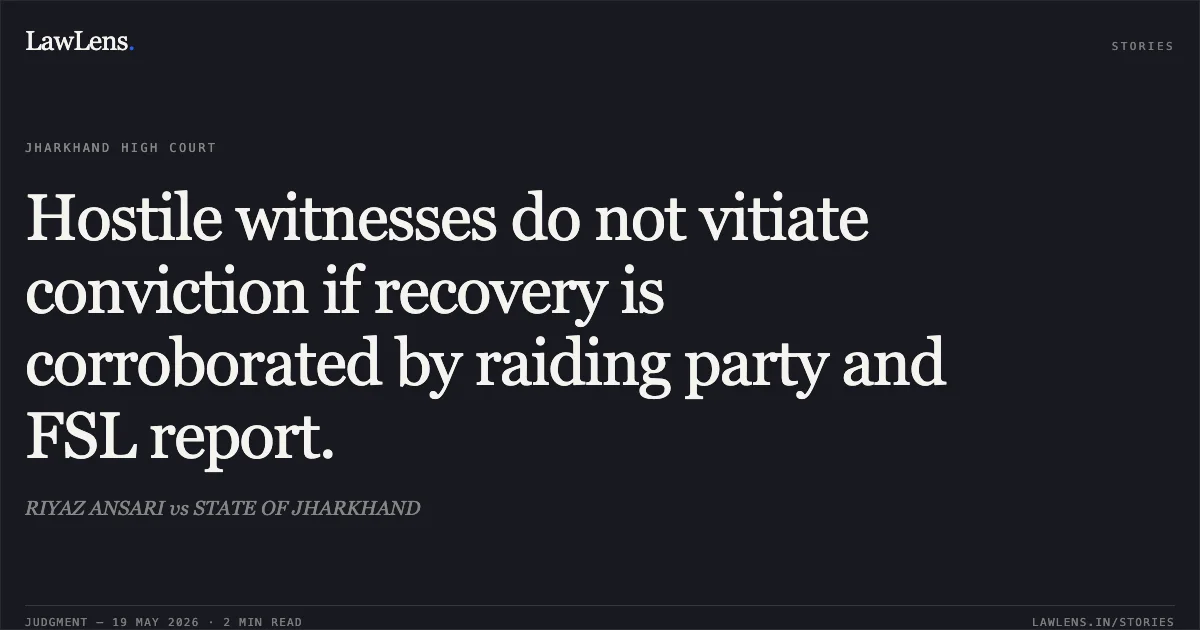
The Court observed that while P.W. 1, 3, 5, and 6 were declared hostile and P.W. 2 did not support the prosecution, the members of the raiding party (P.W. 4, 7, 8, and 9) provided consistent testimony regarding the recovery and arrest
Source reference: p. 7Crucially, the court relied on the FSL Report (Exhibit-6), which confirmed that the seized items contained a prohibited explosive mixture of Arsenic sulphide and potassium chlorate designed to act as missiles
Source reference: p. 6-8The court found no merit in the argument that the police acted with bias, noting that the scientific evidence corroborated the police's recovery version
Source reference: p. 7Regarding sentencing, the court took a lenient view noting the appellant was only 19-20 years old at the time of the incident, had no criminal record, and the items recovered were hand-made "sutli" bombs
Source reference: p. 8Holding
The Court dismissed the appeal on merits, upholding the conviction under Sections 4 and 5 of the Explosive Substance Act
Considering the appellant had already served approximately six months in custody and the case had been pending since 2001, the Court altered the sentence to the period of imprisonment already undergone
Source reference: p. 8-9The appellant was discharged from the liability of his bail bonds
Source reference: p. 9Acts & Sections Cited
2 provisions across 1 statute referred to in this judgment. Each provision opens on LawLens.
Original Court PDF
RIYAZ ANSARIvsSTATE OF JHARKHAND
Click to open original judgment
Original judgment, available to read, download and summarize on LawLens.in