Facts
On May 5, 2016, Rabia Khatoon ("the deceased") was traveling in a Tavera (bearing registration no. RJ 14 TB 7798) from Delhi to Jaipur when the vehicle collided with a roadside tree, resulting in her death.
Source reference: para. 2The Motor Accident Claims Tribunal (MACT) found the driver negligent and awarded ₹5,67,536/- in compensation.
Source reference: para. 3The Insurance Company appealed seeking recovery rights, contending the vehicle was overloaded with 11 passengers against a 7-passenger permit.
Source reference: para. 4The claimants appealed for enhancement of compensation, arguing that the MACT wrongly awarded "loss of estate" instead of "loss of dependency" for a deceased housewife and failed to apply correct standards for future prospects and consortium.
Source reference: paras. 1, 9, 11Issues
1. Whether the Insurance Company is entitled to recovery rights against the owner and driver due to a fundamental breach of policy (overloading).
Source reference: para. 42. Whether the compensation for a deceased housewife should be calculated as "loss of dependency" based on notional income rather than "loss of estate".
Source reference: paras. 11-133. Whether the claimants are entitled to future prospects and enhanced consortium as per settled law.
Source reference: para. 9Law Applied
Principles from National Insurance Co. Ltd. v. Pranay Sethi (2017) regarding the award of future prospects at 25% for those aged 40-50 and the standardization of consortium at ₹40,000 per legal heir.
Source reference: paras. 9, 15Indrawati v. Ranbir Singh (2021) and Oriental Insurance Co. Ltd. v. Vinay Jain (2026) to clarify that "loss of estate" principles from Keith Rowe do not apply to primary dependents (spouse, parents, children), who are instead entitled to "loss of dependency".
Source reference: paras. 11-12Arun Kumar Agrawal v. National Insurance Co. Ltd. (2010) and Uma Rani v. Simranjeet Singh (2026), establishing that a homemaker’s notional income must reflect the economic value of her services and cannot be less than the prevailing minimum wages.
Source reference: para. 13Reasoning
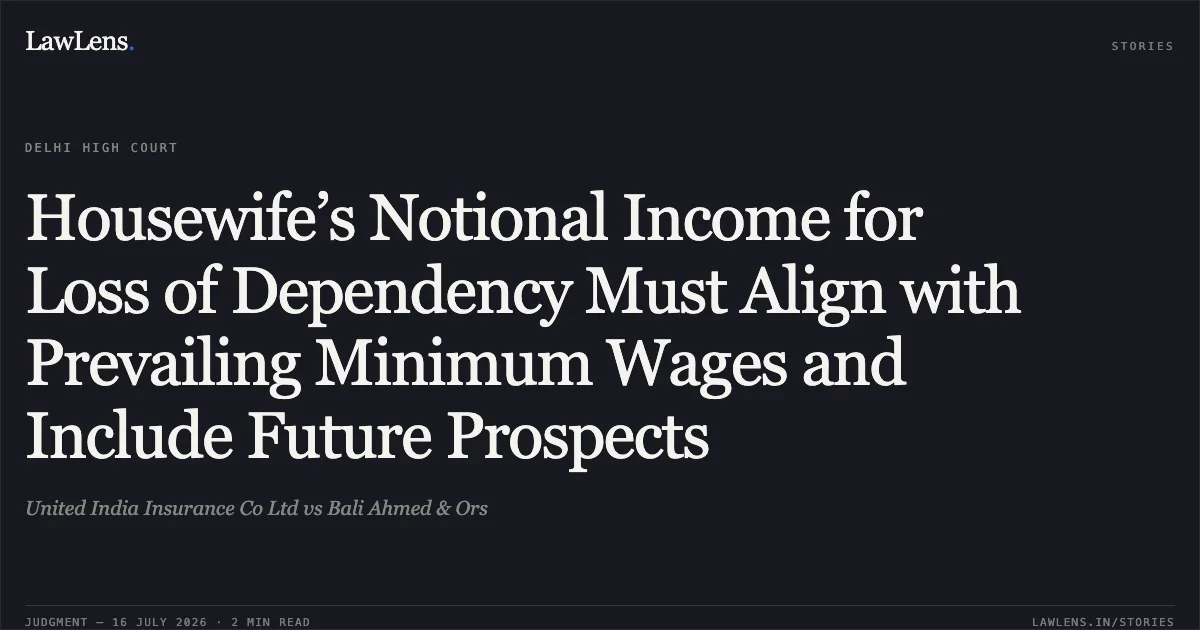
The court examined whether the MACT was correct in awarding only "loss of estate" for a deceased housewife where primary dependents were present, finding that primary dependents such as a spouse and children are rightfully entitled to "loss of dependency" based on the notional income of the deceased homemaker.
Source reference: paras. 11-12The court assessed the valuation of a homemaker's services, reasoning that such notional income must be aligned with prevailing minimum wages to accurately reflect economic value and should include a 25% addition for future prospects as mandated by the age-based brackets in Pranay Sethi.
Source reference: paras. 13, 15On the issue of overloading, the court analyzed whether the presence of 11 passengers in a 7-seater vehicle constituted a fundamental breach of policy sufficient to grant recovery rights to the insurer.
Source reference: para. 4Holding
The court held that compensation for a deceased housewife must be calculated as "loss of dependency" using notional income equivalent to minimum wages when claimed by primary dependents.
The court directed the enhancement of compensation to include 25% future prospects and standardized consortium of ₹40,000 for each legal heir.
Source reference: paras. 9, 15Acts & Sections Cited
2 provisions across 1 statute referred to in this judgment. Each provision opens on LawLens.
Motor Vehicles Act, 19882
Original Court PDF
United India Insurance Co LtdvsBali Ahmed & Ors
Click to open original judgment
Original judgment, available to read, download and summarize on LawLens.in