01Facts
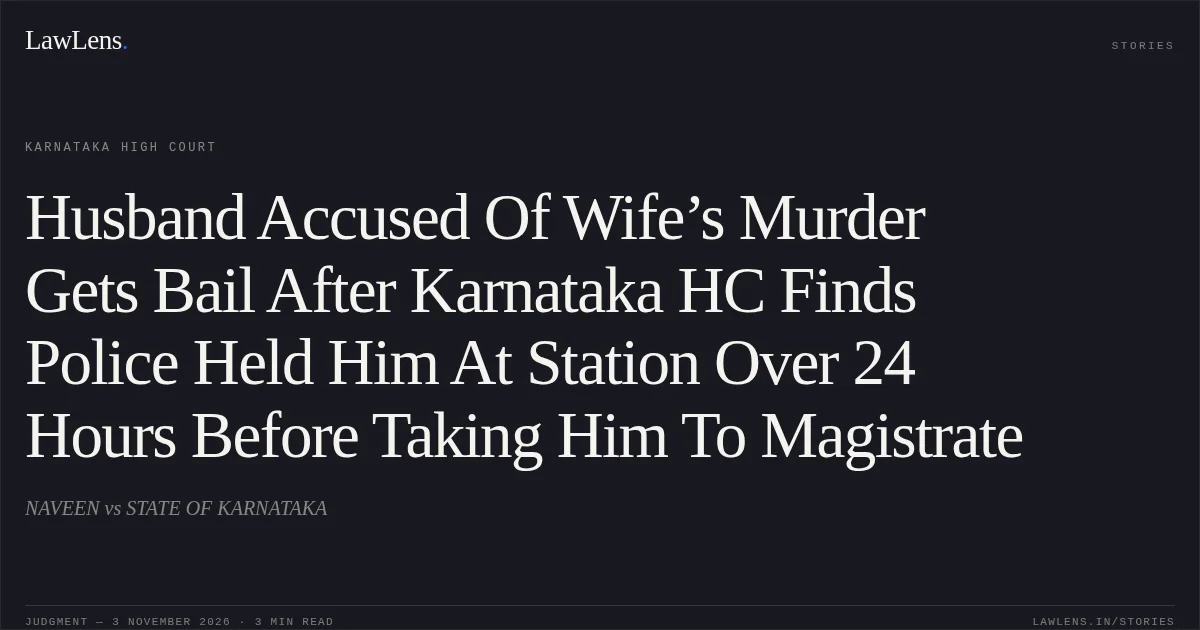
The petitioner, accused No. 1, sought bail in a case arising from the death of his wife, registered for offences under Sections 352, 351(2), 85, 49 and 103 read with Section 3(5) of the Bharatiya Nyaya Sanhita, 2023, and Section 4 of the Dowry Prohibition Act.
¶ 1, 3, 6He voluntarily appeared at the police station at 11:00 a.m. on 14 October 2025, was formally shown as arrested at 9:45 p.m. that day, and was produced before the Magistrate at 5:45 p.m. on 15 October 2025.
¶ 1, 3, 6His bail application before the Sessions Court had been rejected.
¶ 1, 3, 6He contended that his liberty had been restricted from the time he arrived at the station and that his production before the Magistrate therefore exceeded the 24-hour limit under Article 22(2) of the Constitution and Section 58 of the BNSS.
¶ 402Issues
i.1. Whether the petitioner was under arrest or detention from the time he appeared at the police station, rather than from the later time recorded in the arrest memo.
¶ 14, 21, 27ii.2. Whether the petitioner’s production before the Magistrate beyond 24 hours from the commencement of that detention violated Article 22(2) of the Constitution and Section 58 of the BNSS, entitling him to bail.
¶ 9–10, 27–2803Law Applied
Article 22(2) of the Constitution and Section 58 of the BNSS require a person arrested and detained in custody to be produced before the nearest Magistrate within 24 hours, excluding necessary journey time; detention beyond that period requires a Magistrate’s authority.
¶ 7–10Under Section 43 of the BNSS, arrest may occur through physical restraint or submission to custody by words or conduct.
¶ 11The test for arrest is the substance of the restraint on personal liberty, not the label or time entered in police records: Niranjan Singh v. Prabhakar Rajaram Kharote and State of U.P. v. Deoman Upadhyaya were relied on in this regard.
¶ 13–15The Court also considered the principles discussed in Biswajit Mandal v. Inspector, Narcotic Control Bureau, including that the 24-hour period runs from effective detention or curtailment of liberty.
¶ 12, 16It distinguished Subhashree Das alias Milli v. State of Orissa on its facts, and Manohar Sharad Pathare v. State of Maharashtra on the circumstances surrounding the person’s presence at the police station.
¶ 20, 22–23The Court referred to Anuj Kumar Singh v. Union of India on assessing actual restraint and to Jaskaran Jeet Singh Deol v. State of Punjab in relation to bail conditions.
¶ 24–25, 28Provisions in the judgment · 20 · Linked ones open on LawLens
Bharatiya Nyaya Sanhita, 2023 Section 3Section 49Section 85Section 103Section 351Section 352
Bharatiya Nagarik Suraksha Sanhita, 2023 Section 43Section 57Section 58Section 187Section 483
Code of Criminal Procedure, 1973 Section 46Section 57Section 60Section 61Section 167Section 439
Dowry Prohibition Act, 1961 Section 4
Indian Penal Code, 1860 Section 340
Narcotic Drugs and Psychotropic Substances Act, 1985 Section 37
04Reasoning
The Court found that the petitioner’s liberty had been curtailed from 11:00 a.m. on 14 October 2025, when he appeared at the police station, and that the later formal arrest time did not determine when the 24-hour period began.
¶ 21, 27Although the prosecution relied on call-detail records showing that the petitioner had a phone at the station, he made and received no calls after appearing there; the Court therefore found the circumstances distinguishable from Manohar Sharad Pathare.
¶ 23The prosecution also did not claim that, after accounting for journey time, the petitioner had been produced within 24 hours of his detention, and the case diary offered no explanation for the delay in questioning him or formally recording his arrest.
¶ 21, 28The Court accordingly held that his production was outside the constitutional and statutory period and that his detention was illegal.
¶ 2805Holding
The Court allowed the petition and directed that the petitioner be released on bail in S.C. No. 98/2026, subject to a personal bond of ₹1,00,000 with two sureties and conditions requiring his attendance at trial, non-interference with witnesses, avoidance of similar offences, and prior permission to leave the trial court’s jurisdiction.
¶ 29Original Court PDF
NAVEENvsSTATE OF KARNATAKA
Click to open original judgment
Original judgment, available to read, download and summarize on LawLens.in