Facts
The complainant (wife) alleged that following her marriage to Petitioner No. 1, she was subjected to continuous cruelty and dowry demands (₹6,00,000 and a Bullet motorcycle) by her husband and in-laws
Source reference: para. 2She further alleged that her father-in-law (Petitioner No. 2) engaged in inappropriate conduct, and her husband subjected her to physical abuse and unnatural sexual acts
Source reference: para. 2Based on these allegations, an FIR was registered under Sections 377, 354, 498-A, 323, 294, 506, and 34 of the IPC, alongside the Dowry Prohibition Act and the Arms Act
Source reference: para. 1The Petitioners sought quashment under Section 482 of the CrPC, contending that the allegations against the sister-in-law (Petitioner No. 4) were omnibus and that the charge under Section 377 was legally unsustainable in a marital context
Source reference: paras. 3, 6Issues
1. Whether the criminal proceedings against Petitioner No. 4 (sister-in-law) constitute an abuse of process due to a lack of specific allegations
Source reference: para. 112. Whether an offence under Section 377 of the IPC (unnatural offences) can be maintained against a husband for acts committed during the subsistence of a valid marriage
Source reference: para. 163. Whether the remaining charges under Sections 498-A, 354, and others warrant quashing despite disclosed cognizable offences
Source reference: para. 21Law Applied
The court applied the inherent powers under Section 482 of the CrPC to quash proceedings where allegations do not disclose an offence or represent an abuse of process
Source reference: para. 10It interpreted Section 375 of the IPC (Rape), noting that the post-2013 amendment expanded the definition to include oral and anal acts
Source reference: paras. 14-15The court relied on Exception 2 to Section 375, which stipulates that sexual acts by a man with his wife (not being a minor) do not constitute rape
Source reference: para. 14It further applied the principles from Navtej Singh Johar v. Union of India regarding consent
Source reference: para. 17followed the Madhya Pradesh High Court precedents in Manish Sahu v. State of M.P. and Umang Singhar v. State of M.P., which held that Section 377 IPC cannot be invoked for sexual acts between husband and wife due to the expanded definition of rape and the accompanying marital exception
Source reference: paras. 17-18Reasoning
The court found that the allegations against Petitioner No. 4 were "general and omnibus," noting her name was omitted from the complainant's Section 164 statement and earlier maintenance proceedings, rendering her implication a prima facie abuse of law
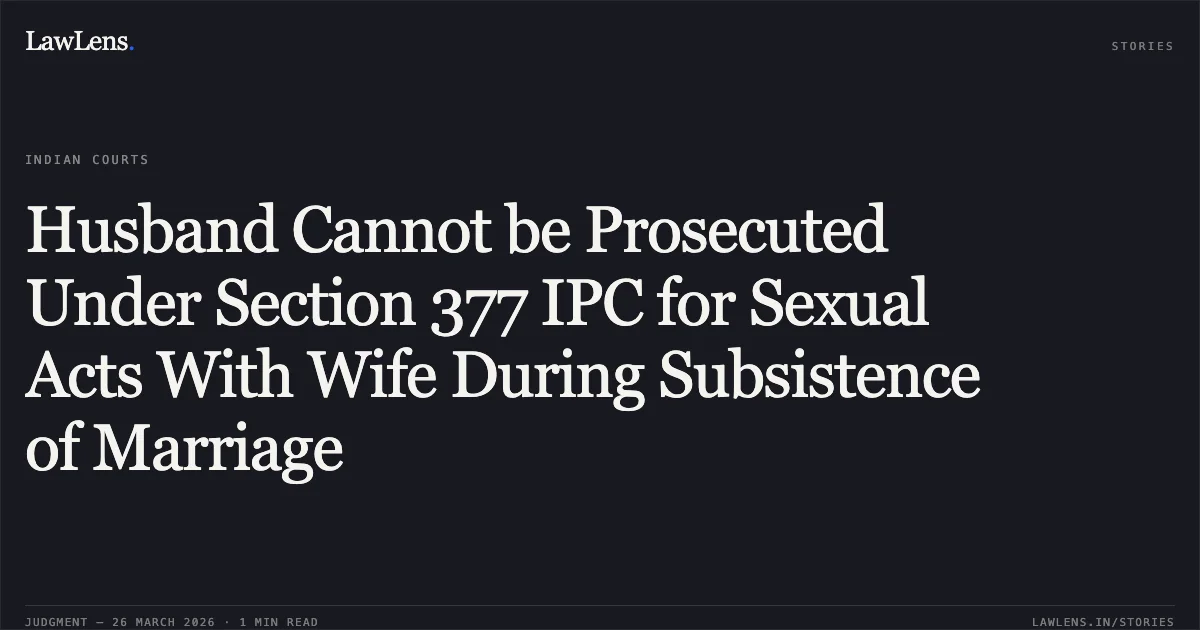
Source reference: para. 11Regarding Section 377 IPC, the court reasoned that since the 2013 amendment to Section 375 IPC specifically incorporated anal and oral penetration into the definition of rape, and since Exception 2 to Section 375 exempts marital sexual acts from being defined as rape, Section 377 cannot be used to prosecute a husband for such acts
Source reference: paras. 15, 18-19However, for the remaining offences (Sections 498-A, 354, etc.), the court held that the FIR and investigation material disclosed prima facie cognizable offences
Source reference: para. 21It ruled that arguments regarding false implication or lack of medical corroboration are disputed questions of fact that must be adjudicated during a trial, not under Section 482 CrPC
Source reference: para. 21Holding
The petition was partly allowed
The court quashed the FIR and all consequential proceedings against Petitioner No. 4 (sister-in-law)
Source reference: para. 11It further quashed the charge under Section 377 of the IPC against Petitioner No. 1 (husband)
Source reference: para. 20However, the court upheld the proceedings for the remaining offences (Sections 498-A, 354, 323, 294, 506, 34 IPC and the Dowry Prohibition Act) against Petitioners Nos. 1, 2, and 3, directing the trial to continue in accordance with law
Source reference: para. 22Acts & Sections Cited
10 provisions across 3 statutes referred to in this judgment. Each provision opens on LawLens.
Arms Act, 19591
Indian Penal Code, 18607
Original Court PDF
Krishnagopal SharmavsThe State Of Madhya Pradesh
Click to open original judgment
Original judgment, available to read, download and summarize on LawLens.in