Facts
The parties married on 24 November 2008 and had a son.
Source reference: para. 2The wife initiated domestic-violence proceedings in 2013, later numbered DVC No. 6 of 2020.
Source reference: para. 2In 2023, the husband applied for a DNA test, asserting that he was not the child’s biological father and that there had been no access between the spouses during the relevant period.
Source reference: para. 6The Magistrate dismissed the application for want of material supporting non-access.
Source reference: para. 6The husband challenged that order in revision.
Source reference: para. 6Issues
Whether the husband established a sufficient prima facie basis, including non-access during the relevant period, to justify directing a DNA test to determine the child’s paternity.
Source reference: paras. 7, 27–30Whether the Magistrate’s refusal to order the DNA test warranted interference in revision.
Source reference: paras. 39–41Law Applied
Section 116 of the Bharatiya Sakshya Adhiniyam, 2023 provides a conclusive presumption of legitimacy for a child born during a valid marriage, unless non-access at a time when the child could have been conceived is shown.
Source reference: paras. 27–29Relying on Goutam Kundu v. State of West Bengal and the Supreme Court’s decision in Ivan Rathinam v. Milan Joseph, the Court stated that DNA testing is not to be ordered routinely or for a roving inquiry; a strong prima facie case, including proof of non-access sufficient to challenge the presumption, is required, and the court must consider the consequences for the child and the parties’ privacy.
Source reference: para. 30The Court also relied on Aparna Ajinkya Firodia v. Ajinkya Arun Firodia for the principles that DNA testing should not be used as a shortcut to prove infidelity and that paternity allegations may be pursued through other evidence.
Source reference: para. 32Reasoning
The husband applied for testing in 2023, years after the domestic-violence proceedings began, and gave no satisfactory explanation for the delay.
Source reference: paras. 26–29He produced no material to support his allegation of non-access or otherwise make out a strong prima facie case.
Source reference: paras. 26–29, 33The statutory presumption therefore remained unrebutted, and the Court considered that testing could intrude on privacy and affect the child’s interests; it was not shown to be the only means of resolving the husband’s allegations.
Source reference: paras. 35–38The Court accordingly found no basis to disturb the Magistrate’s decision.
Source reference: paras. 39–40Holding
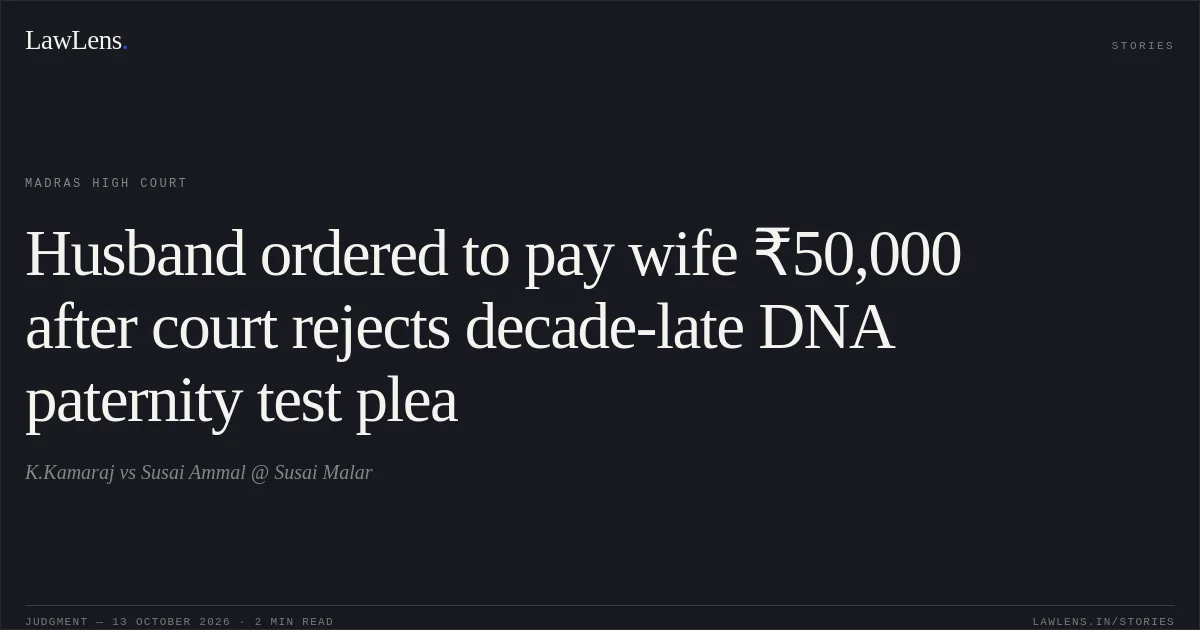
The revision was dismissed, and the Magistrate’s order refusing DNA testing was confirmed.
The Court also ordered the husband to pay ₹50,000 in costs to the credit of the domestic-violence case within six weeks, directing that the amount be released to the wife and recovered in accordance with law if unpaid.
Source reference: paras. 42–43Acts & Sections Cited
10 provisions across 3 statutes referred to in this judgment. Each provision opens on LawLens.
Bharatiya Nagarik Suraksha Sanhita, 20233
Bharatiya Sakshya Adhiniyam, 20234
Code of Criminal Procedure, 19733
Original Court PDF
K.KamarajvsSusai Ammal @ Susai Malar
Click to open original judgment
Original judgment, available to read, download and summarize on LawLens.in
![Widows are entitled to family pension where an employee’s regularization is deemed effective before death.. SMT MUNNI DEVI vs NORTH CENTRAL RAILWAY. CAT - ['Allahabad']. LawLens](/stories/thumbnails/widows-are-entitled-to-family-pension-where-an-employees-regularization-is-deemed-effectiv-0037b18d25494f35be49175c98a87e80.webp)
![A charge memorandum cannot be quashed absent jurisdictional defect or demonstrable mala fides.. ADIYA KUMAR vs HOME AFFAIRS. CAT - ['Patna']. LawLens](/stories/thumbnails/a-charge-memorandum-cannot-be-quashed-absent-jurisdictional-defect-or-demonstrable-mala-fi-498f1b65cb0e4b01bb5d96c572f38b22.webp)
![Failure to assess whether proceedings were pending at retirement warrants recall for reconsideration.. Vishvambhar Singh vs D/O POST. CAT - ['Allahabad']. LawLens](/stories/thumbnails/failure-to-assess-whether-proceedings-were-pending-at-retirement-warrants-recall-for-recon-071167e5391949abbe500a070b3ff27b.webp)