Facts
The Plaintiff, brother of the deceased Bimal Mohan Sikka, filed a suit for administration of her estate, seeking to declare himself the sole surviving heir under intestate succession
Source reference: para 1, 3He challenged a Will dated April 10, 2023, and a Gift Deed dated May 6, 2024, executed by the deceased in favor of Defendant No. 1, alleging the deceased suffered from cognitive difficulties following a stroke
Source reference: para 7, 9, 12The deceased was a childless widow; her husband had predeceased her, but her husband’s sister, Mrs. Shridevi Ruparel, survived her
Source reference: para 30During the pendency of this Interim Application (IA) for the appointment of a Court Receiver and injunctions, Defendant No. 1 obtained Probate of the disputed Will on March 7, 2026
Source reference: para 23Issues
1. Whether the Plaintiff possesses a prima facie share or interest in the estate of the deceased female Hindu under the Hindu Succession Act, 1956, to maintain a claim for interim relief
Source reference: para 572. Whether Section 15(1) of the Hindu Succession Act has been declared unconstitutional by the Bombay High Court, thereby allowing the Plaintiff (a natal heir) to exclude the husband's heirs
Source reference: para 623. Whether the grant of Probate in favor of the Defendant No. 1 precludes the grant of interim relief in an administration suit
Source reference: para 77, 79Law Applied
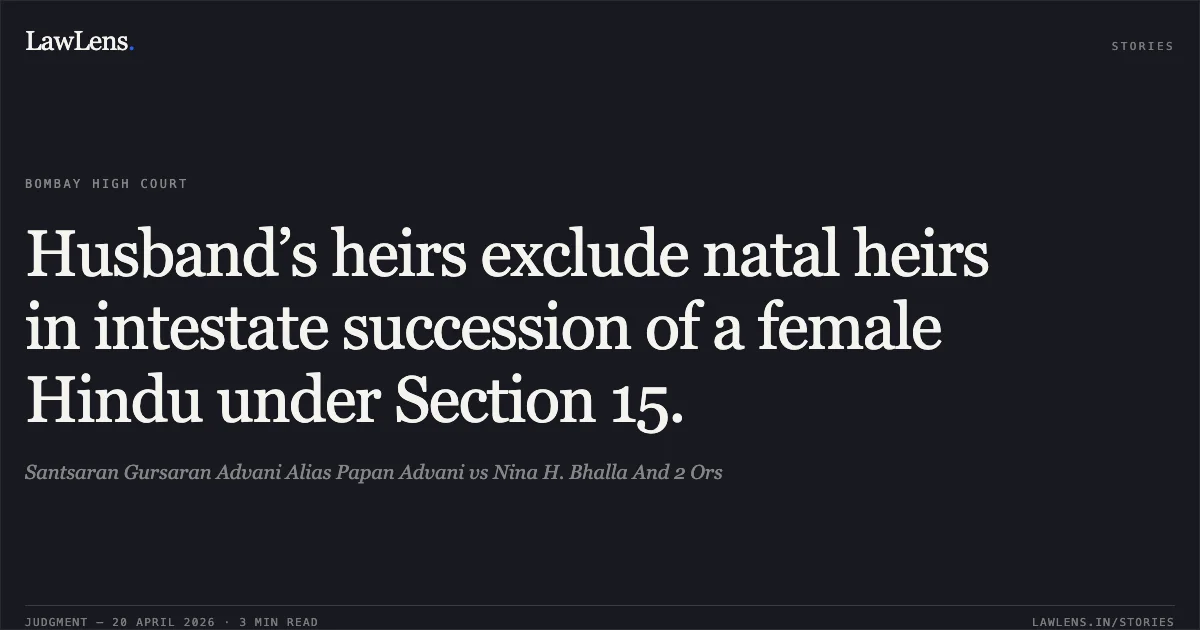
The court primarily applied Section 15 and Section 16 of the Hindu Succession Act (HSA), 1956, which dictate the order of succession for a female Hindu dying intestate, placing "heirs of the husband" (Entry b) in priority over "heirs of the father" (Entry d)
Source reference: para 58-61The court relied on the principle that a Single Judge’s observation on the unconstitutionality of a statute does not attain finality if referred to a Division Bench without a final determination, as seen in Mamta Dinesh Vakil v. Bansi S. Wadhwa
Source reference: para 63-64Furthermore, it applied the principle from Asma Lateef and Anr. v. Shabbir Ahmad and Ors., which mandates that a court must be satisfied regarding the maintainability of a suit before granting interim relief
Source reference: para 82-83Reasoning
The Court observed that under Section 15(1) of the HSA, the deceased's husband's sister (Category 'b') takes precedence over the Plaintiff (Category 'd'), effectively excluding him from inheritance in the event of intestacy
Source reference: para 61The Court rejected the Plaintiff's reliance on Mamta Dinesh Vakil, clarifying that the Division Bench had not affirmed the Single Judge's view on the unconstitutionality of Section 15(1); thus, the section remains valid and applicable
Source reference: para 64-66Regarding the Plaintiff's "caveatable interest," the Court held that since the Plaintiff would not inherit even under intestacy, he does not qualify as "next of kin" under Rule 397 of the Bombay High Court (Original Side) Rules
Source reference: para 75Finally, the Court noted that the grant of Probate serves as authenticated evidence of the Will, vesting the estate in the executrix (Defendant No. 1) from the date of death
Source reference: para 77Since the Plaintiff failed to show a prima facie interest in the estate, the requirements for interim relief—balance of convenience and irreparable injury—could not be met
Source reference: para 72, 84Holding
The Court rejected the Interim Application, holding that the Plaintiff has no prima facie interest in the deceased's estate under the HSA
The Court clarified that Section 15(1) of the HSA is constitutional and operational until determined otherwise by a Division Bench or the Supreme Court
Source reference: para 68The grant of Probate further solidified Defendant No. 1’s title, and the Plaintiff’s pending revocation petition did not entitle him to interim protection in the administration suit
Source reference: para 78, 80No order as to costs was made
Source reference: para 86Acts & Sections Cited
5 provisions across 1 statute referred to in this judgment. Each provision opens on LawLens.
Hindu Succession Act, 19565
Original Court PDF
Santsaran Gursaran Advani Alias Papan AdvanivsNina H. Bhalla And 2 Ors
Click to open original judgment
Original judgment, available to read, download and summarize on LawLens.in