Facts
The parties were married on November 4, 2019, according to Muslim customs.
Source reference: para. 4The wife (applicant) filed an application under Section 125 Cr.P.C. alleging dowry harassment and cruelty, claiming she was forced to live at her parental home
Source reference: para. 4She asserted the husband earns ₹30,000/month as an electrician, while the husband claimed he is a mere helper earning ₹5,000/month
Source reference: para. 4-5By order dated June 12, 2024, the Family Court, Gwalior, granted interim maintenance of ₹4,000/month to the wife
Source reference: para. 1Both parties challenged this order: the wife seeking enhancement (CRR 5223/2024) and the husband seeking its reversal (CRR 3155/2024)
Source reference: para. 2Issues
1. Whether the Family Court erred in awarding interim maintenance based on a notional assessment of the husband's income
Source reference: para. 9, 162. Whether the quantum of ₹4,000 per month is inadequate or excessive given the socio-economic status of the parties
Source reference: para. 8, 17Law Applied
The Court applied Section 125 of the Cr.P.C., which serves as a measure of social justice to prevent vagrancy and destitution
Source reference: para. 1, 15It relied on the principle from Shamima Farooqui v. Shahid Khan (2015) that an able-bodied man is legally obligated to maintain his wife regardless of financial constraints or the availability of shelter at her parental home
Source reference: para. 15Furthermore, it applied Rajnesh v. Neha (2021), which permits judicial "guesswork" in estimating income for interim maintenance when parties fail to disclose accurate or reliable income sources
Source reference: para. 17The Court also noted the limited revisional jurisdiction under Sections 397/401 Cr.P.C. regarding the re-appreciation of evidence
Source reference: para. 18Reasoning
The Court observed that the marriage and separate living status were undisputed, and since the wife lacked an independent income, her entitlement to support was clear
Source reference: para. 12-13Regarding the husband's income, the Court rejected his claim of earning only ₹5,000/month, noting that even a physically abled unskilled laborer is expected to earn minimum wages at the Collector’s rate, approximately ₹12,000 to ₹15,000 per month
Source reference: para. 6, 16Applying the Shamima Farooqui doctrine, the court held that his status as an "able-bodied young man" creates a presumption of earning capacity
Source reference: para. 15The Court reasoned that since interim maintenance proceedings do not permit final adjudication of disputed facts (like the cause of separation), the Family Court's reliance on notional income and "guesswork" per Rajnesh v. Neha was legally sound
Source reference: para. 12, 17Holding
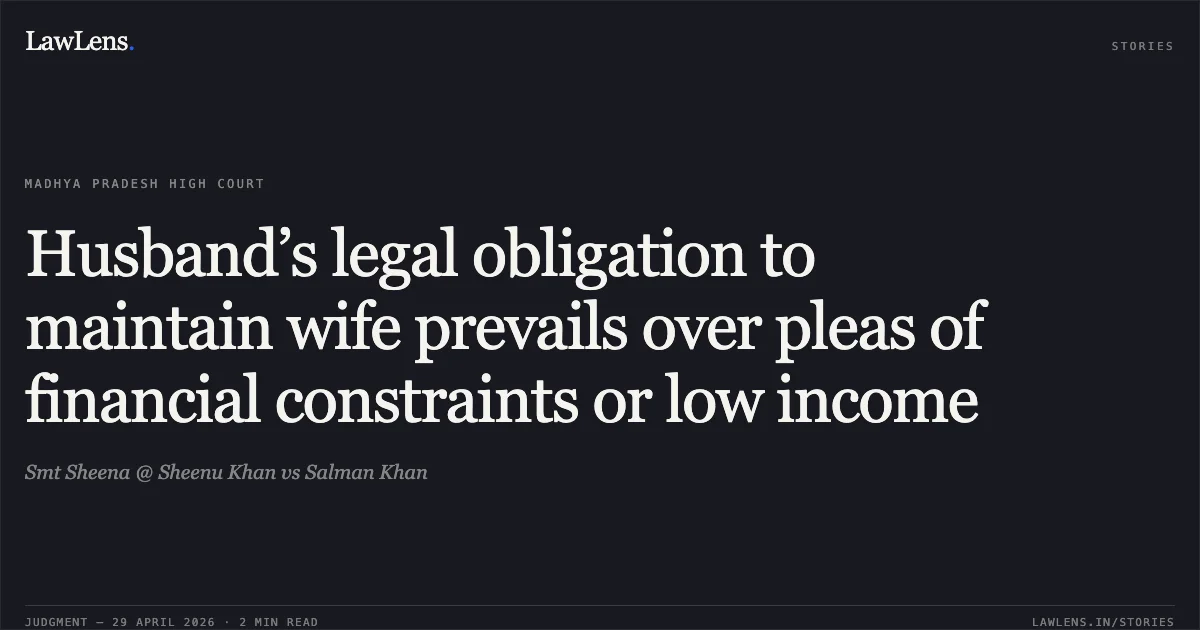
The High Court dismissed both revisions, upholding the Family Court’s order for interim maintenance of ₹4,000 per month
The Court held that the amount was neither excessive nor inadequate at the interim stage and that the lower court’s findings did not suffer from patent illegality or perversity
Source reference: para. 17-18It clarified that these observations are limited to the interim stage and shall not prejudice the final disposal of the case on its merits after a full trial
Source reference: para. 20Acts & Sections Cited
1 provisions across 1 statute referred to in this judgment. Linked provisions open on LawLens.
Code of Criminal Procedure, 19731
Original Court PDF
Smt Sheena @ Sheenu KhanvsSalman Khan
Click to open original judgment
Original judgment, available to read, download and summarize on LawLens.in


