Facts
The applicant, the husband of the deceased, sought bail in Case Crime No. 90 of 2025 under Section 103(1) of the Bharatiya Nyaya Sanhita (BNS).
Source reference: para. 2The prosecution alleged that the applicant murdered his wife on March 19, 2025, following a history of marital disputes and physical abuse.
Source reference: para. 3The post-mortem report identified strangulation as the cause of death, noting additional injuries indicating resistance, though the hyoid bone remained intact.
Source reference: paras. 4-5The applicant contended that the absence of a hyoid fracture negated strangulation and challenged the reliability of witness statements from his daughter and nephew due to delays in recording them under Section 180 of the Bharatiya Nagarik Suraksha Sanhita (BNSS).
Source reference: para. 4The State and the informant opposed bail, asserting the applicant’s presence at the scene and citing medical jurisprudence that a hyoid fracture is not a mandatory finding in all strangulation cases.
Source reference: para. 5Issues
1. Whether the hyoid bone will necessarily be fractured in the case of strangulation?
Source reference: para. 7(i)2. Whether the delay in recording the statement of a witness during investigation will always be fatal to the prosecution case?
Source reference: para. 7(ii)Law Applied
The court applied Section 103(1) of the BNS for murder and Section 109 of the Bharatiya Sakshya Adhiniyam (BSA) regarding the burden of proving facts especially within the knowledge of a person.
Source reference: para. 20Regarding medical evidence, the court relied on Ponnusamy v. State of Tamil Nadu (2008) and Ravirala Laxmaiah v. State of Andhra Pradesh (2013), which established that a hyoid bone fracture is not an essential condition to prove strangulation, particularly in younger victims.
Source reference: paras. 11-12On the issue of procedural delay, the court applied the principles from Ganesh Bhavan Patel v. State of Maharashtra (1978), Goutam Joardar v. State of West Bengal (2022), and Firoz Khan Akbarkhan v. State of Maharashtra (2025), which hold that delay in recording witness statements is not fatal if adequately explained by the circumstances, such as the witnesses being in a state of shock.
Source reference: paras. 13-18Reasoning
The Court rejected the applicant’s contention that the lack of a hyoid bone fracture ruled out strangulation. Referring to Modi's Medical Jurisprudence and Supreme Court precedents, the Court observed that hyoid fractures are more common in older victims and their absence in other cases does not exclude strangulation as the cause of death.
Source reference: paras. 10-12Regarding the delayed statements of the children, the Court found the delay (approximately one month for the daughter) was sufficiently explained by the psychological shock of their mother’s murder.
Source reference: para. 19The Court emphasized that the "factum of delay" must be weighed against surrounding circumstances and is a matter for trial rather than a ground for bail.
Source reference: para. 18-19Furthermore, since the evidence placed the applicant inside the house at the time of the incident, the Court invoked Section 109 of the BSA, noting the applicant's failure to provide a plausible explanation for the death occurring in his presence.
Source reference: para. 20Holding
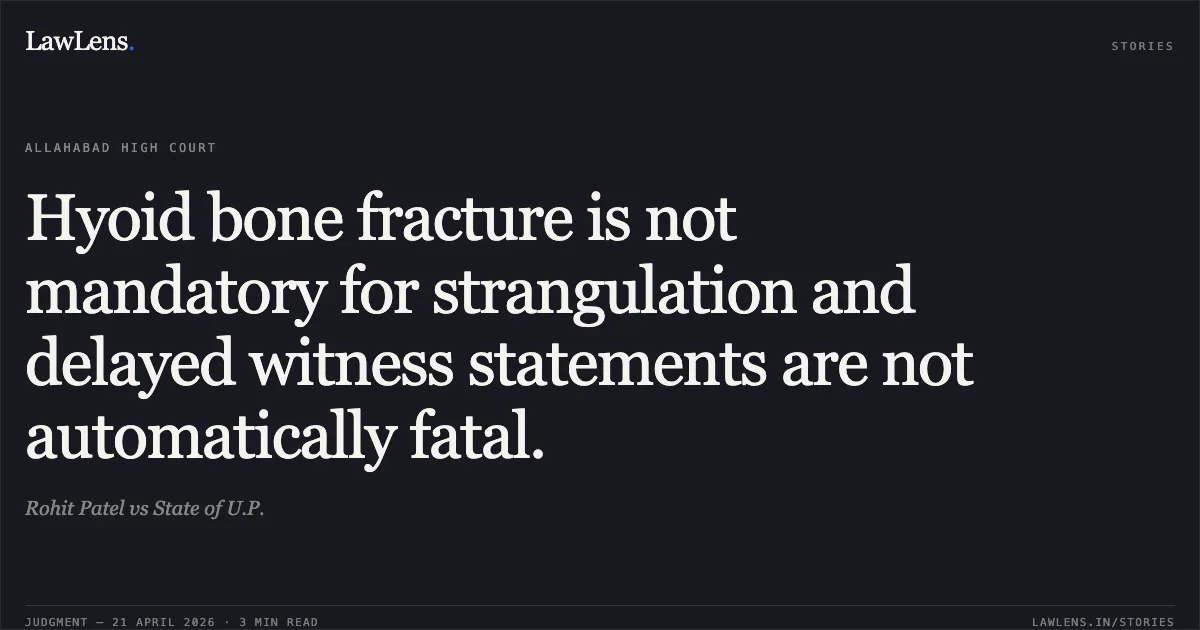
The Court answered both issues in the negative. It held that a hyoid bone fracture is not a prerequisite for a finding of strangulation and that unexplained delay in recording statements is not automatically fatal to the prosecution, especially when justified by facts like witness trauma.
Finding prima facie evidence of the applicant's presence and the homicidal nature of the death, the Court rejected the bail application.
Source reference: para. 21The Court clarified that these observations are limited to the bail proceedings and shall not bind the trial court.
Source reference: para. 22Acts & Sections Cited
3 provisions across 3 statutes referred to in this judgment. Each provision opens on LawLens.
Bharatiya Nyaya Sanhita, 20231
Bharatiya Sakshya Adhiniyam, 20231
Bharatiya Nagarik Suraksha Sanhita, 20231
Original Court PDF
Rohit PatelvsState of U.P.
Click to open original judgment
Original judgment, available to read, download and summarize on LawLens.in