Facts
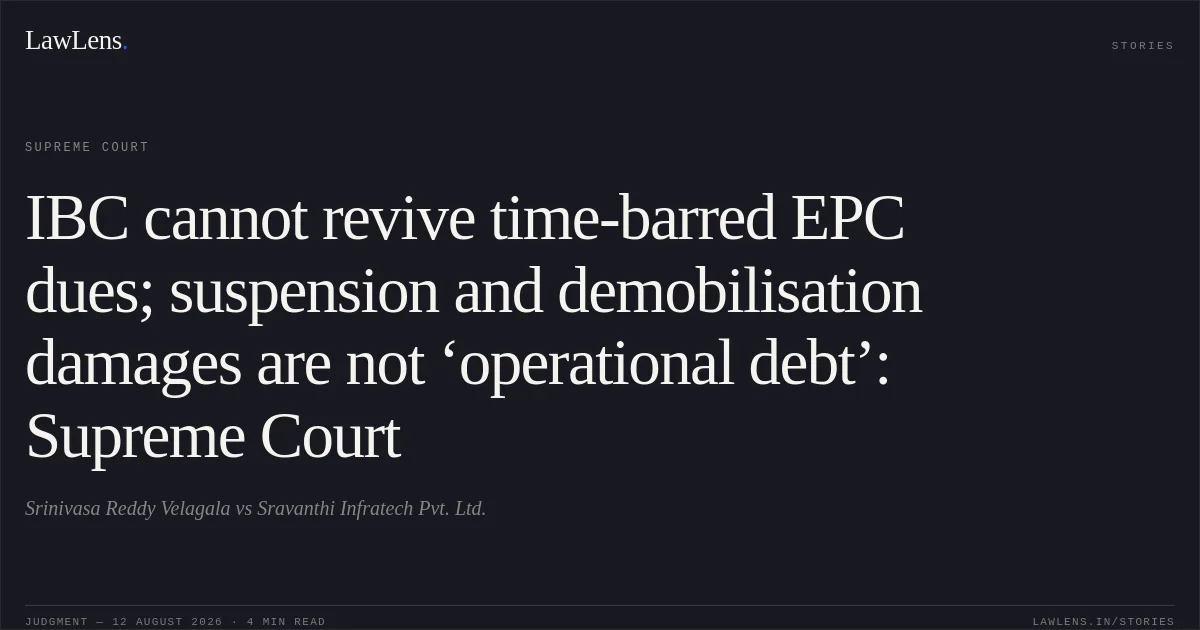
The appellant, the corporate debtor, awarded the respondent an Engineering, Procurement and Construction (“EPC”) contract worth ₹827 crore for establishing a 225 MW gas-based power station. The contract contemplated completion within 14 months and prescribed milestone-based payments.
Source reference: paras. 2–5Although the respondent claimed to have completed the initial milestones and submitted the requisite billing break-ups, the appellant paid only ₹50.15 crore against the amounts claimed to be due.
Source reference: paras. 6–9The respondent issued a suspension notice on 30 July 2011, stopped EPC activities, and subsequently sent legal notices in 2014 and 2015 demanding payment.
Source reference: paras. 10–11The EPC contract contained termination provisions, including termination by the supplier after prolonged suspension for non-payment; however, neither party formally terminated the contract.
Source reference: paras. 29, 37–40On 2 July 2018, the respondent issued a demand notice under Section 8 of the Insolvency and Bankruptcy Code, 2016 (“IBC”), claiming approximately ₹1,292 crore, and filed a Section 9 application on 12 October 2018.
Source reference: para. 13The NCLT admitted the application on 13 December 2019, holding that the EPC contract continued to subsist, the claim constituted operational debt, there was no pre-existing dispute, and the application was not barred by limitation.
Source reference: para. 13The NCLAT affirmed the admission order on 1 February 2021.
Source reference: para. 14Issues
Whether the EPC contract was frustrated or came to an end by efflux of time?
Source reference: para. 36(i)Whether the amounts claimed under the EPC contract constituted “operational debt” under Section 5(21) of the IBC?
Source reference: para. 36(ii)Whether a genuine pre-existing dispute existed between the parties in respect of the respondent’s claims, so as to bar proceedings under Section 9 of the IBC?
Source reference: para. 36(iii)Whether the respondent’s Section 9 application was barred by limitation in respect of the amounts constituting operational debt?
Source reference: para. 36(iv)Law Applied
The Court applied Section 5(21) of the IBC, holding that amounts payable as consideration for goods or services supplied under an EPC works contract constitute operational debt, whereas unadjudicated damages do not.
Source reference: paras. 49–54Sections 8 and 9 of the IBC require rejection of a Section 9 application where a genuine pre-existing dispute exists; under Mobilox Innovations (P) Ltd. v. Kirusa Software (P) Ltd., the dispute need not have progressed to a suit or arbitration, but must be genuine, plausible, and not spurious or illusory.
Source reference: paras. 55–61Section 238A of the IBC attracts the Limitation Act, 1963, and Article 137 prescribes a three-year limitation period from the date on which the right to apply accrues; under Section 3(12) of the IBC, default occurs when a debt becomes due and payable but remains unpaid.
Source reference: paras. 69–73Section 18 of the Limitation Act extends limitation only where a written acknowledgment of liability is made before expiry of the prescribed period; a creditor’s unilateral demand notice does not revive a time-barred claim.
Source reference: paras. 81–84The Court also applied Section 56 of the Contract Act, 1872, holding that frustration requires an unforeseen supervening impossibility and cannot be based on self-induced or party-created circumstances, relying on Boothalinga Agencies v. V.T.C. Poriaswami Nadar.
Source reference: paras. 41–45It further relied on Babulal Vardharji Gurjar v. Veer Gurjar Aluminium Industries (P) Ltd. for the principle that the IBC cannot provide a new lease of life to time-barred debts, and Next Education India (P) Ltd. v. K12 Techno Services for the rule that each invoice or default must be separately tested for limitation.
Source reference: paras. 74–76, 84Reasoning
The Court held that the EPC contract had not been terminated or frustrated. Suspension of performance due to the appellant’s non-payment was expressly contemplated by Clause 14.2 and was not an unforeseen supervening impossibility under Section 56 of the Contract Act; the contract therefore continued to subsist.
Source reference: paras. 37–47The milestone payments payable under the EPC contract represented consideration for goods and services and consequently constituted operational debt under Section 5(21) of the IBC.
Source reference: paras. 48–54However, suspension, idling, demobilisation charges, and interest claimed thereon were damages arising from alleged breach and had not been adjudicated or crystallised; those amounts could not be pursued as operational debt in Section 9 proceedings.
Source reference: paras. 48–54The Court rejected the plea of pre-existing dispute because, although silence alone is not conclusive, the appellant had maintained complete silence in response to multiple legal notices and the statutory demand notice, raising its defence for the first time only in the Section 9 proceedings.
Source reference: paras. 62–64This conduct indicated that the dispute was an afterthought rather than a genuine pre-existing dispute.
Source reference: paras. 62–64Nevertheless, the operational debt had become due and payable in 2011 and was acknowledged in January and February 2012. The respondent did not initiate proceedings within three years thereafter.
Source reference: paras. 65–83Its later legal notices could not restart limitation because they contained no acknowledgment by the appellant under Section 18 of the Limitation Act.
Source reference: paras. 65–83The continuing subsistence of the EPC contract did not create a continuing cause of action for an earlier default.
Source reference: paras. 65–83Holding
The Court answered the first issue in the negative: the EPC contract was neither frustrated nor terminated and continued to subsist.
The second issue was answered partly in the affirmative: milestone-based contractual payments constituted operational debt, but unadjudicated suspension, idling, and demobilisation damages did not.
Source reference: paras. 92–93The third issue was answered in the negative: no genuine pre-existing dispute was established.
Source reference: paras. 94–96The fourth issue was answered in the affirmative: the operational debt claims were time-barred because the Section 9 application was filed more than three years after the relevant defaults and no valid acknowledgment extended limitation.
Source reference: paras. 97–100The appeal was allowed; the NCLAT judgment and the NCLT admission order were set aside.
Source reference: paras. 101–102The respondent was granted liberty to pursue its claims before the appropriate dispute-resolution forum under the EPC contract.
Source reference: paras. 101–102Acts & Sections Cited
10 provisions across 3 statutes referred to in this judgment. Each provision opens on LawLens.
Limitation Act, 19634
Indian Contract Act, 18721
Original Court PDF
Srinivasa Reddy VelagalavsSravanthi Infratech Pvt. Ltd.
Click to open original judgment
Original judgment, available to read, download and summarize on LawLens.in